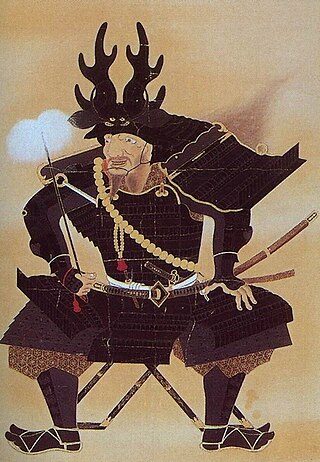
Fudai daimyō (譜代大名) was a class of daimyō (大名) in the Tokugawa Shogunate (徳川幕府) of Japan who were hereditary vassals of the Tokugawa before the Battle of Sekigahara. Fudai daimyō and their descendants filled the ranks of the Tokugawa administration in opposition to the tozama daimyō and held most of the power in Japan during the Edo period.

Hayashi Razan, also known as Hayashi Dōshun, was a Japanese historian, philosopher, political consultant, and writer, serving as a tutor and an advisor to the first four shōguns of the Tokugawa bakufu. He is also attributed with first listing the Three Views of Japan. Razan was the founder of the Hayashi clan of Confucian scholars.

Yushima Seidō, is a Confucian temple in Yushima, Bunkyō, Tokyo, Japan. It was established in end of the 17th century during the Genroku era of the Edo period. Towards the late Edo period, one of the most important educational institutions of the shogunate, the Shōhei-zaka Gakumonjo (昌平坂学問所)), or Shōheikō, was founded on its grounds.
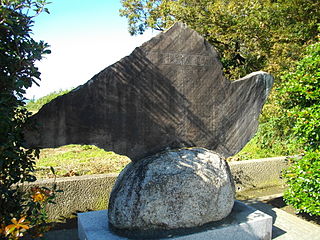
Jōzai Domain was a feudal domain under the Tokugawa shogunate of Edo period Japan, located in Kazusa Province, Japan. The domain was centered on Manube jin’ya, in what is now the city of Kisarazu, Chiba. It was ruled for the entirety of its history by a branch of the Mizuno clan. Relatively small in size, it played an important role at the end of its existence, during the Boshin War of the Meiji Restoration.
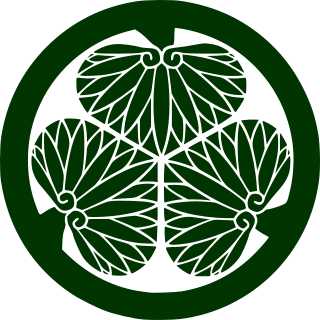
The Owari Tokugawa family is a branch of the Tokugawa clan, and it is the seniormost house of the Gosanke.
The Hayashi clan was the name of several Japanese clans, of varying origin.
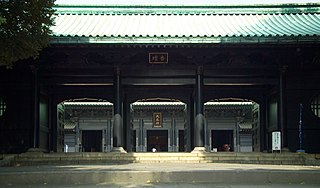
Hayashi Gahō, also known as Hayashi Shunsai|林 春斎|, was a Japanese Neo-Confucian philosopher and writer in the system of higher education maintained by the Tokugawa bakufu during the Edo period. He was a member of the Hayashi clan of Confucian scholars.

Ōmizo Domain was a tozama feudal domain under the Tokugawa shogunate of Edo period Japan. It was located in northwestern Ōmi Province, in the Kansai region of central Honshu. The domain was centered at Ōmizo jin'ya, located in what is now the city of Takashima in Shiga Prefecture.
The Hayashi clan was a Japanese samurai clan which served as important advisors to the Tokugawa shōguns. Among members of the clan in powerful positions in the shogunate was its founder Hayashi Razan, who passed on his post as hereditary rector of the neo-Confucianist Shōhei-kō school to his son, Hayashi Gahō, who also passed it on to his son, Hayashi Hōkō; this line of descent continued until the end of Hayashi Gakusai's tenure in 1867. However, elements of the school carried on until 1888, when it was folded into the newly organized Tokyo University.
The Hayashi clan was a Japanese samurai clan which served as retainers to the Oda clan based in Owari.
Hayashi Akira was an Edo period scholar-diplomat serving the Tokugawa shogunate in a variety of roles similar to those performed by serial Hayashi clan neo-Confucianists since the time of Tokugawa Ieyasu. He was the hereditary Daigaku-no-kami descendant of Hayashi Razan, the first head of the Tokugawa shogunate's neo-Confucian academy in Edo, the Shōhei-kō.
Hayashi Jussai was a Japanese neo-Confucian scholar of the Edo period. He was an hereditary rector of Edo’s Confucian Academy, the Shōhei-kō, also known at the Yushima Seidō, which was built on land provided by the shōgun. The Yushima-Seidō, which stood at the apex of the Tokugawa shogunate's educational system; and Jussai was styled with the hereditary title "Head of the State University".
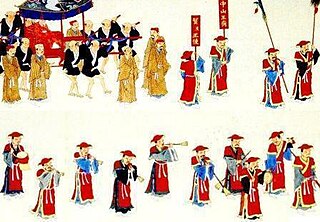
Over the course of Japan's Edo period, the Ryūkyū Kingdom sent eighteen missions to Edo, the capital of Tokugawa Japan. The unique pattern of these diplomatic exchanges evolved from models established by the Chinese, but without denoting any predetermined relationship to China or to the Chinese world order. The Kingdom became a vassal to the Japanese feudal domain (han) of Satsuma following Satsuma's 1609 invasion of Ryūkyū, and as such were expected to pay tribute to the shogunate; the missions also served as a great source of prestige for Satsuma, the only han to claim any foreign polity, let alone a kingdom, as its vassal.

Hayashi Tadataka was a Japanese daimyō of the late Edo period, who ruled the Jōzai Domain. Later in life, he was also known by his style, Ichimu (一夢). During the Boshin War of 1868, Hayashi led his domain's forces in support of the armies of the former shōgun, and then the Ōuetsu Reppan Dōmei. Unlike the Tokugawa forces that went on to Ezo, Hayashi surrendered willingly when he received word that the Tokugawa family was to be granted a fief in Shizuoka. During the Meiji period he worked in various occupations, before working for the government. In the Meiji period, his family was ennobled as part of the kazoku system. For a time he also served at Tōshō-gū in Nikkō. Hayashi lived well into the 20th century, and was famous as "the last daimyō". He died in early 1941, in an apartment run by his daughter Mitsu.
Hayashi Hōkō, also known as Hayashi Nobutatsu, was a Japanese Neo-Confucian scholar, teacher and administrator in the system of higher education maintained by the Tokugawa bakufu during the Edo period. He was a member of the Hayashi clan of Confucian scholars.
Hayashi Ryūkō was a Japanese Neo-Confucian scholar, teacher and administrator in the system of higher education maintained by the Tokugawa bakufu during the Edo period. He was a member of the Hayashi clan of Confucian scholars.

Edo Neo-Confucianism, known in Japanese as Shushi-Gaku, refers to the schools of Neo-Confucian philosophy that developed in Japan during the Edo period. Neo-Confucianism reached Japan during the Kamakura period. The philosophy can be characterized as humanistic and rationalistic, with the belief that the universe could be understood through human reason, and that it was up to man to create a harmonious relationship between the universe and the individual. The 17th-century Tokugawa shogunate adopted Neo-Confucianism as the principle of controlling people and Confucian philosophy took hold. Neo-Confucians such as Hayashi Razan and Arai Hakuseki were instrumental in the formulation of Japan's dominant early modern political philosophy.
Satō Issai was a Confucian scholar in late Edo to Bakumatsu period Japan.

Iwamura Domain was a feudal domain under the Tokugawa shogunate of Edo period Japan, located in Mino Province in what is now the town of Iwamura, Gifu. It was centered around Iwamura Castle, and controlled parts of Mino and Suruga Provinces. Iwamura Domain was controlled by a number of fudai daimyō clans in the course of its history.
