Amati is the last name of a family of Italian violin makers who lived at Cremona from about 1538 to 1740. Their importance is considered equal to those of the Bergonzi, Guarneri, and Stradivari families. Today, violins created by Nicolò Amati are valued at around $600,000. Because of their age and rarity, Amati instruments are mostly kept in museum or private collections and are seldom played in public.

The cello ( CHEL-oh; plural celli or cellos) or violoncello ( VY-ə-lən-CHEL-oh; Italian pronunciation: [vjolonˈtʃɛllo]) is a bowed (sometimes plucked and occasionally hit) string instrument of the violin family. Its four strings are usually tuned in perfect fifths: from low to high, C2, G2, D3 and A3. The viola's four strings are each an octave higher. Music for the cello is generally written in the bass clef, with tenor clef and treble clef used for higher-range passages.
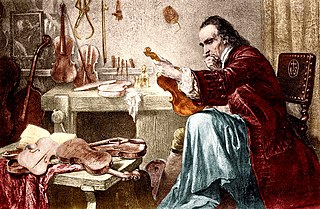
Antonio Stradivari was an Italian luthier and a craftsman of string instruments such as violins, cellos, guitars, violas and harps. The Latinized form of his surname, Stradivarius, as well as the colloquial Strad are terms often used to refer to his instruments. It is estimated that Stradivari produced 1,116 instruments, of which 960 were violins. Around 650 instruments survive, including 450 to 512 violins.

Domenico Carlo Maria Dragonetti was an Italian double bass virtuoso and composer with a 3 string double bass. He stayed for thirty years in his hometown of Venice, Italy and worked at the Opera Buffa, at the Chapel of San Marco and at the Grand Opera in Vicenza. By that time he had become notable throughout Europe and had turned down several opportunities, including offers from the Tsar of Russia. In 1794, he finally moved to London to play in the orchestra of the King's Theatre, and settled there for the remainder of his life. In fifty years, he became a prominent figure in the musical events of the English capital, performing at the concerts of the Philharmonic Society of London as well as in more private events, where he would meet the most influential persons in the country, like the Prince Consort and the Duke of Leinster. He was acquainted with composers Joseph Haydn and Ludwig van Beethoven, whom he visited on several occasions in Vienna, and to whom he showed the possibilities of the double bass as a solo instrument. His ability on the instrument also demonstrated the relevance of writing scores for the double bass in the orchestra separate from that of the cello, which was the common rule at the time. He is also remembered today for the Dragonetti bow, which he evolved throughout his life.
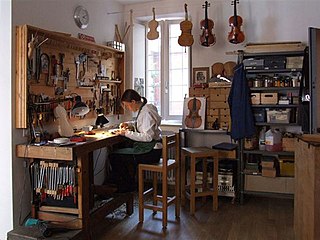
A luthier( LOO-ti-ər) is a craftsperson who builds or repairs string instruments that have a neck and a sound box. The word "luthier" is originally French and comes from the French word for lute. The term was originally used for makers of lutes, but it came to be used already in French for makers of most bowed and plucked stringed instruments such as members of the violin family and guitars. Luthiers, however, do not make harps or pianos; these require different skills and construction methods because their strings are secured to a frame.
The Guarneri, often referred to in the Latinized form Guarnerius, is the family name of a group of distinguished luthiers from Cremona in Italy in the 17th and 18th centuries, whose standing is considered comparable to those of the Amati and Stradivari families.
Jacob Stainer (1619–1683) was the earliest and best known Austrian and Germanic luthier. His violins were sought after by famous 17th- and 18th-century musicians and composers including Johann Sebastian Bach, Wolfgang Amadeus Mozart and George Simon-Lohein.

Carlo Bergonzi was an Italian luthier and is the first and most noted member of the Bergonzi family, an illustrious group of luthiers from Cremona, Italy, a city with a rich tradition of stringed instrument makers. Today his instruments are highly valued for their workmanship and tone. Although he was historically assumed to have first apprenticed with Hieronymus Amati or Antonio Stradivari, he is now known to have been the student of Vincenzo Rugeri.

Gagliano is the name of a famous family of Italian luthiers from Naples, dating back to the early 18th century. The Gagliano dynasty - particularly Alessandro, Nicolò I and Gennaro - are considered the high point of Neapolitan violin making. There are as many as eighteen Gagliano violin makers known worldwide today. Below is a family tree of a few of its most recognizable luthiers.
Francesco Rugeri, also known as Ruger, Rugier, Rugeri, Ruggeri, Ruggieri, Ruggerius, was the first of an important family of luthiers, the Casa Rugeri in Cremona, Italy. His instruments are masterfully constructed. His violins are inspired by Nicolò Amati's "Grand Amati" pattern. Francesco was the first to develop a smaller cello design, which has become the standard for modern cello dimensions. Today, Rugeri's instruments are nearly as renowned as Nicolò Amati's instruments.
Andrea Guarneri was an Italian luthier, musician and founder of the Casa Guarneri. He is the most important student of Nicola Amati and grandfather of one of the best luthiers, Bartolomeo Giuseppe Guarneri, del Gesù.
Ernst Heinrich Roth (1877–1948), also often referred to as Ernst Heinrich Roth I to distinguish him from later family members of the same name, was a German luthier and master of a large and successful violin-making workshop in the East German town of Markneukirchen, near the current border with the Czech Republic. He was the most important and distinguished figure in a whole dynasty of Roth luthiers active in Germany over many generations and to this day.
Giuseppe Giovanni Battista Guarneri, better known as Giuseppe filius Andrea Guarneri was a violin maker from the prominent Guarneri family of luthiers who lived in Cremona, Italy.
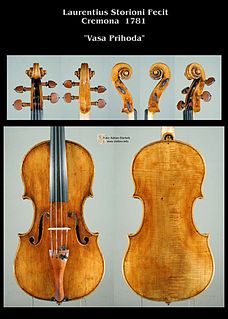
Lorenzo Storioni is considered one of the last of the classic Cremonese master violin makers/luthiers of the 18th century.

Nicola Amati, Nicolò Amati or Nicolao Amati was an Italian Master Luthier from Cremona, Italy. Amati is one of the most well known luthier from the Casa Amati. Nicola was the teacher of illustrious Cremonese School luthiers such as Andrea Guarneri and Giovanni Battista Rogeri. While no clear documentation exists for being apprentices in his shop, Amati may have also apprenticed Antonio Stradivari, Francesco Rugeri, and Jacob Stainer as their work is heavily influenced by Amati.
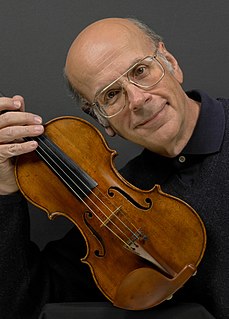
David L. Fulton is a private collector of Cremonese instruments. Born in 1944, he grew up in Eugene, Oregon, playing the violin from an early age. He studied mathematics at the University of Chicago, and was concertmaster of the University of Chicago Symphony while he was there.

Andrea Amati was a luthier, from Cremona, Italy. Amati is credited with making the first instruments of the violin family that are in the form we use today. Several of his instruments survive to the present day, and some of them can still be played. Many of the surviving instruments were among a consignment of 38 instruments delivered to Charles IX of France in 1564.
The Traditional violin craftsmanship in Cremona was declared an intangible cultural heritage by UNESCO in 2012, during the 7th session of the Intergovernmental Committee in Paris. The Cremona's traditional violin making is an ancient form of handicraft typical of Cremona (Italy) where bowed string instruments like violins, violas, cellos and double basses have been made since the 16th century.

Vincenzo Rugeri, was an Italian luthier of string instruments such as violins, cellos, and, violas in Cremona, Italy. His instruments are noted for their craftsmanship and tone quality. Vincenzo came from a distinguished family of luthiers, the first of whom was his father, Francesco Rugeri. Despite the local tradition of artisan families laboring together through generations, Vincenzo left the family shop and set up a successful shop of his own in the center of Cremona. Vincenzo was the third son of luthier Francesco Rugeri. Vincenzo's work, like Francesco's, is influenced by Nicolò Amati's Grand Pattern model, however Vincenzo's work was distinguished from his father's by utilizing a lower arch inspired by Antonio Stradivari. An analysis of the body of his work reveals that the quality of Vincenzo's instruments is remarkable, perhaps even more so than his father's. Vincenzo's instruments, though less numerous, are valued at least equal to those of his father. A violin by Vincenzo Rugeri realized $502,320 on October 3, 2011 at Brompton's Auctions in London. Carlo Bergonzi was a distinguished apprentice of Vincenzo Rugeri.

Girolamo Amati (1561–1630) was an Italian luthier, active from 1580 to 1630.