
Look up hikari in Wiktionary, the free dictionary.
Hikari (ひかり, "Sparkle or Light") may refer to:
Hikari (ひかり, "Sparkle or Light") may refer to:


Hikaru Utada, also known by the mononym Utada, is a Japanese singer, songwriter and producer. Utada is one of the most influential and best-selling musical artists in Japan.

Deep River is the fourth studio album by Japanese-American singer Hikaru Utada. It was released via Toshiba EMI on June 19, 2002. Utada wrote and co-produced the majority of the record, and unlike her previous album Distance (2001), she worked primarily with Japanese collaborator Akira Miyake and her father Teruzane Utada. Musically, Deep River is widely noted as the transition state from Utada's earlier style, R&B, to ethereal pop.

"Passion" is a song recorded by Japanese-American singer-songwriter Hikaru Utada, taken as the fourth single from her studio album Ultra Blue (2006). It premiered on December 14, 2005, in two physical formats and for digital consumption, distributed by EMI Japan and EastWorld. "Passion", alongside its English counterpart "Sanctuary", were used as the national and international theme songs to the Square Enix video game Kingdom Hearts II (2005); the tracks serve as the successors to "Hikari" and its English counterpart, "Simple and Clean", which are found on Kingdom Hearts.

"Hikari" is a song recorded by Japanese–American recording artist Hikaru Utada for her fourth studio and third Japanese language album, Deep River (2002). It premiered on March 20, 2002, as the third single from the album in Japan. It was written and composed by Utada, whilst production and arrangement was handled by Utada, her father Teruzane Utada, and long-time collaborator Miyake Akira. The single, and a remix by Russell McNamara, was used as the official Japanese theme song for the 2002 action role-playing video game Kingdom Hearts, and appeared on its original soundtrack respectively. Musically, "Hikari" is a pop folk song. Lyrically, it is about mysteries in life and human activities.
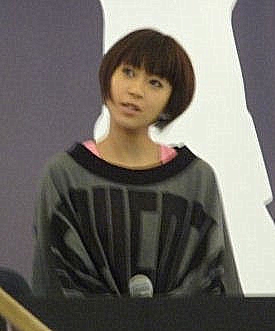
The discography of Japanese-American R&B and pop singer Hikaru Utada consists of eleven studio albums, four compilation albums, eleven video albums and numerous singles and promotional singles. Utada began as a musician in the early 1990s as a member of U3, a family unit made up of her, her mother Junko Utada, also known as 1970s enka singer Keiko Fuji, and her father, musical producer Teruzane Utada. U3 released their debut album Star in 1993, with the hope to debut in America. In 1996, the group was rebranded as Cubic U, an R&B project focusing on Hikaru Utada, resulting in the English language album Precious in 1998 with record label Toshiba EMI.

"Final Distance" is a song by Japanese recording artist Hikaru Utada for her third studio album Deep River (2002). Written by Utada herself, the song was produced and composed by long-time collaborators Akira Miyake, Utada's father Teruzane Utada and herself. "Final Distance" was originally recorded as "Distance" which was taken from the album with the same name, despite not being a single. The song was re-recorded, re-arranged, and dedicated to Rena Yamashita, a six-year-old victim of the Osaka school massacre who had written an essay about being inspired by Utada.

"Beautiful World" is a song by Japanese American musician Hikaru Utada. It served as the theme song for Evangelion: 1.0 You Are (Not) Alone, the 2007 film reboot of the anime Neon Genesis Evangelion. It was released as a double A-side single on August 29, 2007 along with her song "Kiss & Cry", which had been released digitally three months earlier. In 2009, a remix of the song, "Beautiful World " served as the theme song of the second film in the series, Evangelion: 2.0 You Can (Not) Advance.
The music of the Kingdom Hearts video game series was composed by Yoko Shimomura with orchestral music arranged by Kaoru Wada. The original soundtracks of the games have been released on three albums and a fourth compilation album. The soundtracks to the Kingdom Hearts games feature several musical pieces from both Square Enix and Disney works, including such pieces as "Mickey Mouse Club March" by Jimmie Dodd, "This Is Halloween" by Danny Elfman, and "One-Winged Angel" by Nobuo Uematsu. They also feature several vocal songs, the most notable being the four main theme songs: "Hikari", "Passion", "Chikai", and "Face My Fears." The two themes were written and performed by Japanese American pop star Hikaru Utada; in addition to Japanese, English versions of the first three songs were produced, titled "Simple and Clean", "Sanctuary", and "Don't Think Twice", respectively.

Heart Station is the seventh studio and fifth Japanese-language album by Japanese–American recording artist Hikaru Utada. It was released on March 19, 2008, by EMI Music in Japan, and globally on March 26, 2008. It is Utada's eighth consecutive studio album to be fully written and produced by her, with the help of her father Teruzane Utada and long-time collaborator Miyake Akira through the production. Recorded between 2006 and 2008, it was worked on whilst she was recording her ninth studio and second English-language studio album, This Is the One (2009). With the album artwork photographed by Japanese photographer Mitsuo, Heart Station was released in two formats: a physical CD, and as a digital download.

Shin-Yamaguchi Station is a passenger railway station located in the city of Yamaguchi, Yamaguchi Prefecture, Japan. It is operated by the West Japan Railway Company.

"Automatic" is a song recorded by Japanese–American singer Hikaru Utada, taken as the lead single from her debut album First Love (1999). It was released on December 9, 1998, through Toshiba-EMI in three physical formats: mini CD single, standard-size CD single and 12" vinyl. Additionally, the single included the A-side "Time Will Tell", which originally served as the B-side for these versions. The song was written and co-produced by Utada, while Akira Miyake and the singer's father Teruzane Utada served as producers. Despite recording in English under the name Cubic U, "Automatic" is Utada's first Japanese recording, and was released after she enrolled into high school in Japan.

"Goodbye Happiness" is a song by Japanese American singer-songwriter Hikaru Utada. It was released as the lead track from Utada's second Japanese compilation album, Utada Hikaru Single Collection Vol. 2, in November 2010. The song was commercially successful, topping Billboard's Japan Hot 100 chart in December 2010, and in January 2011 was certified gold by the RIAJ for more than 100,000 full-length downloads to cellphones.
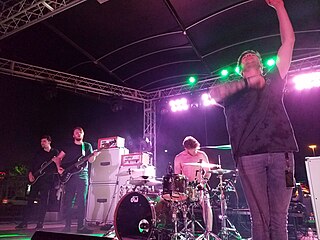
Oceans Ate Alaska are a British metalcore band hailing from Birmingham formed in 2010. The band was signed to Fearless Records and are known for "uniting boundaries between multiple genres in modern metal" and for "fusing unpredictable polyrhythms and sporadic partnering of melodic and dissonant passages". Original vocalist, James Harrison came up with the band name; naming it after the 1958 Lituya Bay earthquake and megatsunami that swallowed one of Alaska’s gulfs.

"Letters" is a song by Japanese American musician Hikaru Utada. It was released as a double A-side single with the song "Sakura Drops" on May 9, 2002.
"Sakura Drops" is a song by Japanese-American musician Hikaru Utada. It was released as a double A-side single with the song "Letters" on May 9, 2002.

"Manatsu no Tōriame" is a song by Japanese singer-songwriter Hikaru Utada. It was released digitally on April 15 2016, alongside "Hanataba o Kimi ni" as joint singles for her album Fantôme. The song is the theme to NTV's news show News Zero. The single is Utada's first release since 2012's Evangelion: 3.0 theme song "Sakura Nagashi", and marks her official comeback to the Japanese music scene.

Fantôme is the sixth Japanese studio album by Japanese-American singer-songwriter Hikaru Utada. Although Utada announced an indefinite hiatus from the public eye in August 2010, she continued writing and composing material with her father, Utada Teruzane, and long-term collaborator, Miyake Akira. Musically, Fantôme contains a collection of tracks that utilizes acoustic and stripped-down instrumentations, alongside influences of pop, electronic, and R&B music. The lyrical content delves into themes of grief, sadness, love, and death—mostly influenced by the death of her mother, her second marriage, and the birth of her son in 2015.
"Nijikan Dake no Bakansu" is a song by Japanese singer-songwriter Hikaru Utada, featuring guest vocals by Sheena Ringo. A corresponding music video was released on September 16, 2016, and the song was sent to radio stations as well, to promote the release of the album Fantôme.

Hatsukoi is the seventh Japanese-language studio album by Japanese–American recording artist Hikaru Utada. It was released on June 27, 2018, as her first album under Sony Music Japan sublabel Epic Records Japan. The release coincided with the commemoration of her 20th Anniversary as an artist in Japan. A national tour was announced to support the album in November 2018. The five previously released songs were confirmed in the album track list, for a total of twelve songs, including the title track "Hatsukoi" and the Kingdom Hearts III theme song "Chikai".

Hikaru Utada Laughter in the Dark Tour 2018 was Japanese-American singer-songwriter Hikaru Utada's fourth Japanese tour. The 13-date sold-out tour began in Yokohama and ended in Chiba. It was Utada's first concert in Japan in 8 years since Wild Life, and first concert tour in the country in 12 years since Utada United 2006. Initially, the concert tour was scheduled with 12 regular dates in arenas, but one extra concert, sponsored by Suntory, was later scheduled for November 17.