Year 473 BC was a year of the pre-Julian Roman calendar. At the time, it was known as the Year of the Consulship of Mamercus and Iullus. The denomination 473 BC for this year has been used since the early medieval period, when the Anno Domini calendar era became the prevalent method in Europe for naming years.
Susanoo is a kami in Japanese mythology. The younger brother of Amaterasu, goddess of the sun and mythical ancestress of the Japanese imperial line, he is a multifaceted deity with contradictory characteristics, being portrayed in various stories either as a wild, impetuous god associated with the sea and storms, as a heroic figure who killed a monstrous serpent, or as a local deity linked with the harvest and agriculture. Syncretic beliefs that arose after the introduction of Buddhism to Japan also saw Susanoo becoming conflated with deities of pestilence and disease.

Musashi Province was a province of Japan, which today comprises Tokyo Metropolis, most of Saitama Prefecture and part of Kanagawa Prefecture. It was sometimes called Bushū (武州). The province encompassed Kawasaki and Yokohama. Musashi bordered on Kai, Kōzuke, Sagami, Shimōsa, and Shimotsuke Provinces.

Ōmiya is one of ten wards of the city of Saitama, in Saitama Prefecture, Japan, and is located in the northeastern part of the city. As of 1 March 2021, the ward had an estimated population of 119,298 and a population density of 9,300 persons per km². Its total area was 12.80 square kilometres (4.94 sq mi). Although Urawa-ku is the governmental center of Saitama City, Ōmiya-ku is the most active commercial and business centre in both Saitama City and Saitama Prefecture thanks to its transport infrastructure, especially railways connected at Ōmiya Station.

Akasaka (赤坂) is a residential and commercial district of Minato, Tokyo, Japan, located west of the government center in Nagatachō and north of the Roppongi district.

Hikawa Shrine is a Shinto shrine located in Ōmiya-ku, Saitama, Saitama Prefecture, Japan. It is one of the two shrines claiming the title of ichinomiya of former Musashi Province. The main festival of the shrine is held annually on August 1. The district of Omiya, literally "Great Shrine", derives from the special favor shown by Emperor Meiji, who raised Hikawa above all other shrines in the Kantō region. It is the head of a network of approximately 280 Hikawa shrines mostly around the Kantō region.

Saitama is the capital and the most populous city of Saitama Prefecture, Japan. Its area incorporates the former cities of Urawa, Ōmiya, Yono and Iwatsuki. It is a city designated by government ordinance. Being in the Greater Tokyo Area and lying 15 to 30 kilometres north of central Tokyo, many of its residents commute into Tokyo. As of 1 February 2021, the city had an estimated population of 1,324,854, and a population density of 6,093 people per km². Its total area is 217.43 square kilometres (83.95 sq mi).

Kita-Ōmiya Station is a passenger railway station on the Tōbu Urban Park Line in Ōmiya-ku, Saitama, Saitama Prefecture, Japan, operated by the private railway operator Tōbu Railway.

Ōmiya-kōen Station is a passenger railway station on the Tōbu Urban Park Line located in Ōmiya-ku, Saitama, Saitama Prefecture, Japan, operated by the private railway operator Tōbu Railway.
Ōmiya was a city located in Saitama Prefecture, Japan.

Hikawa Maru (氷川丸) is a Japanese ocean liner that Yokohama Dock Company built for Nippon Yūsen Kabushiki Kaisha. She was launched on 30 September 1929 and made her maiden voyage from Kobe to Seattle on 13 May 1930. She is permanently berthed as a museum ship at Yamashita Park, Naka-ku, Yokohama.
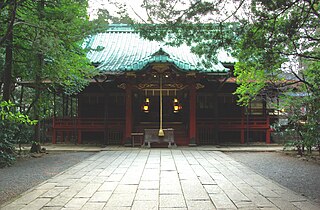
Hikawa Shrine is a Shinto shrine in Akasaka, Tokyo, Japan. In Tokyo, it is the best known of the 59 branch shrines of the Hikawa jinja, which was designated as the chief Shinto shrine (ichinomiya) for the former Musashi province.

Higashi-Urawa Station is a passenger railway station on the Musashino Line located in Midori-ku, Saitama, Saitama Prefecture, Japan, operated by East Japan Railway Company.
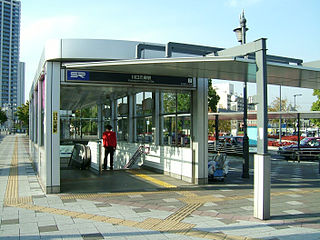
Kawaguchi-motogō Station is a passenger railway station on the Saitama Rapid Railway Line in Kawaguchi, Saitama, Japan, operated by the third-sector railway operator Saitama Railway Corporation.
Sagara Sōzō, real name Kojima Shirō, was the leader of the 1st Unit of the Sekihōtai, a group of Japanese political extremists formed in 1868 during the Boshin War.

Nogi Shrine was established on November 1, 1923 and dedicated to General Nogi Maresuke (63) and his wife Nogi Shizuko (53) after their death on September 13, 1912. The Tokyo Mayor, Baron Yoshio Sakatani, took the initiative to organise the Chūō Nogi Kai to build a shrine to the couple within their residence. It is located in Tokyo, Japan.
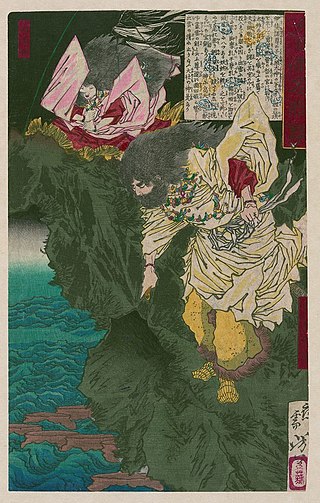
Kushinadahime (クシナダヒメ), also known as Kushiinadahime (クシイナダヒメ) or Inadahime among other names, is a goddess (kami) in Japanese mythology. She is one of the wives of the god Susanoo, who rescued her from the monster Yamata no Orochi.

Omiya Ardija is a professional association football club based in Ōmiya in Saitama, Japan. Its "hometown" as designated by the league is the whole of Saitama city, which is shared with neighbours Urawa Red Diamonds. The team currently competes in the J2 League, the Japanese second tier of professional football.
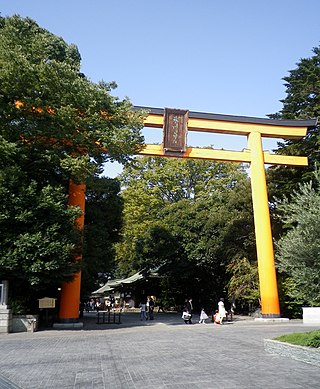
Hikawa Shrine (氷川神社) is a Shinto shrine in Kawagoe, Saitama Prefecture, Japan. In order to separate it from Hikawa Shrine in Omiya Ward, Saitama City, it is often called Kawagoe Hikawa Shrine. Hikawa Shrine is known for its Reitaisai, or a festival considered the origin of Kawagoe festival, which was registered as a National Important Intangible Folk Cultural Property and listed as a UNESCO Intangible Cultural Heritage. It's also well known for its "corridor of windchiimes".
