
Anointing of the sick, known also by other names such as unction, is a form of religious anointing or "unction" for the benefit of a sick person. It is practiced by many Christian churches and denominations.

The last rites, also known as the Commendation of the Dying, are the last prayers and ministrations given to an individual of Christian faith, when possible, shortly before death. They may be administered to those awaiting execution, mortally injured, or terminally ill. Last rites cannot be performed on someone who has already died. Last rites, in sacramental Christianity, can refer to multiple sacraments administered concurrently in anticipation of an individual's passing.

Anointing is the ritual act of pouring aromatic oil over a person's head or entire body.
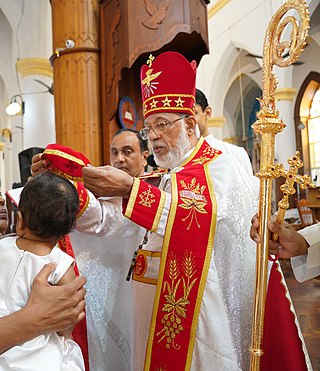
Chrismation consists of the sacrament or mystery in the Eastern Orthodox, Oriental Orthodox and Eastern Catholic churches, as well as in the Assyrian Church of the East initiation rites. The sacrament is more commonly known in the West as confirmation, although Italian normally uses the term cresima ("chrismation") rather than confermazione ("confirmation").

The laying on of hands is a religious practice. In Judaism semikhah accompanies the conferring of a blessing or authority.

In the Latter Day Saint movement, the term ordinance is used to refer to sacred rites and ceremonies that have spiritual and symbolic meanings and act as a means of conveying divine grace. Ordinances are physical acts which signify or symbolize an underlying spiritual act; for some ordinances, the spiritual act is the finalization of a covenant between the ordinance recipient and God.

Chrism, also called myrrh, myron, holy anointing oil, and consecrated oil, is a consecrated oil used in the Anglican, Assyrian, Catholic, Nordic Lutheran, Old Catholic, Eastern Orthodox, Oriental Orthodox, and Latter Day Saint churches in the administration of certain sacraments and ecclesiastical functions.
In Christian theology, the Gifts of healing are among the spiritual gifts listed in 1 Corinthians 12. As an extraordinary charism, gifts of healing are supernatural enablements given to a believer to minister various kinds of healing and restoration to individuals through the power of the Holy Spirit. In the Greek of the New Testament, both the words gift and healing are plural.
The holy anointing oil formed an integral part of the ordination of the priesthood and the High Priest as well as in the consecration of the articles of the Tabernacle and subsequent temples in Jerusalem. The primary purpose of anointing with the holy anointing oil was to sanctify, to set the anointed person or object apart as qodesh, or "holy".
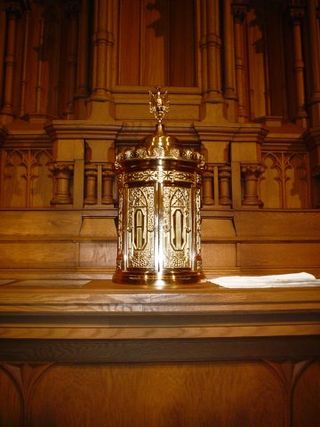
A tabernacle or sacrament house is a fixed, locked box in which the Eucharist is stored as part of the "reserved sacrament" rite. A container for the same purpose, which is set directly into a wall, is called an aumbry.
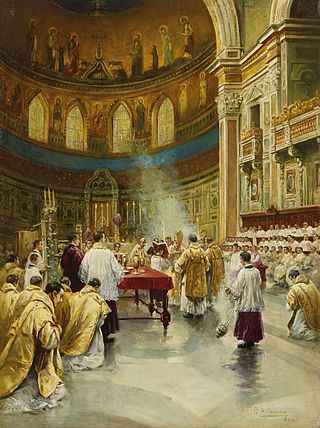
The Chrism Mass is a religious service held in Roman Catholicism, Lutheranism, and Anglicanism.
Abramelin oil, also called Oil of Abramelin, is a ceremonial magic oil blended from aromatic plant materials. Its name came about due to its having been described in a medieval grimoire called The Book of Abramelin written by Abraham the Jew. The recipe is adapted from the Jewish Holy anointing oil of the Tanakh, which is described in the Book of Exodus (30:22-25) attributed to Moses.

An ambry is a recessed cabinet in the wall of a Christian church for storing sacred vessels and vestments. They are sometimes near the piscina, but more often on the opposite side. The word also seems in medieval times to have been commonly used for any closed cupboard or even a bookcase.

The Oil of Catechumens, also known as the Oil of Exorcism, is the oil used in some traditional Christian churches during baptism; it is believed to strengthen the one being baptized to turn away from evil, temptation and sin.
In the Catholic Church, the anointing of the sick, also known as Extreme Unction, is a Catholic sacrament that is administered to a Catholic "who, having reached the age of reason, begins to be in danger due to sickness or old age", except in the case of those who "persevere obstinately in manifest grave sin". Proximate danger of death, the occasion for the administration of Viaticum, is not required, but only the onset of a medical condition of serious illness or injury or simply old age: "It is not a sacrament for those only who are at the point of death. Hence, as soon as anyone of the faithful begins to be in danger of death from sickness or old age, the fitting time for him to receive this sacrament has certainly already arrived."

There are seven sacraments of the Catholic Church, which according to Catholic theology were instituted by Jesus and entrusted to the Church. Sacraments are visible rites seen as signs and efficacious channels of the grace of God to all those who receive them with the proper disposition.
This article is about Coptic Orthodox healing among Egyptians.
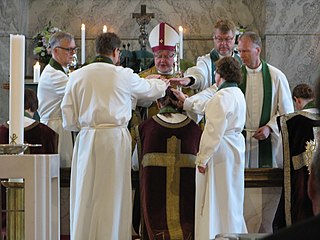
In Christianity, the laying on of hands is both a symbolic and formal method of invoking the Holy Spirit primarily during baptisms and confirmations, healing services, blessings, and ordination of priests, ministers, elders, deacons, and other church officers, along with a variety of other church sacraments and holy ceremonies.
In Mandaeism, misha is anointing sesame oil used during rituals such as the masbuta (baptism) and masiqta, both of which are performed by Mandaean priests.

In Christianity, a rite can refer to a sacred ceremony, which may or may not carry the status of a sacrament depending on the Christian denomination. This use of rite is distinct from reference to liturgical ritual families such as the Byzantine and Latin liturgical rites.
