
The History of Madagascar started from the ancient supercontinent of Pangaea, containing amongst others the African continent and the Indian subcontinent, and by the island's late colonization by human settlers from the Sunda Islands and from East Africa. These two factors facilitated the evolution and survival of thousands of endemic plant and animal species, some of which have gone extinct or are currently threatened with extinction. Trade in the Indian Ocean at the time of first colonization of Madagascar was dominated by Indonesian ships, probably of Borobudur ship and K'un-lun po types.
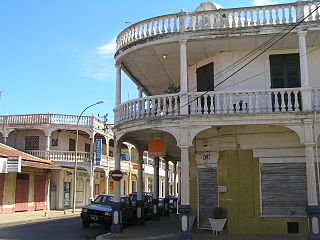
Antsiranana, named Diego-Suarez prior to 1975, is a city in the far north of Madagascar. Antsiranana is the capital of Diana Region. It had an estimated population of 115,015 in 2013.

The Merina people formerly called Amboalambo are the largest ethnic group in Madagascar. They are the "highlander" Malagasy ethnic group of the African island and one of the country's eighteen official ethnic groups. Their origins are mixed, predominantly with Austronesians arriving before the 6th century AD with Untrek Africans resulting in a core population known as Vazimba, later by large number of Javanese and a minority of Arabs, Indians and Europeans. They speak the Merina dialect of the official Malagasy language of Madagascar.

General Jacques Charles René Achille Duchesne was a 19th-century French military officer. He was born at Sens and entered Saint-Cyr in 1855, aged 18, and became a lieutenant in 1861.

Joseph-François Lambert, the "Duke of Imerina" (1824–1873) was a French adventurer, businessman, and diplomat who fathered the Lambert Charter.
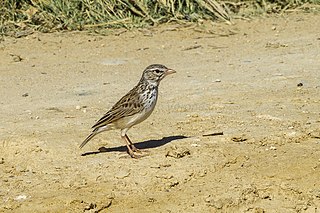
The Madagascar lark is a species of lark in the family Alaudidae endemic to Madagascar.

The mole-like rice tenrec, also known as the fossorial tenrec or hova rice tenrec, is a species of mammal in the tenrec family. Like all other tenrecs, it is endemic to Madagascar. Its natural habitats are subtropical or tropical moist forests, swamps, freshwater lakes, and irrigated or seasonally flooded agricultural land.

The Franco-Hova Wars, also known as the Franco-Malagasy Wars, were two French military interventions in Madagascar between 1883 and 1896 that overthrew the ruling monarchy of the Merina Kingdom, and resulted in Madagascar becoming a French colony. The term "Hova" referred to a social class within the Merina class structure.

Andriana was both the noble class and a title of nobility in Madagascar. Historically, many Malagasy ethnic groups lived in highly stratified caste-based social orders in which the Andriana were the highest strata. They were above the Hova and Andevo (slaves). The Andriana and the Hova were a part of Fotsy, while the Andevo were Mainty in local terminology.

The KingdomofMerina, also known as the Kingdom of Madagascar and officially the Kingdom of Imerina, was a pre-colonial state off the coast of Southeast Africa that, by the 18th century, dominated most of what is now Madagascar. It spread outward from Imerina, the Central Highlands region primarily inhabited by the Merina ethnic group with a spiritual capital at Ambohimanga and a political capital 24 km (15 mi) west at Antananarivo, currently the seat of government for the modern state of Madagascar. The Merina kings and queens who ruled over greater Madagascar in the 19th century were the descendants of a long line of hereditary Merina royalty originating with Andriamanelo, who is traditionally credited with founding Imerina in 1540.
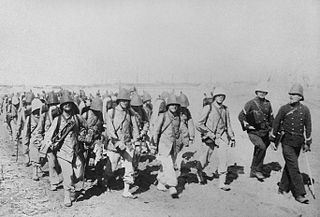
The Second Madagascar expedition was a French military intervention which took place in 1894–1895, sealing the conquest of the Merina Kingdom on the island of Madagascar by France. It was the last phase of the Franco-Hova War and followed the First Madagascar expedition of 1883–1885.
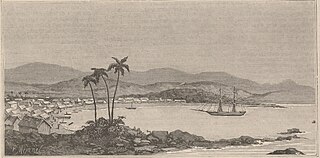
The First Madagascar expedition was the beginning of the Franco-Hova War and consisted of a French military expedition against the Merina Kingdom on the island of Madagascar in 1883. It was followed by the Second Madagascar expedition in 1895.
Andriamanelo was king of Alasora in the central highlands region of Madagascar. He is generally considered by historians to be the founder of the Kingdom of Imerina and originator of the Merina royal line that, by the 19th century, had extended its rule over virtually all of Madagascar. The son of a Vazimba mother and a man of the newly arrived Hova people originating in southeast Madagascar, Andriamanelo ultimately led a series of military campaigns against the Vazimba, beginning a several-decade process to drive them from the Highlands. The conflict that defined his reign also produced many lasting innovations, including the development of fortified villages in the highlands and the use of iron weapons. Oral tradition furthermore credits Andriamanelo with establishing a ruling class of nobles (andriana) and defining the rules of succession. Numerous cultural traditions, including the ritual of circumcision, the wedding custom of vodiondry and the art of Malagasy astrology (sikidy) are likewise associated with this king.
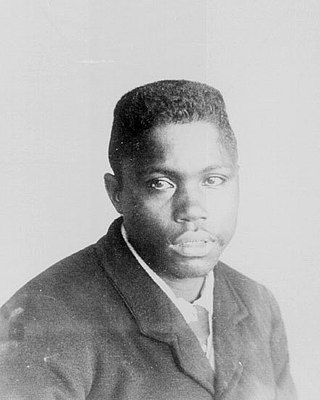
The Hova, or free commoners, were one of the three principal historical castes in the Merina Kingdom of Madagascar, alongside the Andriana (nobles) and Andevo (slaves). The term hova originally applied to all members of a Malagasy clan that migrated into the central highlands from the southeast coast of the island around the 15th century and absorbed the existing population of Vazimba. Andriamanelo (1540–1575) consolidated the power of the Hova when he united many of the Hova chiefdoms around Antananarivo under his rule. The term Hova remained in use through the 20th century, though some foreigners transliterated that word to be Ankova, and increasingly used since the 19th century.
The Democratic Movement for Malagasy Rejuvenation was the first Malagasy political party to be represented in the French National Assembly, taking advantage of the reforms announced by Charles de Gaulle at the Brazzaville Conference of 1944.
Vy Vato Sakelika was a nationalist secret society formed in Madagascar in 1913 by HovaMerina elites to inspire rebellion against French colonial rule on the island.

Hova was an Escorteur in the Free French Naval Forces during World War II and the French Navy post-war. The ship was originally built as USS Hova (DE-110), an American Cannon-class destroyer escort, and then designated in France as the F704 Escorteur.

France–Madagascar relations are the diplomatic relations between the French Republic and the Republic of Madagascar. France controlled Madagascar beginning in 1895 until the islands nation's independence in 1960. Both nations are today members of the Francophonie and the United Nations.

Madagascar, then officially known as French Madagascar, was a French colony at the outbreak of the Second World War, having been under French administration since 1885. It played an important role in the war due to the presence of critically important harbors, the contribution of Malagasy troops, and was also the scene of fighting between Allied and Vichy French forces in 1942. After the fall of France in 1940, Madagascar became a crucial flashpoint in contention between the Free French movement and Vichy France. The island was also consequential in the Pacific theater of the war as Imperial Japanese naval forces operated unopposed off the island for some time.
