
Synchronized swimming or artistic swimming is a sport where swimmers perform a synchronized choreographed routine, accompanied by music. The sport is governed internationally by World Aquatics. It has traditionally been a women's sport, although FINA introduced a new mixed gender duet competition that included one male swimmer in each duet at the 2015 World Aquatics Championships and LEN introduced men's individual events at the 2022 European Aquatics Championships. From 2024, men will be able to compete in the team event at the Olympics.
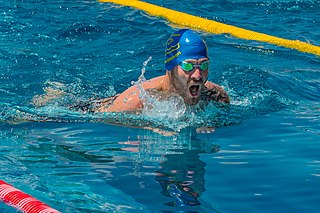
Swimming is the self-propulsion of a person through water, or other liquid, usually for recreation, sport, exercise, or survival. Locomotion is achieved through coordinated movement of the limbs and the body to achieve hydrodynamic thrust that results in directional motion. Humans can hold their breath underwater and undertake rudimentary locomotive swimming within weeks of birth, as a survival response. Swimming requires stamina, skills, and proper technique.
Swimmer most commonly refers to a participant in:
Swimming is the self-propulsion of a human through water or another liquid, usually for recreation, sport, exercise, or survival.

Freediving, free-diving, free diving, breath-hold diving, or skin diving, is a mode of underwater diving that relies on breath-holding until resurfacing rather than the use of breathing apparatus such as scuba gear.

Competitive swimwear refers to the swimsuit, clothing, equipment, and accessories used in the aquatic sports of swimming, diving, synchronized swimming, triathlon, and water polo.

Aquatics GB is the national governing body of swimming, water polo, artistic swimming, diving and open water in Great Britain. Aquatics GB is a federation of the national governing bodies of England, Scotland, and Wales. These three are collectively known as the Home Country National Governing Bodies.
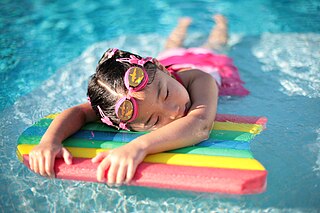
A swimming float, commonly known as pool float or floaty, is a device used for toddlers or other very young children who are beginning to learn how to swim, or during exercise for therapeutic or training purposes. These devices, which come in many shapes and types, are used to aid them with buoyancy, or for floating on for fun.
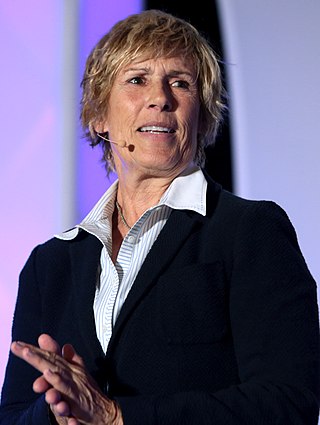
Diana Nyad is an American author, journalist, motivational speaker, and long-distance swimmer. Nyad gained national attention in 1975 when she swam around Manhattan in record time, and in 1979 when she swam from Bimini, The Bahamas to Juno Beach, Florida.

Open water swimming is a swimming discipline which takes place in outdoor bodies of water such as open oceans, lakes, and rivers. Competitive open water swimming is governed by the International Swimming Federation, World Aquatics, except when it is part of multi-sport events, which are governed by the World Triathlon.

Swimming lessons are the process of learning to swim. In most countries there is a definition of a number of swimming levels that are reached in the process of the curriculum. The respective certificates of swimming tests are required for further training in aquatic abilities. Many countries have defined a minimum swimming level that children should reach by the end of primary education, in most cases with the help of school swimming classes being part of the normal curriculum.
Swim England is the national governing body for swimming, diving, water polo, open water swimming, and synchronised swimming in England. It forms part of British Swimming, a federation of the national governing bodies of England, Scotland, and Wales. These three are collectively known as the Home Country National Governing Bodies.
Swim or SWIM may refer to:
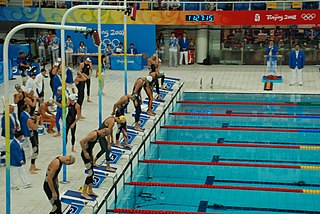
Swimming is an individual or team racing sport that requires the use of one's entire body to move through water. The sport takes place in pools or open water. Competitive swimming is one of the most popular Olympic sports, with varied distance events in butterfly, backstroke, breaststroke, freestyle, and individual medley. In addition to these individual events, four swimmers can take part in either a freestyle or medley relay. A medley relay consists of four swimmers who will each swim a different stroke, ordered as backstroke, breaststroke, butterfly and freestyle.

Free Colchian is the name of a swimming style from Georgia.
S10, SB9, SM10 are disability swimming classifications used for categorizing swimmers based on their level of disability. Swimmers in this class tend to have minimal weakness affecting their legs, missing feet, a missing leg below the knee or problems with their hips. This class includes a number of different disabilities including people with amputations and cerebral palsy. The classification is governed by the International Paralympic Committee, and competes at the Paralympic Games.
S6, SB5, SM6 are disability swimming classifications used for categorising swimmers based on their level of disability. This class includes people with a number of different types of disability including short stature, major limb impairment or loss in two limbs. This includes people with cerebral palsy, people with dwarfism and amputees. The class competes at the Paralympic Games.
S5, SB4, SM5 are disability swimming classifications used for categorizing swimmers based on their level of disability. The class includes people with a moderate level of disability, and includes people with full use of their arms and hands, but limited to no use of their trunk and legs. It also includes people with coordination problems. A variety of disabilities are represented by this class including people with cerebral palsy. The class competes at the Paralympic Games.
Para-swimming classification is a function-based classification system designed to allow for fair competition in disability swimming. The classes are prefixed with "S" for freestyle, butterfly and backstroke events, "SB" for breaststroke and "SM" for individual medley events. Swimmers with physical disabilities are divided into ten classes based on their degree of functional disability: S1, S2, S3, S4, S5, S6, S7, S8, S9 and S10. The lower number indicates a greater degree of impairment. Those with visual impairments are placed in three additional classes: S11, S12 and S13. One more class, S14, is reserved for swimmers with intellectual impairment. A final class, S15, is for athletes with hearing loss.
CP7 is a disability sport classification specific to cerebral palsy. In many sports, it is grouped inside other classifications to allow people with cerebral palsy to compete against people with other different disabilities but with the same level of functionality. Sportspeople in this class can walk but may appear to have a limp as half their body is affected by cerebral palsy.
