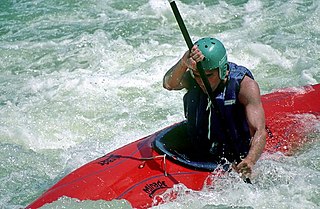
A kayak is a small, narrow watercraft which is typically propelled by means of a double-bladed paddle. The word kayak originates from the Greenlandic word qajaq.

A paddle is a tool used for pushing against liquids, either as a form of propulsion of a boat (paddling) or as an implement for mixing.
A dragon boat is a human-powered watercraft originating from the Pearl River Delta region of China's southern Guangdong Province. These were made of teak, but in other parts of China, different kinds of wood are used. It is one of a family of traditional paddled long boats found throughout Asia, Africa, the Pacific islands, and Puerto Rico. The sport of dragon boat racing has its roots in an ancient folk ritual of contending villagers, which dates back 2000 years throughout southern China, and even further to the original games of Olympia in ancient Greece. Both dragon boat racing and the ancient Olympiad included aspects of religious observances and community celebrations, along with competition.
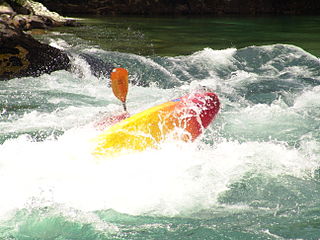
Whitewater kayaking is a recreational outdoor activity which uses a kayak to navigate a river or other body of whitewater or rough water.

Wildwater canoeing is a competitive discipline of canoeing in which kayaks or canoes are used to negotiate a stretch of river speedily. It is also called "Whitewater racing" or "Downriver racing" to distinguish it from whitewater slalom racing and whitewater rodeo or Freestyle competition.
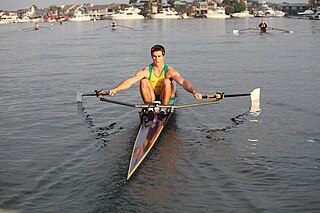
Sculling is the use of oars to propel a boat by moving the oars through the water on both sides of the craft, or moving a single oar over the stern. A long, narrow boat with a sliding seat and rigged with two oars per rower may be referred to as a scull, its oars may be referred to as sculls, and a person rowing it referred to as sculler.
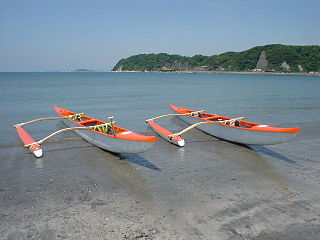
Outrigger boats are various watercraft featuring one or more lateral support floats known as outriggers, which are fastened to one or both sides of the main hull. They can range from small dugout canoes to large plank-built vessels. Outrigger boats can also vary in their configuration, from the ancestral double-hull configuration (catamarans), to single-outrigger vessels prevalent in the Pacific Islands and Madagascar, to the double-outrigger vessels (trimarans) prevalent in Island Southeast Asia. They are traditionally fitted with Austronesian sails, like the crab claw sails and tanja sails, but in modern times are often fitted with petrol engines.

Canoe freestyle is a discipline of whitewater kayaking or canoeing where people perform various technical moves in one place, as opposed to downriver whitewater canoeing or kayaking where the objective is to travel the length of a section of river. Specialised canoes or kayaks (boats) known as playboats are often used, but any boat can be used for playing. The moves and tricks are often similar to those performed by snowboarders, surfers or skaters, where the athlete completes spins, flips, turns, etc. With modern playboats it is possible to get the kayak and the paddler completely airborne while performing tricks. The competitive side of playboating is known as freestyle kayaking.

Rowing is the act of propelling a boat using the motion of oars in the water by displacing water to propel the boat forward. Rowing and paddling are similar. However, rowing requires oars to have a mechanical connection with the boat, while paddles are hand-held and have no mechanical connection.
In competitive rowing, the following specialized terms are important in the corresponding aspects of the sport:

Canoe sprint is a sport in which athletes race canoes or kayaks on calm water.

Squirt boating is a form of whitewater kayaking or canoeing where the boat is designed to be as low in volume as possible while still allowing the paddler to float. Squirt boats are designed to use both surface and underwater currents to manoeuvre within the water. These manoeuvres can be used to effect navigational control or to perform tricks.

A punt is a flat-bottomed boat with a square-cut bow, designed for use in small rivers or other shallow water. Punting is boating in a punt. The punter generally propels the punt by pushing against the river bed with a pole. A punt should not be confused with a gondola, a shallow draft vessel that is structurally different, and which is propelled by an oar rather than a pole.

A war canoe is a watercraft of the canoe type designed and outfitted for warfare, and which is found in various forms in many world cultures. In modern times, such designs have become adapted as a sport, and "war canoe" can mean a type of flatwater racing canoe.
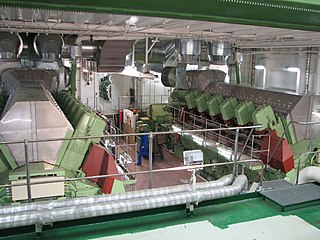
Marine propulsion is the mechanism or system used to generate thrust to move a ship or boat across water. While paddles and sails are still used on some smaller boats, most modern ships are propelled by mechanical systems consisting of an electric motor or engine turning a propeller, or less frequently, in pump-jets, an impeller. Marine engineering is the discipline concerned with the engineering design process of marine propulsion systems.

Creeking is a branch of canoeing and kayaking that involves descending very steep low-volume whitewater. It is usually performed in specialized canoes and kayaks specifically designed to withstand the extreme whitewater environment in which the activity occurs. In addition, the canoes and kayaks give the paddler improved performance and maneuverability needed to avoid river obstacles.

A kayak roll is the act of righting a capsized kayak by use of body motion and/or a paddle. Typically this is done by lifting the torso towards the surface, flicking the hips to right the kayak, and applying a small force by means of the paddle to assist the torso back over the boat.

Sprint kayak is a sport held on calm water. The paddler is seated, facing forward, and uses a double-bladed paddle pulling the blade through the water on alternate sides to propel the boat forward. Kayak sprint has been in every summer Olympics since it debuted at the 1936 Summer Olympics. Racing is governed by the International Canoe Federation.

Human-powered watercraft are watercraft propelled by human power.
Canoe paddle strokes are the means by which a paddle is used to move a canoe through the water. Strokes are generally designated as flatwater or whitewater strokes. The strokes are also combined or modified. Some commonly known and used strokes are in the table below. Names for strokes can vary between geographical regions and even between paddlers with similar backgrounds.

