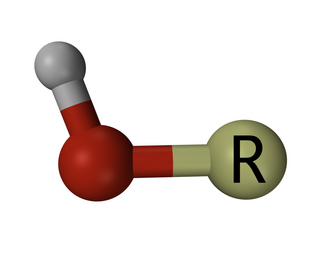
A hydroxy or hydroxyl group is the entity with the formula OH. It contains oxygen bonded to hydrogen. In organic chemistry, alcohols and carboxylic acids contain hydroxy groups. Both the negatively charged anion OH−, called hydroxide, and the neutral radical ·OH, known as the hydroxyl radical, consist of an unbounded hydroxyl group.
The Controlled Drugs and Substances Act is Canada's federal drug control statute. Passed in 1996 under Prime Minister Jean Chrétien's government, it repeals the Narcotic Control Act and Parts III and IV of the Food and Drugs Act, and establishes eight Schedules of controlled substances and two Classes of precursors. It provides that "The Governor in Council may, by order, amend any of Schedules I to VIII by adding to them or deleting from them any item or portion of an item, where the Governor in Council deems the amendment to be necessary in the public interest."

β-Hydroxy β-methylbutyric acid (HMB), otherwise known as its conjugate base, β-hydroxyβ-methylbutyrate, is a naturally produced substance in humans that is used as a dietary supplement and as an ingredient in certain medical foods that are intended to promote wound healing and provide nutritional support for people with muscle wasting due to cancer or HIV/AIDS. In healthy adults, supplementation with HMB has been shown to increase exercise-induced gains in muscle size, muscle strength, and lean body mass, reduce skeletal muscle damage from exercise, improve aerobic exercise performance, and expedite recovery from exercise. Medical reviews and meta-analyses indicate that HMB supplementation also helps to preserve or increase lean body mass and muscle strength in individuals experiencing age-related muscle loss. HMB produces these effects in part by stimulating the production of proteins and inhibiting the breakdown of proteins in muscle tissue. No adverse effects from long-term use as a dietary supplement in adults have been found.

Ethyl bromoacetate is the chemical compound with the formula CH2BrCO2C2H5. It is the ethyl ester of bromoacetic acid and is prepared in two steps from acetic acid. It is a lachrymator and has a fruity, pungent odor. It is also a highly toxic alkylating agent and may be fatal if inhaled.
Calcium hypochlorite is an inorganic compound with formula Ca(ClO)2. It is the main active ingredient of commercial products called bleaching powder, chlorine powder, or chlorinated lime, used for water treatment and as a bleaching agent. This compound is relatively stable and has greater available chlorine than sodium hypochlorite (liquid bleach). It is a white solid, although commercial samples appear yellow. It strongly smells of chlorine, owing to its slow decomposition in moist air. It is not highly soluble in hard water, and is more preferably used in soft to medium-hard water. It has two forms: dry (anhydrous); and hydrated (hydrous).

N-Methyl-2-pyrrolidone (NMP) is an organic compound consisting of a 5-membered lactam. It is a colorless liquid, although impure samples can appear yellow. It is miscible with water and with most common organic solvents. It also belongs to the class of dipolar aprotic solvents such as dimethylformamide and dimethyl sulfoxide. It is used in the petrochemical and plastics industries as a solvent, exploiting its nonvolatility and ability to dissolve diverse materials.
α-Hydroxy acids, or alpha hydroxy acids (AHAs), are a class of chemical compounds that consist of a carboxylic acid substituted with a hydroxyl group on the adjacent carbon. They may be naturally occurring or synthetic. AHAs are well known for their use in the cosmetics industry. They are often found in products that aid in the reduction of wrinkles, that soften strong, defining lines, and that improve the overall look and feel of the skin. They are also used as chemical peels. AHAs have effective results through continuous treatment in the cosmeceutical industry.

Zinc fluoride (ZnF2) is an inorganic chemical compound. It is encountered as the anydrous form and also as the tetrahydrate, ZnF2 · 4H2O (rhombohedral crystal structure). It has a high melting point and has the rutile structure containing 6 coordinate zinc, which suggests appreciable ionic character in its chemical bonding. Unlike the other zinc halides, ZnCl2, ZnBr2 and ZnI2, it is not very soluble in water.

4-Hydroxy-5-methoxydimethyltryptamine, also known as 4-HO-5-MeO-DMT or psilomethoxin, is a novel psychedelic drug. It is the 4-hydroxy counterpart of 5-MeO-DMT, or the 5-methoxy counterpart of psilocin.
3β-Hydroxysteroid dehydrogenase/Δ5-4 isomerase (3β-HSD) is an enzyme that catalyzes the biosynthesis of the steroid progesterone from pregnenolone, 17α-hydroxyprogesterone from 17α-hydroxypregnenolone, and androstenedione from dehydroepiandrosterone (DHEA) in the adrenal gland. It is the only enzyme in the adrenal pathway of corticosteroid synthesis that is not a member of the cytochrome P450 family. It is also present in other steroid-producing tissues, including the ovary, testis and placenta. In humans, there are two 3β-HSD isozymes encoded by the HSD3B1 and HSD3B2 genes.

11-Hydroxy-Δ9-tetrahydrocannabinol (11-OH-THC), usually referred to as 11-hydroxy-THC, is the main active metabolite of tetrahydrocannabinol (THC), which is formed in the body after decarboxylated cannabis is consumed.
In enzymology, a vitamin-K-epoxide reductase (warfarin-insensitive) is an enzyme that catalyzes the chemical reaction

In molecular biology, hydroxymethylglutaryl-CoA synthase or HMG-CoA synthase EC 2.3.3.10 is an enzyme which catalyzes the reaction in which acetyl-CoA condenses with acetoacetyl-CoA to form 3-hydroxy-3-methylglutaryl-CoA (HMG-CoA). This reaction comprises the second step in the mevalonate-dependent isoprenoid biosynthesis pathway. HMG-CoA is an intermediate in both cholesterol synthesis and ketogenesis. This reaction is overactivated in patients with diabetes mellitus type 1 if left untreated, due to prolonged insulin deficiency and the exhaustion of substrates for gluconeogenesis and the TCA cycle, notably oxaloacetate. This results in shunting of excess acetyl-CoA into the ketone synthesis pathway via HMG-CoA, leading to the development of diabetic ketoacidosis.

Hydroxy-alpha sanshool is a molecule found in plants from the genus Zanthoxylum. It is believed to be responsible for the numbing and tingling sensation caused by eating food cooked with Sichuan peppercorns.

1-Testosterone, also known as δ1-dihydrotestosterone (δ1-DHT), as well as dihydroboldenone, is a synthetic anabolic–androgenic steroid (AAS) and a 5α-reduced derivative of boldenone (Δ1-testosterone). It differs from testosterone by having a 1(2)-double bond instead of a 4(5)-double bond in its A ring. It was legally sold online in the United States until 2005, when it was reclassified as a Schedule III drug.

4-Dehydroepiandrosterone (4-DHEA) is a steroid that is an isomer of 5-dehydroepiandrosterone.

4-Hydroxy-α-methyltryptamine (4-HO-αMT) is a psychedelic drug of the tryptamine class. It is a close structural analogue of α-methyltryptamine (αMT) and produces similar effects to it, but with exacerbated side effects similarly to 5-MeO-αMT. Alexander Shulgin describes 4-HO-αMT briefly in his book TiHKAL:
The 4-hydroxy analogue of αMT has been looked at in human subjects. It is reported to be markedly visual in its effects, with some subjects reporting dizziness and a depressed feeling. There were, however, several toxic signs at doses of 15 to 20 milligrams orally, including abdominal pain, tachycardia, increased blood pressure and, with several people, headache and diarrhea.
The queen bee acid or 10-HDA is a bio-active compound found in royal jelly.

Methylhydroxynandrolone, also known as 4-hydroxy-17α-methyl-19-nortestosterone (HMNT), as well as 4,17β-dihydroxy-17α-methylestr-4-en-3-one, is a synthetic, orally active anabolic–androgenic steroid (AAS) and a 17α-alkylated derivative of nandrolone (19-nortestosterone) which was never marketed. It was first described in 1964 and was studied in the treatment of breast cancer, but was not introduced for clinical use. The drug re-emerged in 2004 when it started being sold on the Internet as a "dietary supplement". MOHN joined other AAS as a controlled substance in the United States on 20 January 2005.

7α-Hydroxydehydroepiandrosterone, also known as 3β,7α-dihydroxyandrost-4-ene-17-one, is an endogenous, naturally occurring steroid and a major metabolite of dehydroepiandrosterone (DHEA) that is formed by CYP7B1 in tissues such as the prostate gland and by CYP3A4 in the liver. The major metabolic pathway of DHEA outside the liver is via 7-hydroxylation into 7α-OH-DHEA and 7β-OH-DHEA. 7α-OH-DHEA has weak estrogenic activity, selectively activating the estrogen receptor ERβ. In addition, 7α-OH-DHEA may be responsible for the known antiglucocorticoid effects of DHEA.
