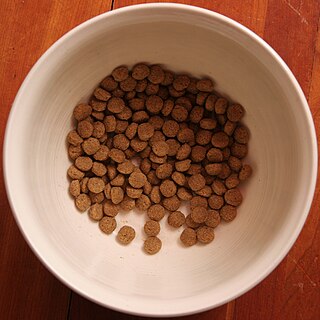
Dog food is specifically formulated and intended for consumption by dogs and other related canines. Dogs are considered to be omnivores with a carnivorous bias. They have the sharp, pointed teeth and shorter gastrointestinal tracts of carnivores, better suited for the consumption of meat than of vegetable substances, yet also have ten genes that are responsible for starch and glucose digestion, as well as the ability to produce amylase, an enzyme that functions to break down carbohydrates into simple sugars – something that obligate carnivores like cats lack. Dogs evolved the ability living alongside humans in agricultural societies, as they managed on scrap leftovers and excrement from humans.

Metabolomics is the scientific study of chemical processes involving metabolites, the small molecule substrates, intermediates, and products of cell metabolism. Specifically, metabolomics is the "systematic study of the unique chemical fingerprints that specific cellular processes leave behind", the study of their small-molecule metabolite profiles. The metabolome represents the complete set of metabolites in a biological cell, tissue, organ, or organism, which are the end products of cellular processes. Messenger RNA (mRNA), gene expression data, and proteomic analyses reveal the set of gene products being produced in the cell, data that represents one aspect of cellular function. Conversely, metabolic profiling can give an instantaneous snapshot of the physiology of that cell, and thus, metabolomics provides a direct "functional readout of the physiological state" of an organism. There are indeed quantifiable correlations between the metabolome and the other cellular ensembles, which can be used to predict metabolite abundances in biological samples from, for example mRNA abundances. One of the ultimate challenges of systems biology is to integrate metabolomics with all other -omics information to provide a better understanding of cellular biology.

The University of Natural Resources and Life Sciences, Vienna, or simply BOKU, founded in 1872, is an education and research centre for renewable resources in Vienna, Austria. BOKU combines expertise in the fields of natural sciences, engineering and biotechnology as well as social and economic sciences. In research and teaching, it focuses on

Tamil Nadu Agricultural University (TNAU) is the state agricultural university of Tamil Nadu in Coimbatore, Tamil Nadu, India.

Assam Agricultural University (AAU) is an agricultural education state university which was established on 1 April 1969 in Jorhat in the state of Assam, India. The jurisdiction of the university extends to the entire State of Assam with regard to teaching, research and extension education in the field of agriculture and allied sciences. The university has a number of campuses with its headquarters at Borbheta, Jorhat.

The University of Agriculture (UAF) is a public research university in Faisalabad, Pakistan. It is the largest university of Pakistan by area, with a covered area of 2,550 acres. It is ranked as a top university of Pakistan for Agriculture/Veterinary and is ranked among top ten Pakistani universities in general category

The University of Agricultural Sciences and Veterinary Medicine of Cluj-Napoca (USAMVCN) is a university in Cluj-Napoca, Romania. With around 6,000 students, the university offers 21 undergraduate programs; all are available in Romanian, 2 in French and 1 in English. Additionally, the university offers 23 Master programs.

Kerala Agricultural University (KAU) is a state university for agricultural education, recognised as a State Agricultural University by the Indian Council of Agricultural Research (ICAR). It is situated in Vellanikkara, Kerala, India.

The University of Veterinary and Animal Sciences, or UVAS originally known as Lahore Veterinary College, is a public university located in Lahore, Punjab, Pakistan.

The University of Florida Institute of Food and Agricultural Sciences (UF/IFAS) is a teaching, research and Extension scientific organization focused on agriculture and natural resources. It is a partnership of federal, state, and county governments that includes an Extension office in each of Florida's 67 counties, 12 off-campus research and education centers, five demonstration units, the University of Florida College of Agricultural and Life Sciences, three 4-H camps, portions of the UF College of Veterinary Medicine, the Florida Sea Grant program, the Emerging Pathogens Institute, the UF Water Institute and the UF Genetics Institute.

Guru Angad Dev Veterinary and Animal Sciences University is a veterinary university in ludhiana Punjab, india. It was a part of Punjab Agricultural University and was established on 9 August 2005 to serve the society by promoting the livestock production, health and prevention of diseases through integrated teaching and extension programs. The mission of the college is to produce veterinary graduates, scientists and extension workers for promoting better livestock health, by prevention of disease, increasing production and reproduction of livestock, thus improving the quality of rural life in Punjab.

Sokoine University of Agriculture (SUA) is a public university in Morogoro, Tanzania, specializing in agriculture. The university is named after the country's second prime minister Edward Sokoine.
The University of Maryland College of Agriculture and Natural Resources is the agricultural and environmental sciences college of the University of Maryland and operates the Maryland Sea Grant College in cooperation with the University of Maryland Center for Environmental Science and the National Oceanic and Atmospheric Administration.
The School of Agricultural and Life Sciences is a French public and national Grande Ecole in agricultural and life sciences, funded by the Ministry of Higher Education and Research and member of Toulouse Tech. The ENSAT is a school of the National Polytechnic Institute of Toulouse (INPT), a university federating several schools dealing with engineering, agriculture and veterinary sciences, chemistry, meteorology.

Stepan Gzhytskyi National University of Veterinary Medicine and Biotechnologies Lviv is a public university located in Lviv, Ukraine.
Biomin is an animal health and nutrition company headquartered in Inzersdorf-Getzersdorf, Austria. Biomin develops and produces feed additives and premixes for livestock animals including swine, poultry, dairy and beef cattle as well as aquaculture.

Dmytro Melnychuk – Hero of Ukraine, academician of National Academy of Sciences and National Academy of Agrarian Sciences, professor (biochemistry), doctor of biological sciences, honored worker of science of Ukraine, state prize laureate in science and technology of Ukraine, Full Cavalier of Ukraine titles "For Merits", rector of the National University of Life and Environmental Sciences of Ukraine, professor of the department of biochemistry and the quality and safety of agricultural products NULES of Ukraine, member of the bureau of biochemistry, physiology and medical sciences of Ukraine, member section "Biology" of the state committee of Ukraine on awarding state prizes of Ukraine in science and technology, member of the scientific council of the world confederation of associations of higher agricultural education and life sciences, member of the agrarian party of Ukraine, chairman of the NGO "Council of Ukraine heroes in agriculture ", honored veteran of Kyiv.

Erich Erber is an Austrian entrepreneur. He is the founder of Erber KG, later known as Biomin GmbH; the animal health and nutrition company specializes in feed additives and premixes. In 2020 Erich Erber sold Erber Group and founded SAN Group. It continues to be family-owned and operated.

The Lilongwe University of Agriculture and Natural Resources (LUANAR) is a university outside Lilongwe, Malawi. It was formed in 2011 by a merger between Bunda College of Agriculture of the University of Malawi and Natural Resources College (NRC).

The TUM School of Life Sciences is a school of the Technical University of Munich, located at its Weihenstephan campus in Freising. It encompasses the life sciences, in particular biology, agricultural science, food technology, landscape architecture, biotechnology, and nutrition.


