
Creole people are ethnic groups which originated during the colonial era from colonialism mainly between West Africans as well as some other people born in the colonies, such as French, Spanish, and Native American peoples; this process is known as creolisation. Creole peoples vary from different race. The development of creole languages is sometimes mistakenly attributed to the emergence of creole ethnic identities; however, they are independent developments.

Filipinos are the people who are native to or citizens of the country of the Philippines. Filipinos come from various Austronesian ethnolinguistic groups. Currently, there are more than 185 ethnolinguistic groups in the Philippines; each with its own language, identity, culture and history. The number of individual languages listed for Philippines is 185. Of these, 183 are living and 2 are extinct. Of the living languages, 175 are indigenous and 8 are non-indigenous. Furthermore, as of 2019, 39 are institutional, 67 are developing, 38 are vigorous, 28 are endangered, and 11 are dying.

The Philippines is inhabited by more than 175 ethnolinguistic nations, the majority of whose languages are Austronesian in origin. Many of these nations converted to Christianity, particularly the lowland-coastal nations, and adopted foreign elements of culture. Ethnolinguistic nations include the Ilocano, Ivatan, Pangasinan, Kapampangan, Tagalog, Bicolano, Visayans, Zamboangueño, Subanon, and more.
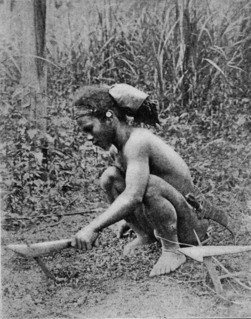
The Bugkalot are a tribe who inhabit the southern Sierra Madre and Caraballo Mountains, on the east side of Luzon in the Philippines, primarily in the provinces of Nueva Vizcaya and Nueva Ecija and along the mountain border between the provinces of Quirino and Aurora. They are also commonly referred to as "Ilongot", especially in older studies, but nowadays, the endonym Bugkalot is preferred in modern ethnic research. They were formerly headhunters.
The Hiligaynon people, often referred to as Ilonggo people or Panayan people are a Visayan ethnic group whose primary language is Hiligaynon, an Austronesian language of the Visayan branch native to Panay, Guimaras, and Negros. Over the years, inter-migrations and intra-migrations have contributed to the diaspora of the Hiligaynons to different parts of the Philippines. Today, the Hiligaynon form the majority in the provinces of Iloilo, Negros Occidental, Guimaras, Capiz, South Cotabato, Sultan Kudarat, and North Cotabato.
Michelle "Shelly" Zimbalist Rosaldo was a social, linguistic, and psychological anthropologist famous for her studies of the Ilongot people in the Philippines and for her pioneering role in women's studies and the anthropology of gender.

The Gaddang language is spoken by up to 30,000 speakers in the Philippines, particularly along the Magat and upper Cagayan rivers in the Region II provinces of Nueva Vizcaya and Isabela and by overseas migrants to countries in Asia, Australia, Canada, Europe, in the Middle East, United Kingdom and the United States. Most Gaddang speakers also speak Ilocano, the lingua franca of Northern Luzon, as well as Tagalog and English. Gaddang is associated with the "Christianized Gaddang" people, and is closely related to the highland tongues of Ga'dang with 6,000 speakers, Cagayan Agta with less than 1,000 and Atta with 2,000, and more distantly to Ibanag, Itawis, Yogad, Isneg and Malaweg.

Arts in the Philippines refer to all the various forms of the arts that have developed and accumulated in the Philippines from the beginning of civilization in the country up to the present era. They reflect the range of artistic influences on the country's culture, including indigenous forms of the arts, and how these influences have honed the country's arts. These arts are divided into two distinct branches, namely, traditional arts and non-traditional arts. Each branch is further divided into various categories with subcategories.
The ethnic groups of Southeast Asia comprise many different linguistic stocks. Apart from Negrito, which is a physical description, they are here arranged according to the family their languages belong to. Besides indigenous Southeast Asians, many East Asians and South Asians call Southeast Asia their home. The total Southeast Asian population stands at 655 million (2019).

The history of the Philippines between 900 and 1565 begins with the creation of the Laguna Copperplate Inscription in 900 and ends with Spanish colonisation in 1565. The inscription records its date of creation in the year 822 of the Hindu Saka calendar, corresponding to 900 AD in the Gregorian system. Therefore, the recovery of this document marks the end of prehistory of the Philippines at 900 AD. During this historical time period, the Philippine archipelago was home to numerous kingdoms and sultanates and was a part of the theorised Indosphere and Sinosphere.
The Meso-Cordilleran languages are a group of languages spoken in or near the Cordillera Central mountain range in Northern Luzon. Its speakers are culturally very diverse, and include the lowland Pangasinense, the Igorot highlanders, and Alta-speaking Aeta groups.
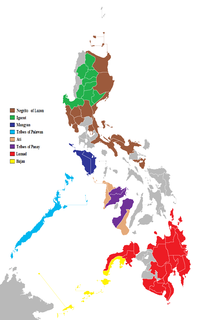
The Philippines consist of numerous upland and lowland indigenous ethnolinguistic groups living in the country, with Austronesians making up the overwhelming majority, while full or partial Australo-Melanesians scattered throughout the archipelago. The highland Austroneians and Australo-Melanesians have co-existed with their lowland Austronesian kin and neighbor groups for thousands of years in the Philippine archipelago. The primary difference is that they were not absorbed by centuries of Spanish and United States colonization of the Philippines, and in the process have retained their customs and traditions. This is mainly due to the rugged inaccessibility of the mountains and established headhunting and warrior cultures, which discouraged Spanish and American colonizers from coming into contact with the highlanders.
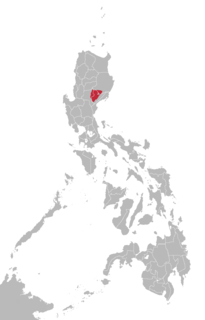
Ilongot is a language of the indigenous Bugkalot people of northern Luzon, Philippines.

Northern Alta is a distinctive Aeta language of the mountains of northern Philippines. It is not close to Southern Alta or to other languages of Luzon.

The Northern Luzon languages are one of the few established large groups within Philippine languages. These are mostly located in and around the Cordillera Central of northern Luzon in the Philippines. Among its major languages are Ilokano, Pangasinan and Ibanag
The Southern Cordilleran languages are a group of closely related languages within the Northern Luzon subgroup of the Austronesian language family. They are spoken in an area stretching from the southern shore of the Lingayen Gulf to the highlands of Quirino province. The most widely spoken Southern Cordilleran language is Pangasinan, one of the eight major languages of the Philippines.
