
Lyndon Baines Johnson, often referred to as LBJ, was the 36th president of the United States, serving from 1963 to 1969. He became president after the assassination of John F. Kennedy, under whom he had served as the 37th vice president from 1961 to 1963. A Democrat from Texas, Johnson previously served as a U.S. representative and U.S. senator.
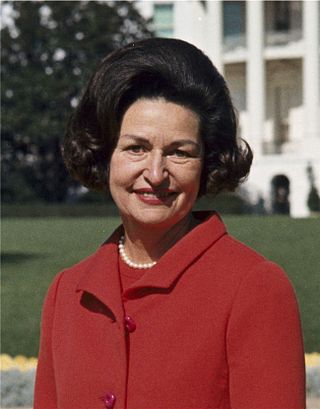
Claudia Alta "Lady Bird" Johnson was first lady of the United States from 1963 to 1969 as the wife of then president Lyndon B. Johnson. She had previously served as second lady from 1961 to 1963 when her husband was vice president.
Claudia Johnson may refer to:

The oath of office of the president of the United States is the oath or affirmation that the president of the United States takes upon assuming office. The wording of the oath is specified in Article II, Section One, Clause 8, of the United States Constitution, and a new president must take it before exercising or carrying out any official powers or duties.
President Johnson may refer to:
A national curriculum is a common programme of study in schools that is designed to ensure nationwide uniformity of content and standards in education. It is usually legislated by the national government, possibly in consultation with state or other regional authorities.
Operation Texas was an alleged undercover operation to relocate European Jews to Texas, USA, away from Nazi persecution, first reported in a 1989 Ph.D. dissertation by Louis Stanislaus Gomolak at the University of Texas at Austin titled Prologue: LBJ's foreign-affairs background, 1908-1948. The following are some of the key arguments of the dissertation:

Cecil William Stoughton was an American photographer. He is best known for being President John F. Kennedy's photographer during his White House years.
Lyndon School may refer to:
Johnson High School can refer to:
During President Lyndon B. Johnson's presidency, federal judicial appointments played a central role. Johnson appointed Abe Fortas and Thurgood Marshall to the Supreme Court of the United States in just over five years as president.

The first inauguration of Lyndon B. Johnson as the 36th president of the United States was held on Friday, November 22, 1963, aboard Air Force One at Dallas Love Field, following the assassination of President John F. Kennedy earlier that day. The inauguration – the eighth non-scheduled, extraordinary inauguration to ever take place – marked the commencement of the first term of Lyndon B. Johnson as president.

The second inauguration of Lyndon B. Johnson as president of the United States was held on Wednesday, January 20, 1965, at the East Portico of the United States Capitol in Washington, D.C. This was the 45th inauguration and marked the second and only full term of Lyndon B. Johnson as president and the only term of Hubert Humphrey as vice president. Chief Justice Earl Warren administered the oath of office. Lady Bird Johnson founded the tradition of incoming first ladies participating in the ceremony by holding the sworn-in president's Bible. Vice President Humphrey was sworn in by John W. McCormack, the speaker of the House of Representatives. This was the first inauguration when the president rode in a bulletproof limousine.
Lyndon B. Johnson (1908–1973) was the 36th President of the United States from 1963 to 1969.
The Great Society may refer to:
John F. Kennedy, a Democrat from Massachusetts, was elected President of the United States on November 8, 1960, was inaugurated as the nation's 35th president on January 20, 1961, and his presidency ended on November 22, 1963, upon his assassination and death. The following articles cover the timeline of Kennedy's presidency:
Lyndon B. Johnson High School may refer to:
Lyndon B. Johnson Hospital may refer to:
This page is based on this
Wikipedia article Text is available under the
CC BY-SA 4.0 license; additional terms may apply.
Images, videos and audio are available under their respective licenses.
