
United States v. Microsoft Corporation, 253 F.3d 34 is a noted American antitrust law case in which the U.S. government accused Microsoft of illegally maintaining its monopoly position in the personal computer (PC) market primarily through the legal and technical restrictions it put on the abilities of PC manufacturers (OEMs) and users to uninstall Internet Explorer and use other programs such as Netscape and Java. At trial, the district court ruled that Microsoft's actions constituted unlawful monopolization under Section 2 of the Sherman Antitrust Act of 1890, and the U.S. Court of Appeals for the D.C. Circuit affirmed most of the district court's judgments.

In the United States, antitrust law is a collection of mostly federal laws that regulate the conduct and organization of business corporations and are generally intended to promote competition and prevent monopolies. The main statutes are the Sherman Act of 1890, the Clayton Act of 1914 and the Federal Trade Commission Act of 1914. These Acts serve three major functions. First, Section 1 of the Sherman Act prohibits price fixing and the operation of cartels, and prohibits other collusive practices that unreasonably restrain trade. Second, Section 7 of the Clayton Act restricts the mergers and acquisitions of organizations that may substantially lessen competition or tend to create a monopoly. Third, Section 2 of the Sherman Act prohibits monopolization.

The United States Marshals Service (USMS) is a federal law enforcement agency in the United States. The USMS is a bureau within the U.S. Department of Justice, operating under the direction of the Attorney General, but serves as the enforcement arm of the United States federal courts to ensure the effective operation of the judiciary and integrity of the Constitution. It is the oldest U.S. federal law enforcement agency, created by the Judiciary Act of 1789 during the presidency of George Washington as the "Office of the United States Marshal". The USMS as it stands today was established in 1969 to provide guidance and assistance to U.S. Marshals throughout the federal judicial districts.
Tying is the practice of selling one product or service as a mandatory addition to the purchase of a different product or service. In legal terms, a tying sale makes the sale of one good to the de facto customer conditional on the purchase of a second distinctive good. Tying is often illegal when the products are not naturally related. It is related to but distinct from freebie marketing, a common method of giving away one item to ensure a continual flow of sales of another related item.
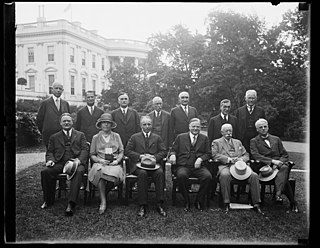
The National Commission on Law Observance and Enforcement was a committee established by the U.S. President, Herbert Hoover, on May 20, 1929. Former attorney general George W. Wickersham (1858–1936) chaired the 11-member group, which was charged with surveying the U.S. criminal justice system under Prohibition and making recommendations for public policy.

Bass Reeves was an American law enforcement officer. He was the first black deputy U.S. marshal west of the Mississippi River. He worked mostly in Arkansas and the Oklahoma Territory. During his long career, he had on his record more than 3,000 arrests of dangerous criminals, and shot and killed 14 of them in self-defense.

Microsoft Corp. v. Commission (2007) T-201/04 is a case brought by the European Commission of the European Union (EU) against Microsoft for abuse of its dominant position in the market. It started as a complaint from Sun Microsystems over Microsoft's licensing practices in 1993, and eventually resulted in the EU ordering Microsoft to divulge certain information about its server products and release a version of Microsoft Windows without Windows Media Player. The European Commission especially focused on the interoperability issue.
The Unlawful Internet Gambling Enforcement Act of 2006 (UIGEA) is United States legislation regulating online gambling. It was added as Title VIII to the SAFE Port Act which otherwise regulated port security. The UIGEA prohibits gambling businesses from "knowingly accepting payments in connection with the participation of another person in a bet or wager that involves the use of the Internet and that is unlawful under any federal or state law." The act specifically excludes fantasy sports that meet certain requirements, skill games, and legal intrastate and intertribal gaming. The law does not expressly mention state lotteries, nor does it clarify whether interstate wagering on horse racing is legal.
Cyber police are police departments or government agencies in charge of stopping cybercrime. Exemples include:
Microsoft Corp. v. AT&T Corp., 550 U.S. 437 (2007), was a United States Supreme Court case in which the Supreme Court reversed a previous decision by the Federal Circuit and ruled in favor of Microsoft, holding that Microsoft was not liable for infringement on AT&T's patent under 35 U.S.C. § 271(f).
Computer Online Forensic Evidence Extractor (COFEE) is a tool kit, developed by Microsoft, to help computer forensic investigators extract evidence from a Windows computer. Installed on a USB flash drive or other external disk drive, it acts as an automated forensic tool during a live analysis. Microsoft provides COFEE devices and online technical support free to law enforcement agencies.
Proprietary software, also known as non-free software or closed-source software, is computer software for which the software's publisher or another person reserves some rights from licenses to use, modify, share modifications, or share the software. It is the opposite of open-source or free software. Non-free software sometimes includes patent rights.
Information technology law concerns the law of information technology, including computing and the internet. It is related to legal informatics, and governs the digital dissemination of both (digitized) information and software, information security and electronic commerce aspects and it has been described as "paper laws" for a "paperless environment". It raises specific issues of intellectual property in computing and online, contract law, privacy, freedom of expression, and jurisdiction.

Jan Philipp Albrecht is a German politician of the Alliance '90/The Greens, part of The Greens-European Free Alliance. Since 2018, he has been serving as Minister for Energy, Agriculture, the Environment, Nature and Digitalization of Schleswig-Holstein. From 2009 until 2018, he was a Member of the European Parliament. He is specialized in the field of civil rights, data protection and democracy.
Child pornography is pornography that exploits children for sexual stimulation. It may be produced with the direct involvement or sexual assault of a child or it may be simulated child pornography. Abuse of the child occurs during the sexual acts or lascivious exhibitions of genitals or pubic areas which are recorded in the production of child pornography. Child pornography may use a variety of mediums, including writings, magazines, photos, sculpture, drawing, painting, animation, sound recording, film, video, and video games. Child pornography may be created for profit or other reasons.

Carlton Wayne Reeves is a United States District Judge of the United States District Court for the Southern District of Mississippi.

The European Cybercrime Centre is the body of the Police Office (Europol) of the European Union (EU), headquartered in The Hague, that coordinates cross-border law enforcement activities against computer crime and acts as a centre of technical expertise on the matter.
Microsoft Corp. v. United States, known on appeal to the U.S. Supreme Court as United States v. Microsoft Corp., 584 U.S. ___, 138 S. Ct. 1186 (2018), was a data privacy case involving the extraterritoriality of law enforcement seeking electronic data under the 1986 Stored Communications Act, Title II of the Electronic Communications Privacy Act of 1986 (ECPA), in light of modern computing and Internet technologies such as data centers and cloud storage.
Microsoft Corporation v. United States of America was a complaint for declaratory judgment action filed in the U.S. District Court in Seattle, Washington. At issue was the 1986 Electronic Communications Privacy Act. with Microsoft arguing that secrecy orders were preventing them from disclosing warrants to customers in violation of the company's and customers' rights. The case was started in April 2016 and although the government bid for dismissal of the suit, in February 2017 a federal judge set a trial date set for June 2018. Microsoft was supported in its lawsuit by companies such as Amazon, Apple, Google, Dropbox and Salesforce. The case was dropped by Microsoft in October 2017 after policy changes at the Department of Justice. Although no laws were changed, the new DOJ policy "changed data request rules on alerting Internet users about agencies accessing their information," and mandated defined periods of time for secrecy orders from the government. Although the change represented "most of what Microsoft was asking for," Microsoft did not rule out future litigation.
Dobbs v. Jackson Women's Health Organization is a pending U.S. Supreme Court case dealing with the constitutionality of a 2018 Mississippi state law that banned abortion operations after the first 15 weeks of pregnancy. Lower courts had ruled in preliminary injunctions to prevent enforcement of the law on the basis that the law violated the holding of women's rights in Planned Parenthood v. Casey, which generally allows a woman to opt for abortion within the first 24 weeks. Oral arguments were held in December 2021, with a decision expected by the end of the 2021–22 term.


