
The Parsis are an ethnoreligious group of the Indian subcontinent adhering to Zoroastrianism. They are descended from Persians who migrated to Medieval India during and after the Arab conquest of the Persian Empire to escape religious persecution and conversion to Islam. The Parsi people comprise the older of the Indian subcontinent's two Zoroastrian communities vis-à-vis the Iranis, whose ancestors migrated to British-ruled India from Qajar-era Iran. According to a 16th-century Parsi epic, Qissa-i Sanjan, Zoroastrian Persians continued to migrate to the Indian subcontinent from Greater Iran in between the 8th and 10th centuries, and ultimately settled in present-day Gujarat after being granted refuge by a local Hindu king, Jadi Rana.

Farah Khan Kunder is an Indian film director, writer, film producer, actress, dancer and choreographer who works predominantly in Hindi films. Khan has choreographed more than a hundred songs in over 80 films, winning the National Film Award for Best Choreography and seven Filmfare Awards for Best Choreography.
Sharma is a Hindu Brahmin surname. The Sanskrit stem ṣárman- can mean 'joyfulness', 'comfort', 'happiness'. Sarma and Sarmah are alternative English spellings of the name, commonly used by Assamese Brahmins. The names Sharman, Sharma and Sharmavu are used in South India, albeit uncommonly.
Modi is a surname in India, most commonly found among people from states of Rajasthan, Gujarat, Bihar, Chhattisgarh, Haryana, Madhya Pradesh, Jharkhand, and Uttar Pradesh. The surname Modi doesn't belong to any particular community. It is distributed among various religions as well. It is used in Hindu, Muslim and even Parsi community.

Farokh Manecksha Engineer is an Indian former cricketer. He was a wicket-keeper-batsman, usually an opening batsman, who represented India in 46 Test matches from 1961 to 1975. In first-class cricket, he played for Bombay from 1959/60 to 1974/75, for West Zone from 1961/62 to 1974/75, and for Lancashire County Cricket Club from 1968 to 1976. He was the first-choice wicket-keeper for the Rest of the World team which toured England in 1970 and Australia in 1971–72.
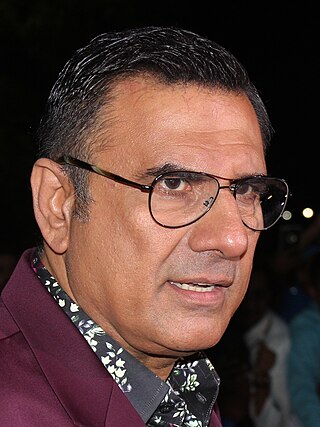
Boman Irani is an Indian actor, photographer and voice artist who works in Hindi-language films in addition to Telugu, Tamil and Marathi films. One of the most popular character actors in Hindi cinema, he has featured in over 100 films. Irani has won a Filmfare Award and an IIFA Award.

The Irani are an ethno-religious community in the Indian subcontinent; they descend from the Zoroastrians who emigrated from Iran to British India in the 19th and 20th centuries. They are culturally, linguistically, ethnically and socially distinct from the Parsis, who – although also Zoroastrians – immigrated to the Indian subcontinent from Greater Iran many centuries prior, starting with the Islamic conquest of Persia.
Khan Bahadur Ardeshir Irani was a writer, director, producer, actor, film distributor, film showman and cinematographer in the silent and sound eras of early Indian cinema. He is considered one of the greatest personalities in recent Indian Cinema. He was the director of India's first sound film Alam Ara. He was the producer of India's first colour film Kisan Kanya. He was renowned for making films in Hindi, Telugu, English, German, Indonesian, Persian, Urdu and Tamil. He was a successful entrepreneur who owned film theatres, a gramophone agency, and a car agency.

Honey Irani is an Indian actress and screenwriter, who works in Hindi cinema. She started her career as a child actor with roles in films such as Mahesh Kaul’s Pyar ki Pyas. She was probably four to five years old when the shooting of the movies Chirag Kahan Roshni Kahan and Bombay Ka Chor started.

Homi Adajania is an Indian film director and writer. He made his directorial debut with Being Cyrus (2006), an English-language psychological drama. He followed this with the commercially successful Hindi-language romantic comedy Cocktail (2012). After this Adajania directed the satire Finding Fanny.

Irani cafés are Iranian-style cafés in the Indian subcontinent. They were originally opened by Zoroastrian Irani immigrants to British India in the 19th century, fleeing Safavid persecution or looking for better economic prospects. In India, Mumbai, Pune and Hyderabad boast a number of Irani cafés, which are very popular for Irani chai (tea). In the 1950s, there were 350 Irani cafés; today, only 25 remain. Karachi, Pakistan, was also home to many Irani cafés.

Daisy Irani Shukla is an Indian actress in Hindi language films. She was a popular child actor in the 1950s and 1960s. She is most known for films such as Bandish (1955), Ek Hi Raasta (1956), Naya Daur (1957), Hum Panchhi Ek Daal Ke (1957), Jailor (1958), Qaidi No. 911 (1959) and Do Ustad (1959). As a supporting actress, she acted in Kati Patang in 1971. She also worked in a popular TV show Shararat.

Tannaz Irani is an Indian actress. She has acted in Bollywood films and Hindi television serials. She has also been credited as Tannaz Lal, her maiden name, and Tannaz Currim.

Bakhtiyaar Irani is an Indian film and television actor who has participated in Indian television reality shows. He has appeared in the reality dance series Nach Baliye, paired with his wife Tannaz Irani. In 2009, the couple became participants in Bigg Boss.
Shukla is a word of Sanskrit origin that means "bright" or "white".
Anand is a name of Indian origin, derived from the Sanskrit abstract noun आनन्द (ānanda), which means happiness or joy.
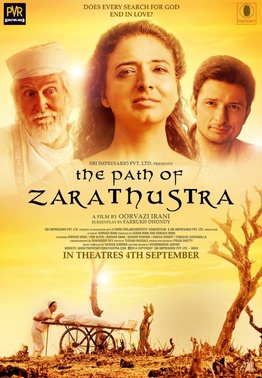
The Path Of Zarathustra is a 2015 Indian magic realism film directed by Oorvazi Irani. It stars Oorvazi Irani, Tom Alter, Rushad Rana and Shishir Sharma. The screenplay of the film is written by the author Farrukh Dhondy. The film was released on 4 September 2015.

