See also
 | This disambiguation page lists articles associated with the title Iranshah. If an internal link led you here, you may wish to change the link to point directly to the intended article. |
Iranshah may refer to:
| | This disambiguation page lists articles associated with the title Iranshah. If an internal link led you here, you may wish to change the link to point directly to the intended article. |

Shiraz is the fifth-most-populous city of Iran and the capital of Fars Province, which is also known as Pars and Persis (Persia). At the 2016 census, the population of the city was 1,869,001 and its built-up area with "Shahr-e Jadid-e Sadra" was home to 1,565,572 inhabitants. Shiraz is located in the southwest of Iran on the "Rudkhaneye Khoshk" seasonal river. It has a moderate climate and has been a regional trade center for over a thousand years. Shiraz is one of the oldest cities of ancient Persia.

Abul-Qâsem Ferdowsi Tusi, or just Ferdowsi was a Persian poet and the author of Shahnameh, which is one of the world's longest epic poems created by a single poet, and the national epic of Greater Iran. Ferdowsi is celebrated as one of the most influential figure in Persian literature and one of the greatest in the history of literature.

Khwāja Shams-ud-Dīn Muḥammad Ḥāfeẓ-e Shīrāzī, known by his pen name Hafez and as "Hafiz", was a Persian poet, whose collected works are regarded by many Iranians as a pinnacle of Persian literature. His works are often found in the homes of people in the Persian-speaking world, who learn his poems by heart and still use them as proverbs and sayings. His life and poems have become the subjects of much analysis, commentary and interpretation, influencing post-14th century Persian writing more than any other author.

Nizami Ganjavi, Nizami Ganje'i, Nizami, or Nezāmi, whose formal name was Jamal ad-Dīn Abū Muḥammad Ilyās ibn-Yūsuf ibn-Zakkī, was a 12th-century Persian Sunni Muslim poet. Nezāmi is considered the greatest romantic epic poet in Persian literature, who brought a colloquial and realistic style to the Persian epic. His heritage is widely appreciated and shared by Afghanistan, Azerbaijan, Iran, the Kurdistan region and Tajikistan.

Persian literature comprises oral compositions and written texts in the Persian language and is one of the world's oldest literatures. It spans over two-and-a-half millennia. Its sources have been within Greater Iran including present-day Iran, Iraq, Afghanistan, the Caucasus, and Turkey, regions of Central Asia and South Asia where the Persian language has historically been either the native or official language. For example, Rumi, one of the best-loved Persian poets, born in Balkh or Wakhsh, wrote in Persian and lived in Konya, at that time the capital of the Seljuks in Anatolia. The Ghaznavids conquered large territories in Central and South Asia and adopted Persian as their court language. There is thus Persian literature from Iran, Mesopotamia, Azerbaijan, the wider Caucasus, Turkey, Pakistan, Bangladesh, India, Tajikistan and other parts of Central Asia. Not all Persian literature is written in Persian, as some consider works written by ethnic Persians or Iranians in other languages, such as Greek and Arabic, to be included. At the same time, not all literature written in Persian is written by ethnic Persians or Iranians, as Turkic, Caucasian, and Indic poets and writers have also used the Persian language in the environment of Persianate cultures.

East Azerbaijan Province is one of the 31 provinces of Iran. It is located in Iranian Azerbaijan, bordering with Armenia, Republic of Azerbaijan, Ardabil Province, West Azerbaijan Province, and Zanjan Province. The capital of East Azerbaijan is Tabriz. East Azerbaijan Province is in Regions 3 of Iran, with its secretariat located in its capital city, Tabriz.

Mohammad-Taqi Bahar, widely known as Malek osh-Sho'arā and Malek osh-Sho'arā Bahār, was a renowned Iranian poet, scholar, politician, journalist, historian and Professor of Literature. Although he was a 20th-century poet, his poems are fairly traditional and strongly nationalistic in character. Bahar was father of prominent Iranist, linguist, mythologist and Persian historian Mehrdad Bahar.
Ervad Godrej Sidhwa was born in Karachi, Pakistan and studied the Avesta, Pahalvi, Persian & Pazend languages, as well as Ancient Iranian literature at M.F. Cama Athornan Institute, Andheri, Mumbai, for six years. He was initiated into the Zoroastrian priesthood by going through the Navar and Maratab initiation ceremony from Iranshah Atash Behram, Udvada, India. His initiation as a priest accounts for the "Ervad" ('Reverend') title.
The Seljuk dynasty, or Seljuks, was an Oghuz Turkic Sunni Muslim dynasty that gradually became Persianate and contributed to the Turco-Persian tradition in the medieval Middle East and Central Asia. The Seljuks established both the Seljuk Empire and the Sultanate of Rum, which at their heights stretched from Iran to Anatolia, and were targets of the First Crusade.
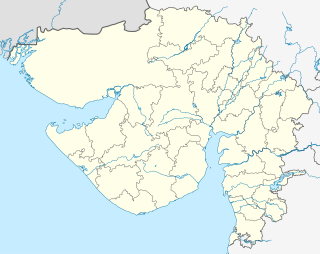
Udvada is a town situated in Pardi taluka in the Valsad district in the state of Gujarat, India. Udvada is a coastal town located around 24 km from the Valsad city. The Zoroastrian temple, Udvada Atash Behram is situated here.
The Bahman-nama is a Persian epic poem of 9500 Distichs (couplets) about Bahman, the son of Esfandiyar of the royal Kayanid dynasty. The earliest attestation of this work is in the book Mojmal al-tawarikh, which gives the author as Īrānšāh b. Abi'l Khayr.
Iranshahr may refer to:
Iranshah is a village in Kakavand-e Gharbi Rural District, Kakavand District, Delfan County, Lorestan Province, Iran. At the 2006 census, its population was 62, in 9 families.

Iran Shahi is a village in Khaveh-ye Shomali Rural District, in the Central District of Delfan County, Lorestan Province, Iran. At the 2006 census, its population was 1,416, in 337 families.

Bahrot Caves, locally known as Barad, near Dahanu, Maharashtra are the only Parsi/Zoroastrian Cave temple in India. Bahrot Caves is located 25 km south of Sanjan, Gujarat and are situated at a small distance of 8 km away from the village of Bordi. They were unused Buddhist caves excavated by Buddhist monks. Zoroastrians hid for 13 years in these mountains after an invasion of their settlement at Sanjan by Alaf Khan, a general of Muhammad bin Tughluq in 1393 CE. The ‘Iranshah Flame’ was also moved to Bahrot during this period. Even today, the Holy Fire is burning and it is given the most eminent grade of devoted fire in the world. Bahrot Caves have been declared a heritage site and is a protected monument under the Archaeological Survey of India (ASI).
Tilku is a village in Tilakuh Rural District, Ziviyeh District, Saqqez County, Kurdistan Province, Iran. At the 2006 census, its population was 966, in 201 families.

Hamadān or Hamedān is the capital city of Hamadan Province of Iran. At the 2019 census, its population was 783,300 in 230,775 families.
Iranshān ibn Abu al-Khayr, better known as Irānshāh, was an 11th or 12th century Persian poet who lived in the Seljuk Empire. He presumably lived before 1117.