Denmark is a modern high-income and highly developed mixed economy, dominated by the service sector with 80% of all jobs; about 11% of employees work in manufacturing and 2% in agriculture. The nominal Gross National Income per capita was the ninth-highest in the world at $68,827 in 2023.

Silkeborg is a Danish town with a population of 51,805. Silkeborg is the seat of Silkeborg Municipality, with a population of 100,747 as of 2024.

The Gramm–Leach–Bliley Act (GLBA), also known as the Financial Services Modernization Act of 1999, is an act of the 106th United States Congress (1999–2001). It repealed part of the Glass–Steagall Act of 1933, removing barriers in the market among banking companies, securities companies, and insurance companies that prohibited any one institution from acting as any combination of an investment bank, a commercial bank, and an insurance company. With the passage of the Gramm–Leach–Bliley Act, commercial banks, investment banks, securities firms, and insurance companies were allowed to consolidate. Furthermore, it failed to give to the SEC or any other financial regulatory agency the authority to regulate large investment bank holding companies. The legislation was signed into law by President Bill Clinton.

Small businesses are types of corporations, partnerships, or sole proprietorships which have a small number of employees and/or less annual revenue than a regular-sized business or corporation. Businesses are defined as "small" in terms of being able to apply for government support and qualify for preferential tax policy. The qualifications vary depending on the country and industry. Small businesses range from fifteen employees under the Australian Fair Work Act 2009, fifty employees according to the definition used by the European Union, and fewer than five hundred employees to qualify for many U.S. Small Business Administration programs. While small businesses can be classified according to other methods, such as annual revenues, shipments, sales, assets, annual gross, net revenue, net profits, the number of employees is one of the most widely used measures.

Svenska Handelsbanken AB is a Swedish bank providing banking services including traditional corporate transactions, investment banking and trading as well as consumer banking including insurance. Handelsbanken is one of the major banks in Sweden with a nationwide branch network.

Bank of India (BoI) is an Indian public sector bank headquartered in Bandra Kurla Complex, Mumbai. Founded in 1906, it has been government-owned since nationalisation in 1969. BoI is a founding member of SWIFT, which facilitates provision of cost-effective financial processing and communication services.
Jyske Bank A/S is the third largest Danish bank in terms of market share.

Jelling is a railway town in Denmark with a population of 3,853, located in Jelling Parish, approximately 10 km northwest of Vejle. The town lies 105 metres above sea level.

The rail transport system in Denmark consists of 2,633 km (1,636 mi) of railway lines, of which the Copenhagen S-train network, the main line Helsingør-Copenhagen-Padborg, and the Lunderskov-Esbjerg line are electrified. Most traffic is passenger trains, although there is considerable transit goods traffic between Sweden and Germany.

Nykredit is a Danish financial service company. Its activities range from mortgages, retail and investment banking to insurance, leasing and asset management.

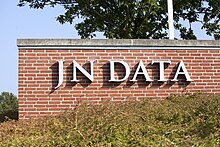
NNIT A/S is a Danish public IT company that provides IT consultancy, development, implementation and outsourcing of IT services to clients within life sciences in Denmark and internationally as well as to all types of customers in Denmark.

The Central Bank of the United Arab Emirates is the state institution responsible for managing the currency, monetary policy, banking and insurance regulation in the United Arab Emirates.

Sergei Sviatchenko is a Danish-Ukrainian architect, artist, photographer and curator. He is a representative of the Ukrainian New Wave, that arose in Ukraine up through the 1980s. Initiator and creative director of the Less Festival of Collage, Viborg and Just A Few Works. He has lived in Denmark since the 1990s. Sviatchenko graduated from the Kharkov National University of Construction and Architecture in 1975, and in 1986 he obtained a Ph.D. at the National Academy of Visual Arts and Architecture. Sviatchenko is the son of architect Evgenij Sviatchenko (1924–2004), who was a professor of architecture and a member of the National Ukrainian Academy of Fine Arts and Architecture, and engineer Ninel Sviatchenko (1926–2000). In 1975 Sergei Sviatchenko completed his architectural studies at the Kharkov National University of Construction and Architecture. Sergei Sviatchenko is especially oriented towards architecture's modern expressions, including Constructivism and the contemporary European Bauhaus movement. From his teacher, Professor Viktor Antonov, Sviatchenko was introduced to the film director Andrei Tarkovsky, and particularly his film Mirror from 1975 has left a thematic footprint in Sviatchenko's more recent collage art. After having worked as an architect for a number of architectural firms in Kharkov until 1983, Sviatchenko moved to Kyiv, where he graduated the master's program at the Kyiv National University of Construction and Architecture, having completed his Ph.D. dissertation "Means to Visual Information in Architecture".

Herning is a Danish town in the Central Denmark Region of the Jutland peninsula. It is the main town and the administrative seat of Herning Municipality. Herning has a population of 51,312 including the suburbs of Tjørring, Snejbjerg, Lind, Birk, Hammerum, and Gjellerup, making Herning the 12th most populous urban area in Denmark.

KHR Architecture A/S, formerly known as KHRAS and KHR Arkitekter is a Danish architecture company founded as Krohn & Hartvig Rasmussen in 1946. The company was founded by Gunnar Krohn and E. Hartvig Rasmussen after winning an architectural competition for the machine factory Atlas.
The MCH Messecenter Herning is an exhibition centre and entertainment complex in Herning, Denmark. The complex is the largest fair and exhibition center in Denmark– beating the Bella Center in Copenhagen. Located on 130 acres (0.53 km2), the complex hosts many events from trade shows, theatrical performances, sporting events, concert tours and other performances. It is one of the main attractions in Herning and draws a crowd of over 900,000 visitors per year.

Mads Øris Nielsen is a Danish former handballer. He played almost his entire career for in the Danish club Bjerringbro-Silkeborg Håndbold with the sole exception being three years from 2014-2017 at Skive fH. His two younger brothers, Mikkel Øris Nielsen and Nikolaj Øris Nielsen are also professional handballers.

Arkitema Architects is a Danish architectural firm headquartered in Aarhus, with branch offices in Copenhagen, Malmö, Stockholm and Oslo. Arkitema Architects was founded in 1969 in Aarhus, and nowadays has about 400 employees with its main activity in Scandinavia.