
Zutphen is a city and municipality located in the province of Gelderland, Netherlands. It lies some 30 km northeast of Arnhem, on the eastern bank of the river IJssel at the point where it is joined by the Berkel. First mentioned in the 11th century, the place-name appears to mean "south fen". In 2005, the municipality of Zutphen was merged with the municipality of Warnsveld, retaining its name. In 2021, the municipality had a population of 48,111.

Juvenile delinquency, also known as juvenile offending, is the act of participating in unlawful behavior as a minor or individual younger than the statutory age of majority. The term delinquent usually refers to juvenile delinquency, and is also generalised to refer to a young person who behaves an unacceptable way.
Melbourne Youth Justice Centre is a youth corrections facility located in Parkville, Victoria, Australia.

The Don Dale Youth Detention Centre is a facility for juvenile detention in the Northern Territory, Australia, located in Berrimah, east of Darwin. It is a detention centre for male and female juvenile delinquents. The facility is named after Don Dale, a former Member of the Northern Territory Legislative Assembly from 1983 to 1989 and one-time Minister for Correctional Services.
A military prison is a prison operated by a military. Military prisons are used variously to house prisoners of war, unlawful combatants, those whose freedom is deemed a national security risk by the military or national authorities, and members of the military found guilty of a serious crime. There are two types: penal and confinement-oriented, where captured enemy combatants are confined for military reasons until hostilities cease. Most militaries have some sort of military police unit operating at the divisional level or below to perform many of the same functions as civilian police, from traffic-control to the arrest of violent offenders and the supervision of detainees and prisoners of war.
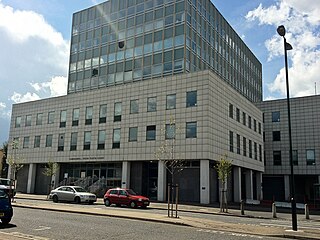
A juvenile court, also known as young offender's court or children's court, is a tribunal having special authority to pass judgements for crimes that are committed by children who have not attained the age of majority. In most modern legal systems, children who commit a crime are treated differently from legal adults that have committed the same offense.

In criminal justice systems, a youth detention center, known as a juvenile detention center (JDC), juvenile detention, juvenile jail, juvenile hall, or more colloquially as juvie/juvy or the Juvey Joint, also sometimes referred to as observation home or remand home is a prison for people under the age of majority, to which they have been sentenced and committed for a period of time, or detained on a short-term basis while awaiting trial or placement in a long-term care program. Juveniles go through a separate court system, the juvenile court, which sentences or commits juveniles to a certain program or facility.
Crime prevention is the attempt to reduce and deter crime and criminals. It is applied specifically to efforts made by governments to reduce crime, enforce the law, and maintain criminal justice.
Juvenile delinquency in the United States refers to crimes committed by children or young people, particularly those under the age of eighteen.

The Texas Youth Commission (TYC) was a Texas state agency which operated juvenile corrections facilities in the state. The commission was headquartered in the Brown-Heatly Building in Austin. As of 2007, it was the second largest juvenile corrections agency in the United States, after the Florida Department of Juvenile Justice. As of December 1, 2011, the agency was replaced by the Texas Juvenile Justice Department.
Ottho Gerhard Heldringstichting(Dutch: Ottho Gerhard Heldring Foundation) is a Dutch orthopaedic institution in Zetten, Netherlands. The facility is a private managed centre for youth with severe behaviour and often also psychiatric problems. The facility caters for youth from 12 – 18 years old (sometime max 24 at end of stay, normal intelligent and without very serious addiction problems. Youth living at the facility are sent via the court when the judge decides that juvenile needs treatment in a closed setting.

The United States incarcerates more of its youth than any other country in the world, although reports claim China has around 600,000 juveniles imprisoned which would be more than the US, through the juvenile courts and the adult criminal justice system, which reflects the larger trends in incarceration practices in the United States. In 2010, approximately 70,800 juveniles were incarcerated in youth detention facilities alone. As of 2006, approximately 500,000 youth were brought to detention centers in a given year. This data does not reflect juveniles tried as adults. As of 2013, around 40% were incarcerated in privatized, for-profit facilities.
The Mississippi Department of Human Services (MDHS) is a state agency of Mississippi, headquartered in Jackson. The department operates the state's family services.
The Massachusetts Department of Youth Services (DYS) is a state agency of Massachusetts. Its administrative office is headquartered in 600 Washington Street, Boston. The agency operates the state's juvenile justice services and facilities for incarcerated of children.

The alternatives to imprisonment are types of punishment or treatment other than time in prison that can be given to a person who is convicted of committing a crime. Some of these are also known as alternative sanctions. Alternatives can take the form of fines, restorative justice, transformative justice or no punishment at all. Capital punishment, corporal punishment and electronic monitoring are also alternatives to imprisonment, but are not promoted by modern prison reform movements for decarceration due to them being carceral in nature.
The Cambridge-Somerville Youth Study was the first large-scale randomised experiment in the history of criminology. It was commissioned in 1936 by Dr. Richard Cabot, a Boston physician who proposed an experiment to evaluate the effects of early intervention in preventing or reducing rates of juvenile delinquency. It was started in 1939 by Edwin Powers and Helen Witmer.
W.J. Maxey Boys Training School was a juvenile corrections facility that served delinquent male youths ages 12–21 years old. The facility has sixty beds and provided services to Michigan youth who require intensive or specialized rehabilitation treatment and a high level of security and structure. Maxey closed on October 1, 2015, due to budget cuts in Michigan.
Incarceration prevention refers to a variety of methods aimed at reducing prison populations and costs while fostering enhanced social structures. Due to the nature of incarceration in the United States today caused by issues leading to increased incarceration rates, there are methods aimed at preventing the incarceration of at-risk populations.
The Ashley Youth Detention Centre is a youth detention centre outside Deloraine, Tasmania, Australia. It is the only such centre in Tasmania and has a capacity of 51 beds for 10 to 18 year old offenders.