
The Jacquard machine is a device fitted to a loom that simplifies the process of manufacturing textiles with such complex patterns as brocade, damask and matelassé. The resulting ensemble of the loom and Jacquard machine is then called a Jacquard loom. The machine was patented by Joseph Marie Jacquard in 1804, based on earlier inventions by the Frenchmen Basile Bouchon (1725), Jean Baptiste Falcon (1728), and Jacques Vaucanson (1740). The machine was controlled by a "chain of cards"; a number of punched cards laced together into a continuous sequence. Multiple rows of holes were punched on each card, with one complete card corresponding to one row of the design.

The Luddites were a secret oath-based organisation of English textile workers in the 19th century who formed a radical faction which destroyed textile machinery. The group is believed to have taken its name from Ned Ludd, a legendary weaver supposedly from Anstey, near Leicester. They protested against manufacturers who used machines in what they called "a fraudulent and deceitful manner" to get around standard labour practices. Luddites feared that the time spent learning the skills of their craft would go to waste, as machines would replace their role in the industry.
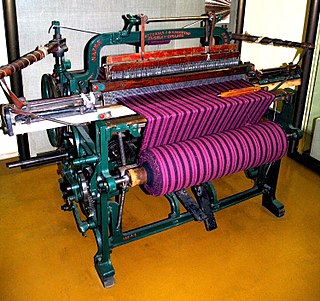
A loom is a device used to weave cloth and tapestry. The basic purpose of any loom is to hold the warp threads under tension to facilitate the interweaving of the weft threads. The precise shape of the loom and its mechanics may vary, but the basic function is the same.

Weaving is a method of textile production in which two distinct sets of yarns or threads are interlaced at right angles to form a fabric or cloth. Other methods are knitting, crocheting, felting, and braiding or plaiting. The longitudinal threads are called the warp and the lateral threads are the weft, woof, or filling. The method in which these threads are interwoven affects the characteristics of the cloth. Cloth is usually woven on a loom, a device that holds the warp threads in place while filling threads are woven through them. A fabric band that meets this definition of cloth can also be made using other methods, including tablet weaving, back strap loom, or other techniques that can be done without looms.
This timeline of clothing and textiles technology covers the events of fiber and flexible woven material worn on the body; including making, modification, usage, and knowledge of tools, machines, techniques, crafts, and manufacturing systems (technology).

Joseph Marie CharlesditJacquard was a French weaver and merchant. He played an important role in the development of the earliest programmable loom, which in turn played an important role in the development of other programmable machines, such as an early version of digital compiler used by IBM to develop the modern day computer.
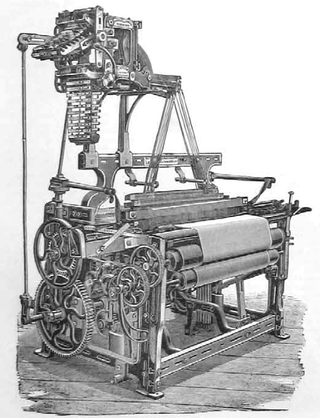
A dobby loom, or dobbie loom, is a type of floor loom that controls all the warp threads using a device called a dobby.

Damask is a reversible patterned fabric of silk, wool, linen, cotton, or synthetic fibers, with a pattern formed by weaving. Damasks are woven with one warp yarn and one weft yarn, usually with the pattern in warp-faced satin weave and the ground in weft-faced or sateen weave. Twill damasks include a twill-woven ground or pattern.
Chaos or CHAOS may refer to:
A loom is a device used to weave cloth.
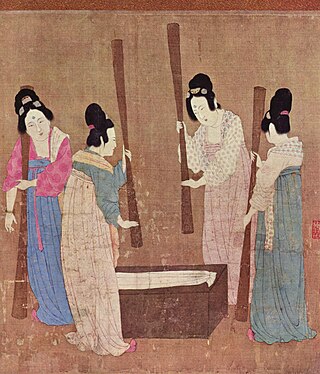
The production of silk originated in Neolithic China within the Yangshao culture. Though it would later reach other places in the world, the art of silk production remained confined to China until the Silk Road opened at 114 BC, though China maintained its virtual monopoly over silk production for another thousand years. The use of silk within China was not confined to clothing alone, and silk was used for a number of applications, such as writing. Within clothing, the color of silk worn also held social importance, and formed an important guide of social class during the Tang dynasty.
The Hattersley loom was developed by George Hattersley and Sons of Keighley, West Yorkshire, England. The company had been started by Richard Hattersley after 1784, with his son, George Hattersley, later entering the business alongside him. The company developed a number of innovative looms, of which the Hattersley Standard Loom – developed in 1921 – was a great success.
Textile Engineering College, Chittagong is a college in Bangladesh, offering bachelor's degree in textile engineering. It is situated by the side of old Dhaka Trunk road which passes through Zorargonj, Mirsharai, Chittagong. It is one of the seven constituent textile engineering colleges of Bangladesh University of Textiles, which are collectively funded by the Department of Textiles.

A rapier loom is a shuttleless weaving loom in which the filling yarn is carried through the shed of warp yarns to the other side of the loom by finger-like carriers called rapiers.

Lace machines took over the commercial manufacture of lace during the nineteenth century.

Google's Advanced Technology and Projects group (ATAP) is a skunkworks team and in-house technology incubator, created by former DARPA director Regina Dugan. ATAP is similar to X, but works on projects, granting project leaders time—previously only two years—in which to move a project from concept to proven product. According to Dugan, the ideal ATAP project combines technology and science, requires a certain amount of novel research, and creates a marketable product. Historically, the ATAP team was born at Motorola Mobility and kept when Google sold Motorola Mobility to Lenovo in 2014; for this reason, ATAP ideas have tended to involve mobile hardware technology.
Lia Cook is an American fiber artist noted for her work combining weaving with photography, painting, and digital technology. She lives and works in Berkeley, California and is known for her weavings which expanded the traditional boundaries of textile arts. She has been a professor at California College of the Arts since 1976.

The Game of Thrones Tapestry is a hand-crafted tapestry, woven by hand on a jacquard loom, with additional embroidery. The tapestry tells the entire story of the television show, Game of Thrones. It consists of seven 11-metre-long panels and one 10.5-metre panel. The eight panels depict scenes from each episode and include images of crew at work. The tapestry was commissioned by HBO and Tourism Ireland, the tourism bureau of Northern Ireland where HBO filmed much of the series.
