
Pieter Brueghelthe Younger was a Flemish painter, known for numerous copies after his father Pieter Bruegel the Elder's work as well as his original compositions. The large output of his studio, which produced for the local and export market, contributed to the international spread of his father's imagery.

Jan Brueghelthe Elder was a Flemish painter and draughtsman. He was the son of the eminent Flemish Renaissance painter Pieter Brueghel the Elder. A close friend and frequent collaborator with Peter Paul Rubens, the two artists were the leading Flemish painters in the first three decades of the 17th century.
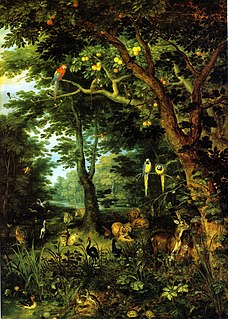
Jan Brueghelthe Younger was a Flemish Baroque painter, and the son of Jan Brueghel the Elder.
Brueghel, Bruegel or Breughel was the name of several Dutch/Flemish painters from the Brueghel family:

Hendrick van Balen or Hendrick van Balen I was a Flemish Baroque painter and stained glass designer. Hendrick van Balen specialised in small cabinet pictures often painted on a copper support. His favourite themes were mythological and allegorical scenes and, to a lesser extent, religious subjects. The artist played an important role in the renewal of Flemish painting in the early 17th century and was one of the teachers of Anthony van Dyck.

Abraham Brueghel was a Flemish painter from the famous Brueghel family of artists. He emigrated at a young age to Italy where he played an important role in the development of the style of decorative Baroque still lifes.
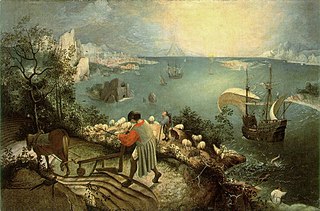
Dutch and Flemish Renaissance painting represents the 16th-century response to Italian Renaissance art in the Low Countries. These artists, who span from the Antwerp Mannerists and Hieronymus Bosch at the start of the 16th century to the late Northern Mannerists such as Hendrik Goltzius and Joachim Wtewael at the end, drew on both the recent innovations of Italian painting and the local traditions of the Early Netherlandish artists. Antwerp was the most important artistic centre in the region. Many artists worked for European courts, including Bosch, whose fantastic painted images left a long legacy. Jan Mabuse, Maarten van Heemskerck and Frans Floris were all instrumental in adopting Italian models and incorporating them into their own artistic language. Pieter Brueghel the Elder, with Bosch the only artist from the period to remain widely familiar, may seem atypical, but in fact his many innovations drew on the fertile artistic scene in Antwerp.

Jan van Kessel the Elder or Jan van Kessel (I) was a Flemish painter active in Antwerp in the mid 17th century. A versatile artist he practised in many genres including studies of insects, floral still lifes, marines, river landscapes, paradise landscapes, allegorical compositions, scenes with animals and genre scenes. A scion of the Brueghel family many of his subjects took inspiration of the work of his grandfather Jan Brueghel the Elder as well as from the earlier generation of Flemish painters such as Daniel Seghers, Joris Hoefnagel and Frans Snyders. Van Kessel’s works were highly prized by his contemporaries and were collected by skilled artisans, wealthy merchants, nobles and foreign luminaries throughout Europe.

Joos de Momper the Younger or Joost de Momper the Younger (1564–1635) was one of the foremost Flemish landscape painters between Pieter Brueghel the Elder and Peter Paul Rubens. Brueghel's influence is clearly evident in many of de Momper's paintings. His work is situated at the transition from late 16th-century Mannerism to the greater realism in landscape painting that developed in the early 17th century. He achieved considerable success during his lifetime.
The Antwerp School was a school of artists active in Antwerp, first during the 16th century when the city was the economic center of the Low Countries, and then during the 17th century when it became the artistic stronghold of the Flemish Baroque under Peter Paul Rubens.
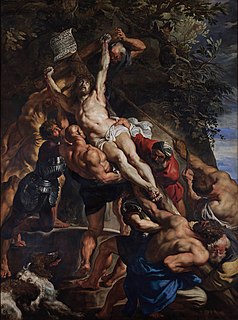
Flemish Baroque painting refers to the art produced in the Southern Netherlands during Spanish control in the 16th and 17th centuries. The period roughly begins when the Dutch Republic was split from the Habsburg Spain regions to the south with the Spanish recapturing of Antwerp in 1585 and goes until about 1700, when Habsburg authority ended with the death of King Charles II. Antwerp, home to the prominent artists Peter Paul Rubens, Anthony van Dyck, and Jacob Jordaens, was the artistic nexus, while other notable cities include Brussels and Ghent.

Ambrosius Brueghel was a Flemish painter from the famous Brueghel family of artists. Less prolific and less well-known than a number of his family members, his oeuvre is not very well understood and is believed to comprise Baroque still lifes, garland paintings as well as landscapes.

Jan van Balen was a Flemish painter known for his Baroque paintings of history and allegorical subjects. He also painted landscapes and genre scenes.
Jan Baptist Brueghel was a Flemish Baroque flower painter.

Jan Pieter Brueghel or Jan Pieter Breughel was a Flemish Baroque painter specialised in flower still lifes.

Peeter Gijsels or Pieter Gijsels, was a Flemish Baroque painter. He is known for his landscapes, architectural compositions and still lifes. His landscapes in the style of Jan Brueghel the Elder were very sought after in his time. He is also regarded as a genre painter as he painted village scenes of village markets and kermises.

The Five Senses is a set of allegorical paintings created at Antwerp in 1617–18 by Jan Brueghel the Elder and Peter Paul Rubens, with Brueghel being responsible for the settings and Rubens for the figures. They are now in the Prado Museum in Madrid. They are all painted in oils on wood panel, approximately 65 by 110 centimetres in dimensions.

The Garden of Eden with the Fall of Man or The Earthly Paradise with the Fall of Adam and Eve is an about 1615 painting by Peter Paul Rubens (figures) and Jan Brueghel the Elder. It is housed in the Mauritshuis, Netherlands. The painting depicts the moment just before the consumption of forbidden fruit and the fall of man.
Klaus Ertz is a German art historian specializing in the Brueghel family of artists and their workshop.

The Brueghel family, also spelled Bruegel or Breughel, is an extended family of Flemish painters which played a mayor role in the development of the art in Flanders throughout the 16th and 17th centuries. Due to the organisation in guilds and training being done with established painters and not in schools or academies, painters often passed on the knowledge from father to son, and there are many examples of Flemish painting families spanning two or more generations, e.g. the Francken family, which had at least ten painters spanning four generations. The Brueghel family produced the largest number of major painters of all Flemish families.
