
Poraj is a Polish Coat of Arms. Used by several knighthood families of medieval Poland and noble families of the Polish–Lithuanian Commonwealth - those descended in the male-line from the Poraj family and those allowed into the heraldic clan by adoption.
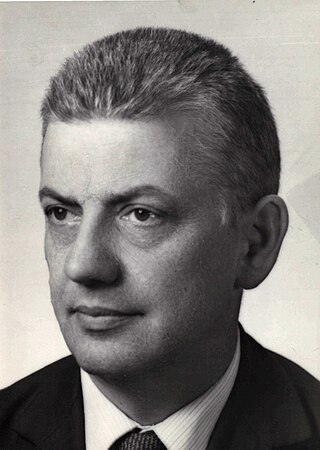
Henryk Zieliński was a Polish historian and professor at the University of Wrocław.

The Kraków pogrom was the first anti-Jewish riot in post World War II Poland, that took place on 11 August 1945 in the Soviet-occupied city of Kraków, Poland. The incident was part of anti-Jewish violence in Poland towards and after the end of World War II. The immediate cause of the pogrom was a blood libel rumour of a ritual murder of Polish children by Jews in the city. A false allegation that a child had been abducted by a Jewish woman had grown to allegations that Jews had killed up to 80 children over the course of weeks. These allegations led to attacks on Jews, as well as some Poles mistaken for Jews, in the Kazimierz quarter, and other parts of the Old Town, and the burning of the Kupa Synagogue. At least one person was killed and an unknown number were injured.

Stanisław Marian Kutrzeba (1876–1946) was a Polish historian and politician who was Professor of the Jagiellonian University from 1908, and then until the end of his life the Chair of Studies in Polish law. He was chair of the Law Department, university's rector (1932/33), General Secretary of Polish Academy of Learning (1926–39) and its president (1939–1946). He was one of many professors of Jagiellonian University arrested by Nazis during Sonderaktion Krakau in 1939. After being freed in 1940, he took part in the underground education. In 1945, he was deputy to the State National Council.

Idzi Jan Panic is a Polish historian, professor at the University of Silesia. He is specializing in history of Cieszyn Silesia and medieval Poland.

Grzegorz Motyka is a Polish historian and author specializing in the history of Poland–Ukraine relations. Since 1992 he served at the Institute of Political Studies of the Polish Academy of Sciences and at the Institute of National Remembrance.
Henryk Kocój was a Polish historian. Professor of the Silesian University, he specialised in the Polish history of the 17th and 18th century, in particular, the history of the Constitution of 3 May, Great Sejm, and the partitions of Poland.
Stanisław Salmonowicz was a Polish historian, professor of the Nicolaus Copernicus University in Toruń, and a member of the Polish Academy of Learning and History Institute of the Polish Academy of Sciences.

Maria of Bytom was a Queen of Hungary by marriage to Charles I of Hungary.
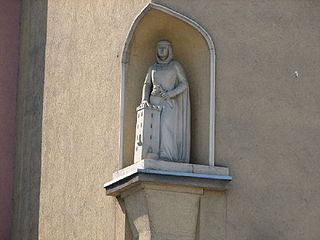
Constance was a Polish princess from the House of Piast and sovereign Duchess of Wodzisław Śląski from 1324 until her death.
Roman Grodecki, Poraj coat of arms, was a Polish economic historian, a professor at the Jagiellonian University in Kraków, and a member of the Polish Academy of Arts and Sciences.
Emanuel Mateusz Rostworowski was a Polish historian, professor at Kraków's Jagiellonian University, and member of the Polish Academy of Sciences.
Jan Jacek Bruski is a Polish historian. His specialization is a history of 20th Century.
KrzysztofKościelniak – a Catholic priest, full Professor of History. Currently, a full professor at the Jagiellonian University, 1994-2021 the researcher and lecturer at the John Paul II Pontifical Academy (UPJPII) in Kraków and in the Seminary of the Pauline Fathers in Kraków.
Władysław Andrzej Serczyk (1935-2014) was a Polish historian-Ukrainist. Born in Krakow, he after graduating Jagiellonian University stayed in the university and began his scientific career. In 1963, he received his doctorate and in 1968 Serczyk received his habilitation. Since 1976 he was a professor. In 1974-1978, Serczyk was a director of Jagiellonian Library. In 1986-1996, he headed a branch of University of Warsaw in Bialystok, Institute of History of Eastern Europe.

Krzysztof Zbigniew Bojko is a Polish diplomat, ambassador to Jordan (2012–2016) and Mongolia.

Benedykt Zientara was a Polish historian.

Saint Luke painting the Virgin is a c.1510 International Gothic limewood relief sculpture, probably carved by Jakub Beinhart and now in the National Museum, Warsaw. It is the only surviving fragment of an altarpiece for the painters' guild chapel in St Mary Magdalene Church, Wrocław, formerly forming its central panel.
Michał Tymowski is a Polish historian, professor of the humanities and an academic at the University of Warsaw. He specialises in the history of Africa.
Jerzy Jarzębski was a Polish literary historian and critic, a long time professor at the Jagiellonian University.

