
A cruiser is a type of warship. Modern cruisers are generally the largest ships in a fleet after aircraft carriers and amphibious assault ships, and can usually perform several roles.
Six ships of the Royal Navy have been named HMS Indefatigable:

Akagi (赤城) was a steel-hulled, steam gunboat, serving in the early Imperial Japanese Navy. She was the fourth and final vessel to be completed in the four-vessel Maya class and was named after Mount Akagi in Gunma Prefecture.

Takao (高雄) was the lead vessel in the Takao-class heavy cruisers, active in World War II with the Imperial Japanese Navy. These were the largest cruisers in the Japanese fleet, and were intended to form the backbone of a multipurpose long-range strike force. Her sister ships were Atago, Maya and Chōkai.
Ten ships of the Royal Navy have been named HMS Pandora after the mythological Pandora. Another was planned, but the name was reassigned to another ship:

USS Pillsbury (DD-227) was a Clemson-class destroyer of the United States Navy that served during World War II and the first of two ships named after John E. Pillsbury, a Rear Admiral in the United States Navy. She was sunk by Japanese cruisers, approximately 200 miles east of Christmas Island on or around 2 March 1942 with all hands, one of two major American surface warships lost in World War II with no survivors.
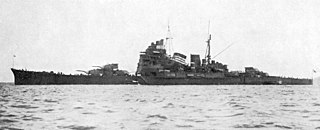
The Takao-class cruiser (高雄型) was a class of four heavy cruisers of the Imperial Japanese Navy (IJN) launched between May 1930 and April 1931. They all served during World War II.

Atago (愛宕) was the second vessel in the Takao-class heavy cruisers, active in World War II with the Imperial Japanese Navy (IJN). These were among the largest and most modern cruisers in the Japanese fleet, designed with the intention to form the backbone of a multipurpose long-range strike force. Her sister ships were Takao, Maya and Chōkai.

Maya (摩耶) was one of four Takao-class heavy cruisers, active in World War II with the Imperial Japanese Navy (IJN). These were the largest and most modern cruisers in the Japanese fleet, and were intended to form the backbone of a multipurpose long-range strike force. These ships were fast, powerful and heavily armed, with enough firepower to hold their own against any cruiser in any other navy in the world. Her sister ships were Takao, Atago and Chōkai.
Ibuki may refer to one of the following ships of the Imperial Japanese Navy named after Mount Ibuki:

Kure Naval Arsenal was one of four principal naval shipyards owned and operated by the Imperial Japanese Navy.

The Amagi class was a series of four battlecruisers planned for the Imperial Japanese Navy (IJN) as part of the Eight-eight fleet in the early 1920s. The ships were to be named Amagi, Akagi, Atago, and Takao. The Amagi design was essentially a lengthened version of the Tosa-class battleship, but with a thinner armored belt and deck, a more powerful propulsion system, and a modified secondary armament arrangement. They were to have carried the same main battery of ten 41 cm (16.1 in) guns and been capable of a top speed of 30 knots.

Atago (愛宕) was a composite hulled, steam gunboat, serving in the early Imperial Japanese Navy. She was the third vessel to be completed in the four vessel Maya class, and was named after Mount Atago in Kyoto.

Chōkai (鳥海) was an iron-hulled, steam gunboat, serving in the early Imperial Japanese Navy. She was the second vessel to be completed in the four vessel Maya class, and was named after Mount Chōkai in between Yamagata and Akita Prefectures.
Three ships of the Japanese Navy have been named Hashidate:
At least three warships of Japan have borne the name Maya:
This page is based on this
Wikipedia article Text is available under the
CC BY-SA 4.0 license; additional terms may apply.
Images, videos and audio are available under their respective licenses.

