
Bezique or bésigue is a 19th-century French melding and trick-taking card game for two players, which was imported to Britain and is still played today. The game is derived from piquet, possibly via marriage (sixty-six) and briscan, with additional scoring features, notably the peculiar liaison of the Q♠ and J♦ that is also a feature of pinochle, Binokel, and similarly named games that vary by country.

Ambigu is an historical French vying game, composed of the characteristic elements of Whist, Bouillotte and Piquet. A Whist pack with the court cards removed is used, and from two to six persons may play. Each player is given an equal number of counters, and a limit of betting is agreed upon.
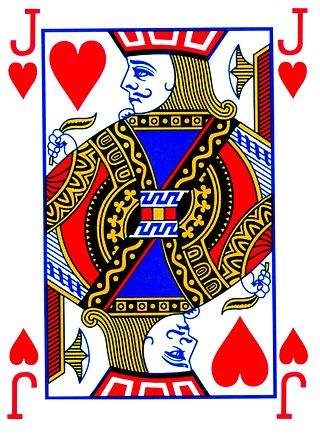
Reversis, or more rarely Réversi, is a very old trick-taking card game in the Hearts family. Its origin is uncertain, but it may have emerged in Italy before spreading to Spain and France. It is considered one of the two probable ancestors of Hearts, Black Lady and Black Maria, the other being Coquimbert or Coquinbert. It was very popular with the French aristocracy in the 17th and 18th centuries, and much played elsewhere, except in Britain. Initially quite simple, the game eventually developed more complex mechanics such as vast quantities of counters and a system of pools and side-payments. Its name may have possibly come from the reverse order and construction of the game itself, or even from its exceptional slam which, like "shooting the moon" in Black Lady, reverses the entire aim of the game.
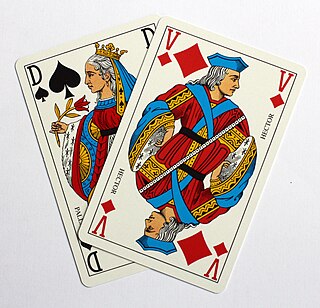
Marjolet is a French 6-card trick-and-draw game for two players using a 32-card piquet pack. It is of the Queen-Jack type, and thus a relative of Bezique and Pinochle, albeit simpler. The trump Jack is called the Marjolet from which the name of the game derives.

Tippen, also known as Dreiblatt, Dreikart, Drei Karten, Dreekort, Kleinpréférence or Labet, is an historical German 3-card, plain-trick game which was popular as a gambling game for three or more players. The Danish version of the game was known as Trekort and more elaborate Swedish variants include Knack and Köpknack. It appears to be related to the English game of Three-Card Loo. It was banned as a gambling game in some places.

Bestia is an Italian card game. It is a gambling game and is similar to Briscola and Tressette. The word bestia means beast.

Aluette or Vache ("Cow") is an old, plain trick-taking card game that is played on the west coast of France. It is played by two teams, usually of four people, but sometimes also of six. It is unusual in using a unique pack of 48 Spanish playing cards and a system of signalling between playing partners. The French colloquial names for the game, jeu de la Vache or Vache, refer to the cow depicted on one of the cards.
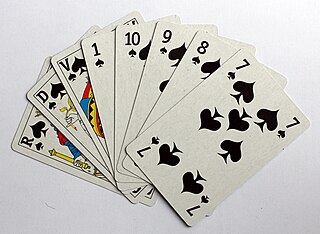
Triomphe, once known as French ruff, is a card game dating from the late 15th century. It most likely originated in France or Spain and later spread to the rest of Europe. When the game arrived in Italy, it shared a similar name with the pre-existing game and deck known as trionfi; probably resulting in the latter becoming renamed as Tarocchi (tarot). While trionfi has a fifth suit that acts as permanent trumps, triomphe randomly selects one of the existing four suits as trumps. Another common feature of this game is the robbing of the stock. Triomphe became so popular that during the 16th century the earlier game of trionfi was gradually renamed tarocchi, tarot, or tarock. This game is the origin of the English word "trump" and is the ancestor of many trick-taking games like Euchre and Whist. The earliest known description of Triomphe was of a point-trick game, perhaps one of the earliest of its type; later, the name was applied to a plain-trick game.

Mistigri, historically Pamphile, is an old, French, trick-taking card game for three or four players that has elements reminiscent of poker. It is a member of the Rams family of games and, although it is a gambling game, often played for small stakes, it is also suitable as a party game or as a family game with children from the age of 12 upwards.
Bester Bube, also Fiefkort mit 'n besten Buren, is an historical German card game for 3–6 players played with a Piquet pack. It is one of the Rams group of card games characterised by allowing players to drop out of the current game if they think they will be unable to win any tricks or a minimum number of tricks. It may be an ancestor of Five-Card Loo.
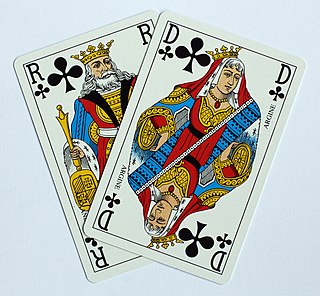
Briscan is an 18th-century, French ace–ten card game for two players played with a 32-card piquet pack. It is a member of the marriage group of games in which the 'marriage' of a king and queen brings a bonus score, but briscan takes this simple concept to extraordinary lengths.

Mouche, also known as Lanterlu, is an old, French, trick-taking card game for two to six players which has elements, such as bluffing, reminiscent of the much later game of poker. It is a member of the Rams family of games and, although it is a gambling game, often played for small stakes, it is also suitable as a party game or as a family game with children from the age of 12 upwards. It is named after the mouche, a term that variously refers to its winning hand, the basic stake and the penalty for failing to take any tricks. Although also called Bête, it should not be confused with the older game of that name from which it came and which, in turn, was a derivative of Triomphe.
Bête, la Bête, Beste or la Beste, originally known as Homme or l'Homme, was an old, French, trick-taking card game, usually for three to five players. It was a derivative of Triomphe created by introducing the concept of bidding. Its earlier name gives away its descent from the 16th-century Spanish game of Ombre. It is the "earliest recorded multi-player version of Triomphe".

The game of Nain Jaune or Yellow Dwarf, also formerly called Lindor, is an "attractive and unique traditional French card game" using a board comprising five compartments or boxes. It is a reasoned game of chance because it combines the hazards of card distribution with the strategy of building suits. Nain Jaune, which is considered a classic French game, is named after the seven of diamonds, which is depicted as a yellow dwarf in the centre of the game board.
Thierry Depaulis is an independent historian of games and especially of playing cards, card games, and board games. He is President of the association Le Vieux Papier, a member of the editorial board of the International Board Game Studies Association, and a member of the board of directors of the foundation of the Swiss Museum of Games. He was President of the International Playing-Card Society from 2017 to 2022.

Vieux garçon is a card game played with a standard 52-card pack from which the jack of clubs is removed. It is a game for two to eight players. It is of the same family as old maid and Black Peter.
Homme d'Auvergne is an historical French card game for two to five players dating to the 17th century. It is a derivative of Triomphe and ancestral to la Bête with which it gradually became almost identical over time. It was a source of inspiration for other games, such as Écarté.

Culbas or Cul-bas is an historical French card game of the fishing type for three to eight players that dates to at least the 17th century. It is described as being "very old" and having "a great simplicity in which chance plays the biggest role."

Gé, Point, Flux et Sequence, also called Les Quatre Jeux is an historical, French gambling, card game of the 17th and early 18th centuries.
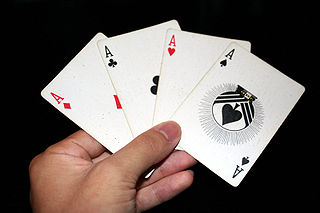
Romestecq is an historical Dutch card game for two, four or six players in two teams that dates to at least the 17th century. It was also popular in France for over a century. Despite being criticised in contemporary sources as "complicated" it continued to appear in the literature until the end of the 19th century and was sufficiently interesting for it to appear in The Penguin Book of Card Games in 2008.
