
Yiddish is a West Germanic language historically spoken by Ashkenazi Jews. It originates from the 9th century Central Europe, providing the nascent Ashkenazi community with a vernacular based on High German fused with many elements taken from Hebrew and to some extent Aramaic. Most varieties of Yiddish include elements of Slavic languages and the vocabulary contains traces of Romance languages. Yiddish has traditionally been written using the Hebrew alphabet; however, there are variations, including the standardized YIVO orthography that employs the Latin alphabet.
Separatism is the advocacy of cultural, ethnic, tribal, religious, racial, regional, governmental, or gender separation from the larger group. As with secession, separatism conventionally refers to full political separation. Groups simply seeking greater autonomy are usually not considered separatists. Some discourse settings equate separatism with religious segregation, racial segregation, or sex segregation, while other discourse settings take the broader view that separation by choice may serve useful purposes and is not the same as government-enforced segregation. There is some academic debate about this definition, and in particular how it relates to secessionism, as has been discussed online.

Simon Dubnow was a Jewish-Russian historian, writer and activist.

Yiddishism is a cultural and linguistic movement which began among Jews in Eastern Europe during the latter part of the 19th century. Some of the leading founders of this movement were Mendele Moykher-Sforim (1836–1917), I. L. Peretz (1852–1915), and Sholem Aleichem (1859–1916). The Yiddishist movement gained popularity alongside the growth of the Jewish Labor Bund and other Jewish political movements, particularly in the Russian Empire and United States. The movement also fluctuated throughout the 20th and 21st century because of the revival of the Hebrew language and the negative associations with the Yiddish language.
The Folkspartei was founded after the 1905 pogroms in the Russian Empire by Simon Dubnow and Israel Efrojkin. The party took part in several elections in Poland and Lithuania in the 1920s and 1930s and did not survive the Holocaust.
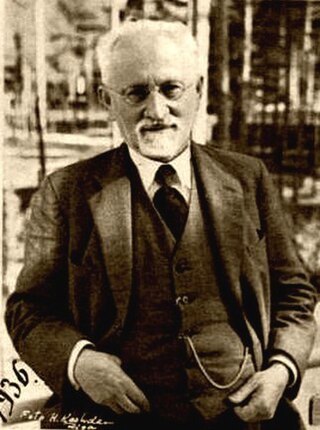
Jewish Autonomism, not connected to the contemporary political movement autonomism, was a non-Zionist political movement and ideology that emerged in the Russian and Austro-Hungarian empires, before spreading throughout Eastern Europe in the late 19th and early 20th century. In the late 19th century, Jewish Autonomism was seen "together with Zionism [as] the most important political expression of the Jewish people in the modern era." One of its first and major proponents was the historian and activist Simon Dubnow. Jewish Autonomism is often referred to as "Dubnovism" or "folkism".

The history of Jews in Sweden can be traced from the 17th century, when their presence is verified in the baptism records of the Stockholm Cathedral. Several Jewish families were baptised into the Lutheran Church, a requirement for permission to settle in Sweden. In 1681, for example, 28 members of the families of Israel Mandel and Moses Jacob were baptised in the Stockholm German Church in the presence of King Charles XI of Sweden, the dowager queen Hedvig Eleonora of Holstein-Gottorp, and several other high state officials.
There were several proposals for a Jewish state in the course of Jewish history between the destruction of ancient Israel and the founding of the modern State of Israel. While some of those have come into existence, others were never implemented. The Jewish national homeland usually refers to the State of Israel or the Land of Israel, depending on political and religious beliefs. Jews and their supporters, as well as their detractors and anti-Semites have put forth plans for Jewish states.

The Jewish Territorial Organisation, known as the ITO, was a Jewish political movement which first arose in 1903 in response to the British Uganda Scheme, but only institutionalized in 1905. Its main goal was to find an alternative territory to that of Palestine, which was preferred by the Zionist movement, for the creation of a Jewish homeland. The organization embraced what became known as Jewish Territorialism also known as Jewish Statism. The ITO was dissolved in 1925.
Non-Zionism is the political stance of Jews who are "willing to help support Jewish settlement in Palestine ... but will not come on aliyah."
The negation of the Diaspora is a central assumption in many currents of Zionism. The concept encourages the dedication to Zionism and it is used to justify the denial of the feasibility of Jewish emancipation in the Diaspora, arguing that Diasporic life leads either to discrimination and persecution or Jewish national decadence and assimilation. A more moderate formulation says that the Jews as a people have no future without a "spiritual center" in the Land of Israel.
The Jewish art music movement began at the end of the 19th century in Russia, with a group of Russian Jewish classical composers dedicated to preserving Jewish folk music and creating a new, characteristically Jewish genre of classical music. The music it produced used Western classical elements, featuring the rich chromatic harmonies of Russian late Romantic music, but with melodic, rhythmic and textual content taken from traditional Jewish folk or liturgical music. The group founded the St. Petersburg Society for Jewish Folk Music, a movement that spread to Moscow, Poland, Austria, and later Palestine and the United States. Although the original society existed formally for only 10 years, its impact on the course of Jewish music was profound. The society, and the art music movement it fostered, inspired a new interest in the music of Eastern European Jewry throughout Europe and America. It laid the foundations for the Jewish music and Klezmer revival in the United States, and was a key influence in the development of Israeli folk and classical music.

United Jewish Socialist Workers Party was a political party that emerged in Russia in the wake of the 1917 February Revolution. Members of the party along with the Poalei Zion participated in the government of Ukraine and condemned the October Revolution.
Zionist-Socialist Workers Party, often referred to simply as Zionist-Socialists or S.S. by their Russian initials, was a Jewish territorialist and socialist political party in the Russian Empire and Poland, that emerged from the Vozrozhdenie (Renaissance) group in 1904. The party held its founding conference in Odessa in 1905.

Benno or Beno Straucher was a Bukovina-born Austro-Hungarian lawyer, politician and Jewish community representative, who spent the final part of his career in Romania. A Jewish nationalist influenced by classical liberalism and Zionism, he first held political offices in Czernowitz city. After 1897, he was one of the noted Jewish representatives in the Austrian Parliament's upper chamber (Abgeordnetenhaus). Straucher, who was instrumental in creating the reformist Progressive Peasants' Fellowship, maintained his Abgeordnetenhaus seat throughout the remainder of Austria-Hungary's existence. From 1906, he led the Jewish National People's Party locally and helped establish the pan-Austrian Jewish National Party. He vied for political direction over the Bukovina Jews with several other groups, most notably the Zionist People's Council Party of Mayer Ebner, who became his personal rival.
Dos Abend Blatt was a Yiddish-language daily newspaper published in New York City, United States. Dos Abend Blatt was launched as an outgrowth of the weekly Di Arbeter Tsaytung. Published between 1894 and 1902, it was an organ of the Socialist Labor Party of America (SLP).

Bundism is a secular Jewish socialist movement whose first organizational manifestation was the General Jewish Labour Bund in Lithuania, Belarus, Poland, and Russia, founded in the Russian Empire in 1897.

The Jewish Socialist Workers Party, often nicknamed Seymists, was a Jewish socialist political party in the Russian Empire. The party was founded in April 1906, emerging out of the Vozrozhdenie (Renaissance) circles. The Vozrozhdenie was a non-Marxist tendency which was led by the nonmarxist thinker and politician Chaim Zhitlowsky. Zhitlowsky became the theoretician of the new party that advocated with the same emphasis Jewish self-reliance and socialism. Leaders of the party included Avrom Rozin (Ben-Adir), Nokhem Shtif, Moyshe Zilberfarb and Mark Ratner. The party was close to the Socialist-Revolutionary Party (PSR).

The Jewish left consists of Jews who identify with, or support, left-wing or left-liberal causes, consciously as Jews, either as individuals or through organizations. There is no one organization or movement which constitutes the Jewish left, however. Jews have been major forces in the history of the labor movement, the settlement house movement, the women's rights movement, anti-racist and anti-colonialist work, and anti-fascist and anti-capitalist organizations of many forms in Europe, the United States, Australia, Algeria, Iraq, Ethiopia, South Africa, and modern-day Israel. Jews have a history of involvement in anarchism, socialism, Marxism, and Western liberalism. Although the expression "on the left" covers a range of politics, many well-known figures "on the left" have been of Jews who were born into Jewish families and have various degrees of connection to Jewish communities, Jewish culture, Jewish tradition, or the Jewish religion in its many variants.

Golus nationalism, or diaspora nationalism, is a national movement of the Jewish people that argues for furthering Jewish national and cultural life in centers of large Jewish communities throughout the world while simultaneously seeking recognition for a Jewish national identity from world powers. The term golus has been understood to mean both "diaspora" and "exile."
