Chen Shou, courtesy name Chengzuo (承祚), was a Chinese historian, politician, and writer who lived during the Three Kingdoms period and Jin dynasty of China. Chen Shou is best known for his most celebrated work, the Records of the Three Kingdoms (Sanguozhi), which records the history of the late Eastern Han dynasty and the Three Kingdoms period. Chen Shou wrote the Sanguozhi primarily in the form of biographies of notable persons of those eras. Today, Chen's Records of the Three Kingdoms is part of the Twenty-Four Histories canon of Chinese history.

Yang is the transcription of a Chinese family name. It is the sixth most common surname in Mainland China. It is the 16th surname on the Hundred Family Surnames text.

Shi Jin is a fictional character in Water Margin, one of the Four Great Classical Novels in Chinese literature. Nicknamed "Nine-Tattoo Dragon", he ranks 23rd among the 36 Heavenly Spirits, the first third of the 108 Stars of Destiny.
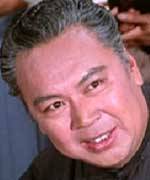
Lo Wei was a Hong Kong film director and film actor best known for launching the martial arts film careers of both Bruce Lee, in The Big Boss and Fist of Fury, and Jackie Chan, in New Fist of Fury.
Zhang Hua, courtesy name Maoxian, was a Chinese poet and politician of the Western Jin dynasty and the preceding state of Cao Wei. An accomplished poet, Zhang also authored the Bowuzhi, a compendium of entries about natural wonders and supernatural phenomena. His political career reached its zenith from 291 to 300, when he served as a leading minister during the de facto regency of Empress Jia Nanfeng. Zhang was considered an effective minister and, in conjunction with his colleague Pei Wei, helped ensure a period of relative stability within the Jin court. As the court fell into factional disputes from 299 to 300, Zhang rebuffed the rebellious overtures of the imperial relative Sima Lun and was executed when the latter seized power from the empress.

Hua Mei is a female giant panda. She is the first giant panda cub to survive to adulthood in the United States. She was born to Bai Yun (mother) and Shi Shi (father) at the San Diego Zoo. Millions of people around the world watched Hua Mei grow up via the zoo's Panda Cam.
Hua is a common transliteration for some Chinese surnames, of which the most common ones are 華/华 and 花. The Cantonese romanizations for 華 and 花 are Wah and Fa, respectively. 華, when pronounced in the fourth tone in Mandarin, is exclusively used in the name of Mount Hua and as a surname. The usual pronunciation of 華 is huá, which literally means "prosper" and is used as a reference to the Chinese people. On the other hand, 花 literally means "flower".

Three Kingdoms is a 2010 Chinese television series based on the events in the late Eastern Han dynasty and the Three Kingdoms period. The plot is adapted from the 14th century historical novel Romance of the Three Kingdoms and other stories about the Three Kingdoms period. Directed by Gao Xixi, the series had a budget of over 160 million RMB and took five years of pre-production work. Shooting of the series commenced in October 2008, and it was released in China in May 2010.
During the late Zhou dynasty, the inhabitants of the Central Plains began to make a distinction between Hua and Yi, referred to by some historians as the Sino–barbarian dichotomy. They defined themselves as part of cultural and political region known as Huaxia, which they contrasted with the surrounding regions home to outsiders, conventionally known as the Four Barbarians. Although Yi is usually translated as "barbarian", other translations of this term in English include "foreigners", "ordinary others", "wild tribes" and "uncivilized tribes". The Hua–Yi distinction asserted Chinese superiority, but implied that outsiders could become Hua by adopting their culture and customs. The Hua–Yi distinction was not unique to China, but was also applied by various Vietnamese, Japanese, and Koreans regimes, all of whom considered themselves at one point in history to be legitimate successors to the Chinese civilization and the "Central State" in imitation of China.

Yuè is the Hanyu Pinyin transliteration of the Chinese family name 岳. In places which use the Wade-Giles romanization such as Taiwan, Yue is usually spelled as "Yüeh" or "Yueh".
The Mount Hua Sect, also known as the Huashan Sect, is a non fictional martial arts sect mentioned in several works of wuxia fiction. It is commonly featured as one of the leading orthodox sects in the wulin. It is named after the place where it is based, Mount Hua. The sect appears in three of Jin Yong's novels.

King Flower is a 2013 Taiwanese comedy romance television series. It was produced by SETTV and started filming on November 26, 2012. It stars James Wen and Nikki Xie (謝欣穎). It was first aired on January 6, 2013 on TTV.

A Flower in a Sinful Sea is a novel by Jin Tianhe and Zeng Pu. First published in serial installments beginning in 1904, the work is a roman à clef. The work was partially translated to English by Rafe de Crespigny and Liu Ts'un-yan in 1982. It was also translated to French and Russian.

Orchideae is a tribe of orchids in the subfamily Orchidoideae. Historically, it was divided into 2 subtribes, Orchidinae and Habenariinae. The subtribe Orchidinae alone contains about 1,800 species. However, although some phylogenetic studies have established the monophyly of the subtribes, the generic boundaries are unclear, with many genera as traditionally circumscribed being paraphyletic or even polyphyletic. Species of genera such as Habenaria and Platanthera have been placed into both subtribes. A 2017 molecular phylogenetic study found that both subtribes did form clades, but did not formally recognize Habenariinae, because of missing genera and uncertainty over generic boundaries. The Asian species of Orchideae, in particular, have been subject to repeated changes of generic placement from 2012 onwards.

Five Golden Flowers is a 1959 Chinese romantic musical film directed by Wang Jiayi and produced by Changchun Film Studio. The screenplay was written by Zhao Jikang and Wang Gongpu. Set in the Dali City in Yunnan Province, the film is about a Bai ethnic youth, Ah Peng, searching for his beloved ethnic girl Jin Hua. Made during the Great Leap Forward, the film celebrates socialist construction and agricultural collectivization. The theme song of the film "By the Butterfly Spring," composed by musician Lei Zhenbang, was one of the most well-known folk songs in China. The film was produced and released in 1959. It received exuberant responses from audiences and was exported to 46 countries after its debut. During the Cultural Revolution, it was banned and attacked by Jiang Qing for promoting romanticism. In 1978, the film was re-released. At the Second Asian-African Film Festival in Cairo in 1960, the film won the best director and best actress awards. In the 2000 Changchun Film Festival, Five Golden Flowers won first place in the "Top 10 Chinese Films of the Century" selection.
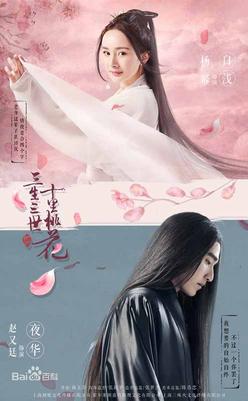
Eternal Love, also known as Three Lives, Three Worlds, Ten Miles of Peach Blossoms, is a 2017 Chinese television series starring Yang Mi and Mark Chao, directed by Lin Yufen. It is based on the xianxia novel of the same name from 2015 by Tang Qi Gong Zi. The series was broadcast on Zhejiang TV and Dragon TV from 30 January to 1 March 2017.

Phenuiviridae is a family of negative-strand RNA viruses in the order Bunyavirales. Ruminants, camels, humans, and mosquitoes serve as natural hosts. Member genus Phlebovirus is the only genus of the family that has viruses that cause disease in humans except Dabie bandavirus.

Sun Yueh was a Taiwanese actor.
Pú (蒲) is a Chinese surname.
