
Ceiba is a genus of trees in the family Malvaceae, native to tropical and subtropical areas of the Americas and tropical West Africa. Some species can grow to 70 m (230 ft) tall or more, with a straight, largely branchless trunk that culminates in a huge, spreading canopy, and buttress roots that can be taller than a grown person. The best-known, and most widely cultivated, species is Kapok, Ceiba pentandra, one of several trees called kapok.
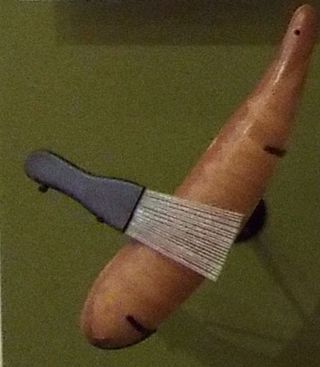
The güiro is a Puerto Rican percussion instrument consisting of an open-ended, hollow gourd with parallel notches cut in one side. It is played by rubbing a stick or tines along the notches to produce a ratchet sound.

The music of Puerto Rico has evolved as a heterogeneous and dynamic product of diverse cultural resources. The most conspicuous musical sources of Puerto Rico have included European, Indigenous, and African influences, although many aspects of Puerto Rican music reflect origins elsewhere in the Caribbean. Puerto Rican music culture today comprises a wide and rich variety of genres, ranging from essentially indigenous genres like bomba to recent hybrids like Latin trap and reggaeton. Broadly conceived, the realm of "Puerto Rican music" should naturally comprise the music culture of the millions of people of Puerto Rican descent who have lived in the United States, and especially in New York City. Their music, from salsa to the boleros of Rafael Hernández, cannot be separated from the music culture of Puerto Rico itself.

A shrunken head is a severed and specially prepared human head that is used for trophy, ritual, or trade purposes.
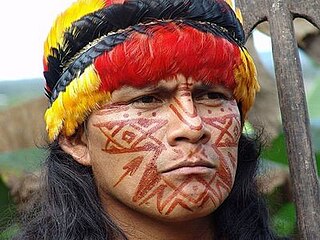
The Shuar are an Indigenous people of Ecuador and Peru. They are members of the Jivaroan peoples, who are Amazonian tribes living at the headwaters of the Marañón River.
At the time of first contact between Europe and the Americas, the indigenous peoples of the Caribbean included the Taíno of the northern Lesser Antilles, most of the Greater Antilles and the Bahamas, the Kalinago of the Lesser Antilles, the Ciguayo and Macorix of parts of Hispaniola, and the Guanahatabey of western Cuba. The Kalinago have maintained an identity as an indigenous people, with a reserved territory in Dominica.
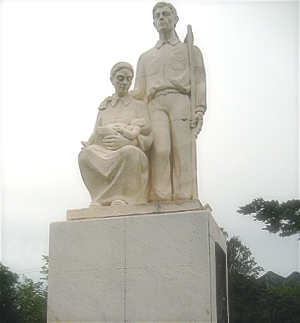
Jíbaro is a word used in Puerto Rico to refer to the countryside people who farm the land in a traditional way. The jíbaro is a self-subsistence farmer, and an iconic reflection of the Puerto Rican people. Traditional jíbaros were also farmer-salesmen who would grow enough crops to sell in the towns near their farms to purchase the bare necessities for their families, such as clothing.

The Chicham languages, also known as Jivaroan is a small language family of northern Peru and eastern Ecuador.
Shuar, which literally means "people", also known by such terms as Chiwaro, Jibaro, Jivaro, or Xivaro, is an indigenous language spoken by the Shuar people of Morona Santiago Province and Pastaza Province in the Ecuadorian Amazon basin.

Ilex guayusa is a species of tree of the holly genus, native to the Amazon Rainforest. One of four known caffeinated holly trees, the leaves of the guayusa tree are harvested fresh and brewed like a tea for their stimulative effects.
Lomas, also called fog oases and mist oases, are areas of fog-watered vegetation in the coastal desert of Peru and northern Chile.
Huambisa, Huambiza, Wambiza, Jíbaro, Xívaro, Wampis, Maina, or Shuar-Huampis is an indigenous language of the Huambisa people of Peru. Spanish colonizers first generated the name Xívaro in the late 16th century as a way of overgeneralizing several ethnicities of similar sociopolitical statuses within the region and referring to them as savages. It is an established language spoken in the extreme north of Peru. It is closely related to the Achuar-Shiwiar, Shuar, and Aguaruna languages, all of which belong to the Jivaroan language family. It has official standing in the area it is spoken.
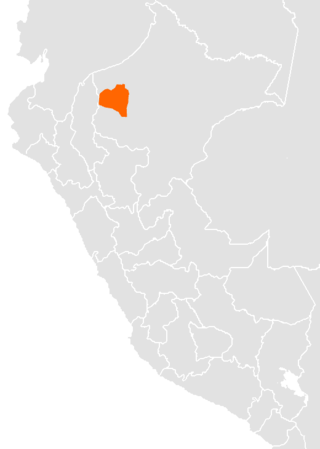
Candoshi-Shapra is an indigenous American language isolate, spoken by several thousand people in western South America along the Chapuli, Huitoyacu, Pastaza, and Morona river valleys. There are two dialects, Chapara and Kandoashi. It is an official language of Peru, like other native languages in the areas in which they are spoken and are the predominant language in use. Around 88.5 percent of the speakers are bilingual with Spanish. The literacy rate in Candoshi-Shapra is 10 to 30 percent and 15 to 25 percent in the second language Spanish. There is a Candoshi-Shapra dictionary, and grammar rules have been codified.
The Macro-Jibaro proposal, also known as (Macro-)Andean, is a language proposal of Morris Swadesh and other historical linguists. The two families, Jivaroan and Cahuapanan are most frequently linked, the isolates less often. Documentation of Urarina is underway as of 2006, but Puelche and Huarpe are extinct. Kaufman (1994) linked Huarpe instead to the Muran languages and Matanawi, but as of 1990 found the Jibaro–Cahuapanan connection plausible. It forms one part of his expanded 2007 suggestion for Macro-Andean.

The Jivaroan peoples are the indigenous peoples in the headwaters of the Marañon River and its tributaries, in northern Peru and eastern Ecuador. The tribes speak the Chicham languages.
Shiwiar, also known as Achuar, Jivaro and Maina, is a Chicham language spoken along the Pastaza and Bobonaza rivers in Ecuador. Shiwiar is one of the thirteen indigenous languages of Ecuador. All of these indigenous languages are endangered.
The Intercontinental Dictionary Series is a large database of topical vocabulary lists in various world languages. The general editor of the database is Bernard Comrie of the Max Planck Institute for Evolutionary Anthropology, Leipzig. Mary Ritchie Key of the University of California, Irvine is the founding editor. The database has an especially large selection of indigenous South American languages and Northeast Caucasian languages.

The Marañón River basin, at a low point in the Andes which made it an attractive location for trade between the Inca Empire and the Amazon basin, once harbored numerous languages which have been poorly attested or not attested at all. Those of the middle reaches of the river, above the Amazon basin, were replaced in historical times by Aguaruna, a Jivaroan language from the Amazon which is still spoken there. The languages further upriver are difficult to identify, due to lack of data. The region was multilingual at the time of the Conquest, and the people largely switched to Spanish rather than to Quechua, though Quechua also expanded during Colonial times.
Christian Nieves is a Puerto Rican cuatro player. Although having been playing with his father for most of his life, Nieves is mostly known for been a performer in the American reality television series Q'Viva!: The Chosen, where his performance became famous for bringing singer Jennifer Lopez to tears who considered the melody very emotional.
