
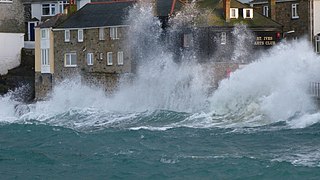
St Ives is a seaside town, civil parish and port in Cornwall, England, United Kingdom. The town lies north of Penzance and west of Camborne on the coast of the Celtic Sea. In former times, it was commercially dependent on fishing. The decline in fishing, however, caused a shift in commercial emphasis, and the town is now primarily a popular seaside resort, notably achieving the title of Best UK Seaside Town from the British Travel Awards in both 2010 and 2011. St Ives was incorporated by Royal Charter in 1639. St Ives has become renowned for its number of artists. It was named best seaside town of 2007 by The Guardian newspaper.

Bernard Howell Leach was a British studio potter and art teacher. He is regarded as the "Father of British studio pottery".

Shōji Hamada was a Japanese potter. He had a significant influence on studio pottery of the twentieth century, and a major figure of the mingei (folk-art) movement, establishing the town of Mashiko as a world-renowned pottery centre. In 1955 he was designated a "Living National Treasure".

Studio pottery is pottery made by professional and amateur artists or artisans working alone or in small groups, making unique items or short runs. Typically, all stages of manufacture are carried out by the artists themselves. Studio pottery includes functional wares such as tableware and cookware, and non-functional wares such as sculpture, with vases and bowls covering the middle ground, often being used only for display. Studio potters can be referred to as ceramic artists, ceramists, ceramicists or as an artist who uses clay as a medium.

Hans Coper was an influential German-born British studio potter. His work is often coupled with that of Lucie Rie due to their close association, even though their best known work differs dramatically, with Rie's being less sculptural, while Coper's was much more abstract, but also always functional. The latter point was noted by M. S. Thomas in his recent book "The Essential Potness." Coper always made functional vessels, principally containers for flowers (vases), fruit (bowls), candles including work for Coventry Cathedral and Sussex University meeting house. He made a small group of Figures in the fifties, which were not vessels and were never put on sale.

Dame Lucie Rie, was an Austrian-born, independent, British studio potter working in a time when most ceramicists were male. She is known for her extensive technical knowledge, her meticulously detailed experimentation with glazes and with firing and her unusual decorative techniques.

Michael Ambrose Cardew (1901–1983), was an English studio potter who worked in West Africa for twenty years.
William "Bill" Marshall was an English studio potter, known for his Japan-influenced style.

Frans Wildenhain also known as Franz Rudolf Wildenhain was a Bauhaus-trained German potter and sculptor, who taught for many years at the School for American Craftsmen at the Rochester Institute of Technology in Rochester, New York.

Gwyn Hanssen Pigott OAM (1935–2013) was an Australian ceramic artist. She was recognized as one of Australia’s most significant contemporary artists. By the time she died she was regarded as "one of the world's greatest contemporary potters". She worked in Australia, England, Europe, the US, New Zealand, Japan and Korea. In a career spanning nearly 60 years, influences from her apprenticeships to English potters were still apparent in her later work. But in the 1980s she turned away from production pottery to making porcelain still-life groups largely influenced by the Italian painter Giorgio Morandi.
The St Ives School refers to a group of artists living and working in the Cornish town of St Ives. The term is often used to refer to the 20th century groups which sprung up after the First World War around such artists as Borlase Smart, however there was considerable artistic activity there from the late 19th Century onwards.
Janet Darnell Leach, was an American studio potter working in later life at the Leach Pottery in St Ives, Cornwall in England. After studying pottery at Black Mountain, North Carolina under Shoji Hamada, a visiting artisan, she traveled to Japan to work with him. She studied with him for two years and always considered him to be her principal mentor. She was the first foreign woman to study pottery in Japan and only the second westerner.
John Maltby was a distinguished English sculptor and studio potter.
Clive Bowen is a Devon based potter whose work is included in a number of public collections.

Ray Finch MBE, formally Alfred Raymond Finch, was an English studio potter who worked at Winchcombe Pottery for a period spanning seventy-five years.
Jack Doherty is a Northern Irish studio potter and author. He is perhaps best known for his vessels made of soda-fired porcelain. He has been featured in a number of books, and his work has been exhibited widely in both Europe and North America. Articles of his have appeared in various pottery journals and he has been Chair of the Craft Potters Association.
Byron Temple (1933–2002) was an American potter.
Robin Welch was a studio potter.
John Reeve was a Canadian studio potter.

Richard Hugh Neville Batterham was a British potter.
