See also
 | This disambiguation page lists articles about people with the same name. If an internal link led you here, you may wish to change the link to point directly to the intended article. |
Joseph Cruess Callaghan was an Irish flying ace.
Joseph Callaghan may also refer to:
| | This disambiguation page lists articles about people with the same name. If an internal link led you here, you may wish to change the link to point directly to the intended article. |
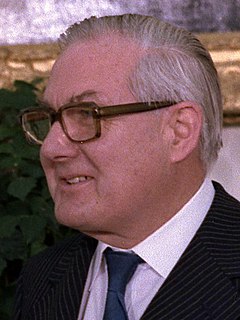
Leonard James "Jim" Callaghan, Baron Callaghan of Cardiff, was a British politician who served as Prime Minister of the United Kingdom from 1976 to 1979 and Leader of the Labour Party from 1976 to 1980. To date, Callaghan remains the only person to have held all four Great Offices of State, having served as Chancellor of the Exchequer (1964–1967), Home Secretary (1967–1970) and Foreign Secretary (1974–1976) prior to his appointment as Prime Minister. As Prime Minister, he had some successes, but is mainly remembered for the "Winter of Discontent" of 1978–79. During a very cold winter, his battle with trade unions led to immense strikes that seriously inconvenienced the public, leading to his defeat in the polls by Conservative leader Margaret Thatcher.

Louis-Joseph Papineau, born in Montreal, Quebec, was a politician, lawyer, and the landlord of the seigneurie de la Petite-Nation. He was the leader of the reformist Patriote movement before the Lower Canada Rebellion of 1837–1838. His father was Joseph Papineau, also a politician in Quebec. Papineau was the eldest of eight children and was the grandfather of the journalist Henri Bourassa, founder of the newspaper Le Devoir. The Papineau metro station in Montreal was named after him.

Edmund Bailey O'Callaghan, was a doctor and journalist.
O'Callaghan or simply Callaghan without the prefix is an Irish surname. Often when Irish emigrated to the United States the "g" was removed from the spelling in ships' manifests.
Sean O'Callaghan was a member of the Provisional Irish Republican Army (IRA), who from the late 1970s to the mid-1980s worked against the organisation from within as an intelligence agent for the Irish Government with the Garda Síochána's Special Branch.

USS Callaghan (DD-792), a Fletcher-class destroyer, was a ship of the United States Navy named for Rear Admiral Daniel J. Callaghan (1890–1942), who was killed in action in the Naval Battle of Guadalcanal and posthumously awarded the Medal of Honor for heroism during the action.
Callaghan Lake Provincial Park is a provincial park in British Columbia, Canada, located in the upper Callaghan Valley to the west of the resort town of Whistler. The dormant volcano Mount Callaghan overlooks the lake on its north side, while just to the south of the park is the sliding events facility for the 2010 Olympics. Callaghan Lake was to be the site of the base village for a proposed ski resort, Powder Mountain Resort, but the project never went through due to alleged interference by William Vander Zalm and others in the then-Social Credit government.

The West Virginia 2nd congressional district election for the 110th Congress was held on November 7, 2006. Incumbent Shelley Moore Capito was the nominee for the Republican Party; attorney Mike Callaghan was the nominee for the Democratic Party. Capito won with 57% of the vote to 43% for Callaghan.
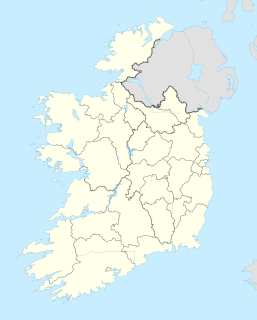
O'Callaghan's Mills is a village in County Clare, Ireland, and a Catholic parish by the same name. It takes its name from the O'Callaghan family who were large landowners in the area and a corn and grist mill built by John Coonan on the lands of Cornelius O'Callaghan in 1772. The community sustains a regular senior Gaelic Athletic Association hurling panel team with county championship achievements at under-age, junior and senior levels.
Major Joseph Cruess Callaghan was an Irish World War I flying ace credited with five aerial victories.
Frederick John Callaghan is an English retired professional football left back, who made over 290 appearances in the Football League for Fulham. As a player, he was described as "a tough-tackling defender who was not averse to crunching tackles and the occasional overlap down the flank". After retiring as a player, Callaghan became a manager and coach, most notably in the Football League with Brentford. He had a long career managing and coaching in non-league football.
The J. Pius Callaghan Cup is a trophy that was formerly given to the ice hockey Junior A Champion of Atlantic Canada from 1981 until 1991. The trophy is named for Joseph Pius Callaghan, sports writer for the Charlottetown Guardian, school teacher, and sports executive, by Hockey PEI. From 1991 until 2006, the trophy was awarded to the playoff champion of the Maritime Junior A Hockey League. In 2006 it was retired and now resides in the Charlottetown Civic Centre. Prior to 1981, the championship was just called the Atlantic Junior A Championship.
The Siege of Santarém, lasted from June 1184 to July 1184. In the spring of 1184, Abu Yaqub Yusuf assembled an army, crossed the straits of Gibraltar and marched to Seville. From there he marched towards Badajoz and headed west to besiege Santarém, which was defended by Afonso I of Portugal. Upon hearing of Abu Yusuf's attack, Ferdinand II of León marched his troops to Santarém to support his father-in-law, Afonso I.

The Siege of Seville was a 16-month successful investment during the Reconquista of Seville by forces of Ferdinand III of Castile. Although perhaps eclipsed in geopolitical importance by the rapid capture of Córdoba in 1236, which sent a shockwave through the Muslim world, the Siege of Seville was nonetheless the most complex military operation undertaken by Fernando III. It is also the last major operation of the Early Reconquista. The operation also marked the appearance of indigenous naval forces of Castile-León of military significance. In effect, Ramón de Bonifaz was the first admiral of Castile, although he never held an official title of that kind.
John O'Callaghan may refer to:
The Siege of Jerez by King Alfonso X of Castile took place in 1261, probably in the late spring or early summer. It resulted in the incorporation of Jerez de la Frontera into the Crown of Castile.
The 1979 Dissolution Honours List was issued in June 1979 following the general election of that year.
The 2017 Clare Senior Hurling Championship will be the 119th staging of the Clare Senior Hurling Championship since its establishment by the Clare County Board in 1887.

The Mudéjar revolt of 1264–1266 was a rebellion by the Muslim populations (Mudéjares) in the Lower Andalusia and Murcia regions of the Crown of Castile. The rebellion was in response to Castile's policy of relocating Muslim populations from these regions and was partially instigated by Muhammad I of Granada. The rebels were aided by the independent Emirate of Granada, while the Castilians were allied with Aragon. Early in the uprising, the rebels managed to capture Murcia and Jerez, as well as several smaller towns, but were eventually defeated by the royal forces. Subsequently, Castile expelled the Muslim populations of the reconquered territories and encouraged Christians from elsewhere to settle their lands. Granada became a vassal of Castile and paid an annual tribute.
The Siege of Almería was an unsuccessful attempt by Aragon to capture the city of Almería from the Emirate of Granada in 1309. The city defenders repelled multiple assaults, and by the end of December James II of Aragon, who personally led the siege, asked for a truce and subsequently withdrew from Granadan territory.