
The House of Habsburg, also officially called the House of Austria, was one of the most influential and distinguished royal houses of Europe. The throne of the Holy Roman Empire was continuously occupied by the Habsburgs from 1438 until their extinction in the male line in 1740. The house also produced kings of Bohemia, Hungary, Croatia, Galicia, Portugal and Spain with their respective colonies, as well as rulers of several principalities in the Netherlands and Italy. From the 16th century, following the reign of Charles V, the dynasty was split between its Austrian and Spanish branches. Although they ruled distinct territories, they nevertheless maintained close relations and frequently intermarried.

Franz Joseph I or Francis Joseph I was Emperor of Austria, King of Hungary, King of Bohemia, and monarch of many other states of the Austro-Hungarian Empire, from 2 December 1848 to his death. From 1 May 1850 to 24 August 1866 he was also President of the German Confederation. He was the longest-reigning Emperor of Austria and King of Hungary, as well as the third-longest-reigning monarch of any country in European history, after Louis XIV of France and Johann II of Liechtenstein.
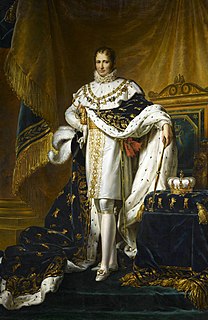
Joseph-Napoléon Bonaparte, Comte de Survilliers, born Giuseppe di Buonaparte, was a French lawyer and diplomat, the older brother of Napoleon Bonaparte, who made him King of Naples and Sicily, and later King of Spain. After the fall of Napoleon, Joseph styled himself Comte de Survilliers.

Ferdinand III was Holy Roman Emperor from 15 February 1637 until his death, as well as King of Hungary and Croatia, King of Bohemia and Archduke of Austria.
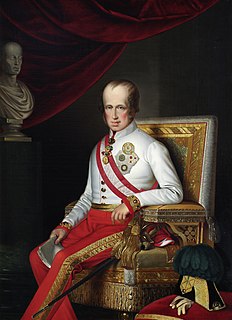
Ferdinand I was the Emperor of Austria from 1835 until his abdication in 1848. As ruler of Austria, he was also President of the German Confederation, King of Hungary, Croatia and Bohemia, King of Lombardy–Venetia and holder of many other lesser titles. Due to his rocky, passive but good-intended character, he gained the sobriquet The Benign or The Good.
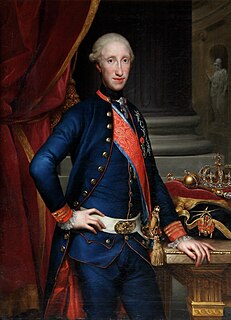
Ferdinand I, was the King of the Two Sicilies from 1816, after his restoration following victory in the Napoleonic Wars. Before that he had been, since 1759, Ferdinand IV of the Kingdom of Naples and Ferdinand III of the Kingdom of Sicily. He was also King of Gozo. He was deposed twice from the throne of Naples: once by the revolutionary Parthenopean Republic for six months in 1799 and again by Napoleon Bonaparte in 1805.

The Kingdom of Naples, officially known as the Kingdom of Sicily, comprised that part of the Italian Peninsula south of the Papal States between 1282 and 1816. It was established by the War of the Sicilian Vespers (1282–1302), when the island of Sicily revolted and was conquered by the Crown of Aragon, becoming a separate kingdom also called the Kingdom of Sicily. For much of its existence, the realm was contested between French and Spanish dynasties. In 1816, it reunified with the island of Sicily to form the Kingdom of the Two Sicilies.

The Imperial Crypt, also called the Capuchin Crypt (Kapuzinergruft), is a burial chamber beneath the Capuchin Church and monastery in Vienna, Austria. It was founded in 1618 and dedicated in 1632, and located on the Neuer Markt square of the Innere Stadt, near the Hofburg Palace. Since 1633, the Imperial Crypt serves as the principal place of entombment for the members of the House of Habsburg. The bones of 145 Habsburg royalty, plus urns containing the hearts or cremated remains of four others, are here, including 12 emperors and 18 empresses. The visible 107 metal sarcophagi and five heart urns range in style from puritan plain to exuberant rococo. Some of the dozen resident Capuchin friars continue their customary role as the guardians and caretakers of the crypt, along with their other pastoral work in Vienna. The most recent entombment was in 2011.150

Habsburg Monarchy is an umbrella term used by historians for the lands and kingdoms of the House of Habsburg, especially for those of the Austrian branch. Although from 1438 until 1806 the head of the House of Habsburg was also Holy Roman Emperor, the Empire itself is not considered a part of the Habsburg Monarchy.

Ferdinand Brucker was a politician from the U.S. state of Michigan.
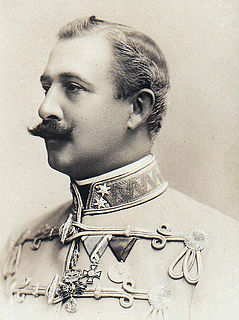
Archduke Otto Franz Joseph Karl Ludwig Maria of Austria was the second son of Archduke Karl Ludwig of Austria and his second wife, Princess Maria Annunciata of Bourbon-Two Sicilies. He was the father of Charles I of Austria, the last Emperor of Austria.

Archduke Ferdinand Karl of Austria-Este was a son of Holy Roman Emperor Franz I and Maria Theresa of Austria. He was the founder of the House of Austria-Este and Governor of the Duchy of Milan between 1765 and 1796. He was also designated as the heir to the Duchy of Modena and Reggio, but he never reigned, owing to the Napoleonic Wars.

Archduchess Elisabeth Franziska Maria of Austria was born in Ofen (Buda), Hungary, the daughter of Palatine Joseph of Hungary (1776–1847) and his third wife Maria Dorothea of Württemberg (1797–1855).

Archduke Ferdinand Karl Joseph of Austria-Este was the third son of Archduke Ferdinand of Austria-Este and of his wife Princess Maria Beatrice Ricciarda d'Este, last member and heiress of the House of Este. For much of the Napoleonic Wars he was in command of the Austrian army.

Archduke Joseph Ferdinand of Austria was an Austro-Hungarian Archduke and the titular Grand Duke of Tuscany from 17 January 1908 to 2 May 1921, military commander, from 1916 Generaloberst, and early advocate of air power. He later retired to life as a common citizen of Austria, and was briefly imprisoned in Dachau during the Nazi era.

Archduke Franz Ferdinand Carl Ludwig Joseph Maria of Austria was the heir presumptive to the throne of Austria-Hungary. His assassination in Sarajevo precipitated Austria-Hungary's declaration of war against Serbia, which in turn triggered a series of events that eventually led to Austria-Hungary's allies and Serbia's declaring war on each other, starting World War I.

Archduke Karl Ferdinand of Austria was the second son of Archduke Charles, Duke of Teschen (1771–1847) and Princess Henrietta of Nassau-Weilburg, and the maternal grandfather of King Alfonso XIII of Spain.
The Abdications of Bayonne is the name given to a series of forced abdications of the Kings of Spain that led to what the Spanish-speaking world calls the Guerra de la Independencia Española (1808–1814), which overlaps with the Peninsular War. The failed El Escorial Conspiracy preceded the Mutiny of Aranjuez, which forced King Charles IV to abdicate the throne to his son Ferdinand VII in 1808 by order of the Spanish Royal Council. Ferdinand VII also abdicated later that year.

Alexander Ferdinand, 3rd Prince of Thurn and Taxis, full German name: Alexander Ferdinand Fürst von Thurn und Taxis was the third Prince of Thurn and Taxis, Postmaster General of the Imperial Reichspost, and Head of the Princely House of Thurn and Taxis from 8 November 1739 until his death on 17 March 1773. Alexander Ferdinand served as Principal Commissioner at the Perpetual Imperial Diet in Frankfurt am Main and Regensburg for Charles VII, Holy Roman Emperor, Francis I, Holy Roman Emperor, and Joseph II, Holy Roman Emperor from 1 February 1743 to 1745 and again from 1748 until 1773.
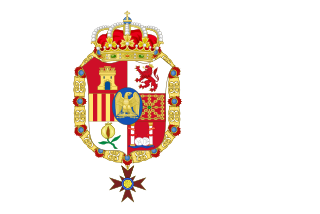
Napoleonic Spain was the part of Spain loyal to Joseph I during the Peninsular War (1808–1813) after the country was partially occupied by French forces. During this period, the country was considered a client state of the First French Empire.
