
An associate justice of the Supreme Court of the United States is any member of the Supreme Court of the United States other than the chief justice of the United States. The number of associate justices is eight, as set by the Judiciary Act of 1869.
The Supreme Court of the United States (SCOTUS) is the highest court in the federal judiciary of the United States of America. It has ultimate appellate jurisdiction over all federal and state court cases that involve a point of federal law, and original jurisdiction over a narrow range of cases, specifically "all Cases affecting Ambassadors, other public Ministers and Consuls, and those in which a State shall be Party". The Court holds the power of judicial review, the ability to invalidate a statute for violating a provision of the Constitution. It is also able to strike down presidential directives for violating either the Constitution or statutory law. However, it may act only within the context of a case in an area of law over which it has jurisdiction. The Court may decide cases having political overtones, but it has ruled that it does not have power to decide non-justiciable political questions.
The chief justice of the United States is the chief judge of the Supreme Court of the United States and the highest-ranking officer of the U.S. federal judiciary. Article II, Section 2, Clause 2 of the U.S. Constitution grants plenary power to the president of the United States to nominate, and with the advice and consent of the United States Senate, appoint "Judges of the supreme Court", who serve until they resign, retire, are impeached and convicted, or die. The existence of a chief justice is explicit in Article One, Section 3, Clause 6 which states that the chief justice shall preside on the impeachment trial of the president.

A judge is a person who presides over court proceedings, either alone or as a part of a panel of judges. The powers, functions, method of appointment, discipline, and training of judges vary widely across different jurisdictions. The judge is supposed to conduct the trial impartially and, typically, in an open court. The judge hears all the witnesses and any other evidence presented by the barristers or solicitors of the case, assesses the credibility and arguments of the parties, and then issues a ruling on the matter at hand based on their interpretation of the law and their own personal judgment. In some jurisdictions, the judge's powers may be shared with a jury. In inquisitorial systems of criminal investigation, a judge might also be an examining magistrate. The presiding judge ensures that all court proceedings are lawful and orderly.

John Paul Stevens was an American lawyer and jurist who served as an associate justice of the United States Supreme Court from 1975 until his voluntary retirement in 2010. At the time of his retirement, he was the second-oldest-serving justice in the history of the court and the third-longest-serving justice. At the time of his death, he was the longest lived Supreme Court justice ever. His long tenure saw him write for the court on most issues of American law, including civil liberties, death penalty, government action and intellectual property. In cases involving presidents of the United States, he wrote for the court that they were to be held accountable under American law. A registered Republican when appointed who throughout his life identified as a conservative, Stevens was considered to have been on the liberal side of the court at the time of his retirement.
Associate justice or associate judge is the title for a member of a judicial panel who is not the chief justice in some jurisdictions. The title "Associate Justice" is used for members of the Supreme Court of the United States and some state supreme courts, and for some other courts in Commonwealth of Nations countries, as well as for members of the Supreme Court of the Federated States of Micronesia, a former United States Trust Territory. In other common law jurisdictions, the equivalent position is called "Puisne Justice".

High court usually refers to the superior court of a country or state. In some countries, it is the highest court. In others, it is positioned lower in the hierarchy of courts. A person who presides as a judge in such a court may be called a 'High Court judge'.

The Supreme Court of California is the highest and final court in the courts of the State of California. It resides inside the Earl Warren Building in San Francisco, overlooking Civic Center Square along with City Hall. It also holds sessions in Los Angeles and Sacramento. Its decisions are binding on all other California state courts. Since 1850, the court has issued many influential decisions in a variety of areas including torts, property, civil and constitutional rights, and criminal law.

Stephen Johnson Field was an American jurist. He was an Associate Justice of the United States Supreme Court from May 20, 1863, to December 1, 1897, the second longest tenure of any justice. Prior to this appointment, he was the fifth Chief Justice of California.
Senior status is a form of semi-retirement for United States federal judges, as well as judges in some state courts. A judge in the federal court system must be at least 65 years of age to qualify, and the combination of the judge's age and years of service must be at least 80 years. Senior judges vacate their seats on the bench, and the president may appoint new full-time judges to fill those seats.
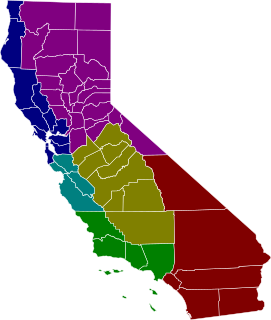
The California Courts of Appeal are the state intermediate appellate courts in the U.S. state of California. The state is geographically divided along county lines into six appellate districts. The Courts of Appeal form the largest state-level intermediate appellate court system in the United States, with 106 justices.
The lists of law clerks of the Supreme Court of the United States cover the law clerks who have assisted the justices of the Supreme Court of the United States in various capacities since the first one was hired by Justice Horace Gray in 1882. The list is divided into separate lists for each position in the Supreme Court.

The Supreme Court of Korea is the highest court in South Korea. It is located in Seoul. Articles 101–110 of the Constitution of the Republic of Korea establish the Supreme Court and enumerate its powers and responsibilities. Although the Supreme Court is the highest court for most legal issues, the Constitutional Court of Korea is the court of last resort for more specialized constitutional issues such as impeaching presidents or dissolving political parties.

The University of Santo Tomas Faculty of Civil Law or "UST Law", is the law school of the University of Santo Tomas, the oldest and the largest Catholic university in Manila, Philippines.

The Ellsworth Court refers to the Supreme Court of the United States from 1796 to 1800, when Oliver Ellsworth served as the third Chief Justice of the United States. Ellsworth took office after the Senate refused to confirm the nomination of Chief Justice John Rutledge, who briefly served as a Chief Justice as a recess appointment. Ellsworth served as Chief Justice until his resignation, at which point John Marshall took office. With some exceptions, the Ellsworth Court was the last Supreme Court to use seriatim opinions.

Diosdado "Dado" Madarang Peralta is a Filipino attorney and jurist who serves as the Chief Justice of the Philippines. He was appointed by President Rodrigo Duterte on October 23, 2019. He previously served as Associate Justice of the Supreme Court from January 13, 2009 to October 22, 2019. He is the third Sandiganbayan Presiding Justice to be appointed to the High Tribunal.
Fred Tarbell Field was an Associate Justice of the Massachusetts Supreme Judicial Court from January 30, 1929 until he became Chief Justice on June 30, 1938, serving in that capacity until his resignation on July 24, 1947. He was appointed by Governor Charles F. Hurley.
The judiciary of the Philippines refers to the judicial branch of government of the Philippines. All judges and justices are appointed by the President of the Philippines from a shortlist submitted by the Judicial and Bar Council.
The Tenth Circuit Act of 1863 was a federal statute which increased the size of the Supreme Court of the United States from nine justices to ten, and which also reorganized the circuit courts of the federal judiciary. The newly created Tenth Circuit consisted of California and Oregon, and addressed the judicial needs of the newly-created western states. The Act became effective on March 3, 1863, during the Lincoln administration.
Be it enacted by the Senate and House of Representatives of the United States of America in Congress assembled, That the supreme court of the United States shall hereafter consist of a chief justice and nine associate justices, any six of whom shall constitute a quorum; and for this purpose there shall be appointed one additional associate justice of said court, with the like powers, and to take the same oaths, perform the same duties, and be entitled to the same salary, as the other associate justices.
