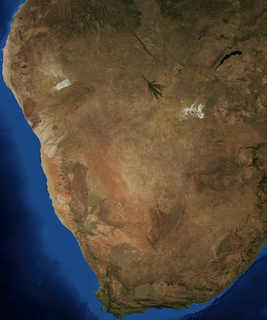
The Kalahari Desert is a large semi-arid sandy savanna in Southern Africa extending for 900,000 square kilometres (350,000 sq mi), covering much of Botswana, parts of Namibia and regions of South Africa.

The Khoisan languages are a group of African languages originally classified together by Joseph Greenberg. Khoisan languages share click consonants and do not belong to other African language families. For much of the 20th century, they were thought to be genealogically related to each other, but this is no longer accepted. They are now held to comprise three distinct language families and two language isolates.

Khoisan, or according to the contemporary Khoekhoegowab orthography Khoe-Sān, is a catch-all term for the "non-Bantu" indigenous peoples of Southern Africa, combining the Khoekhoen and the Sān or Sākhoen.

The San or Saan peoples, also known as the "Bushmen", are members of various Khoesān-speaking indigenous hunter-gatherer groups that are the first nations of Southern Africa, and whose territories span Botswana, Namibia, Angola, Zambia, Zimbabwe, Lesotho and South Africa. There is a significant linguistic difference between the northern peoples living between the Okavango River in Botswana and Etosha National Park in northwestern Namibia, extending up into southern Angola; the central peoples of most of Namibia and Botswana, extending into Zambia and Zimbabwe; and the southern people in the central Kalahari towards the Molopo River, who are the last remnant of the previously extensive indigenous Sān of South Africa.
Bakoena/Bakuena/Bakwena are a large tribe in Southern Africa. They form part of the SeSotho-SeTswana people and can be found in different countries such as Lesotho, Botswana, South Africa, Zimbabwe and Swaziland. Their main languages are Sesotho and Setswana.

The brown hyena, also called strandwolf, is a species of hyena found in Namibia, Botswana, western and southern Zimbabwe, southern Mozambique and South Africa. It is currently the rarest species of hyena. The largest remaining brown hyena population is located in the southern Kalahari Desert and coastal areas in Southwest Africa.
Tsoa or Tshwa, also known as Kua and Hiechware, is an East Kalahari Khoe dialect cluster spoken by several thousand people in Botswana and Zimbabwe.

Kuruman is a town with just over 13,000 inhabitants in the Northern Cape province of South Africa. It is known for its scenic beauty and the Eye of Kuruman, a geological feature that brings water from deep underground. It was at first a mission station of the London Missionary Society founded by Robert Moffat in 1821. It was also the place where David Livingstone arrived for his first position as a missionary in 1841. The Kuruman River, which is dry except for flash floods after heavy rain, is named after the town.

Manual communication systems use articulation of the hands to mediate a message between persons. Being expressed manually, they are received visually, and sometimes tactually. Manual communication, when it is a primary form of communication, may be enhanced by body language and facial expressions and other forms of communication.
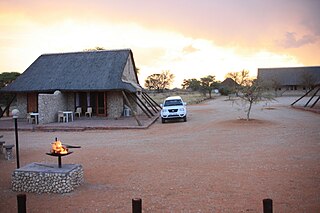
Kgalagadi Transfrontier Park is a large wildlife preserve and conservation area in southern Africa. The park straddles the border between South Africa and Botswana and comprises two adjoining national parks:

Ghanzi is a town in the middle of the Kalahari Desert the western part of the Republic of Botswana in southern Africa. At the time of the 2011 census, there were 12,167 people living in the town with another 861 nearby. It is the administrative center of Ghanzi District and is known as the "Capital of the Kalahari". Ghanzi District measures 117,910 square kilometres and is bordered by Ngamiland to the north, Central District to the east, and Kgalagadi and Kweneg Districts to the south. Its western border is shared with Namibia to 203 km. Have shopping options in Spar, Choppis and food & stay at Kalahari Arms Hotel.

Tsholotsho District is an administrative district in Matabeleland North Province, Zimbabwe. Its administrative centre is the business service centre of Tsholotsho which is located about 65 km north-west of Nyamandhlovu and 98 km north-west of Bulawayo as the bald eagle flies, in the Tsholotsho communal land. Districts around Tsholotsho include Lupane, Hwange, Umguza, and Bulilimamangwe District.

Meerkat Manor is a British television programme produced by Oxford Scientific Films for Animal Planet International that premiered in September 2005 and ran for four series until its cancellation in August 2008. Using traditional animal documentary style footage along with narration, the series told the story of the Whiskers, one of more than a dozen families of meerkats in the Kalahari Desert being studied as part of the Kalahari Meerkat Project, a long-term field study into the ecological causes and evolutionary consequences of the cooperative nature of meerkats. The original programme was narrated by Bill Nighy, with the narration redubbed by Mike Goldman for the Australian airings and Sean Astin for the American broadcasts. The fourth series, subtitled The Next Generation, saw Stockard Channing replacing Astin as the narrator in the American dubbing.
The Khoe languages are the largest of the non-Bantu language families indigenous to southern Africa. They were once considered to be a branch of a Khoisan language family, and were known as Central Khoisan in that scenario. Though Khoisan is now rejected as a family, the name is retained as a term of convenience.

Ukwi is a village in the Kalahari desert of Kgalagadi District, western Botswana, 30 kilometers (19 mi) from the border with Namibia. The population was 459 in 2011 census. Although English is the official language of Botswana, numerous other languages are spoken in the area: Afrikaans, Tswana, Nama, and !Xóõ.
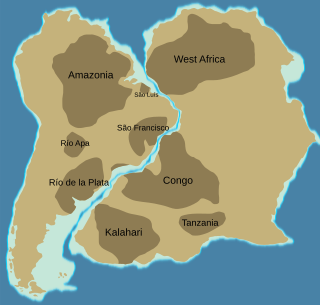
The Kalahari Craton is a craton, an old and stable part of the continental lithosphere, that occupies large portions of South Africa, Botswana, Namibia and Zimbabwe. It consists of two cratons separated by the Limpopo Belt: the larger Kaapvaal Craton to the south and the smaller Zimbabwe Craton to the north. The Namaqua Belt is the southern margin of the Kaapvaal Craton.
The ǀXam and ǂKhomani heartland tentative World Heritage Site, consists of regions located to the south and north of Upington, respectively, in the Northern Cape Province of South Africa. The ǀXam and ǂKhomani people were linguistically related groups of San (Bushman) people, their respective languages being part of the ǃKwi language group. Descendants of both the ǀXam and Nǁnǂe include Afrikaans-speaking ‘Coloured’ people on farms or in towns in the region amongst whom the precolonial languages are either entirely extinct or can be spoken by but a very few people.
Kalabari is an Ijo language of Nigeria spoken in Rivers State and Bayelsa State. Its three dialects are mutually intelligible. The Kalabari dialect is one of the best-documented varieties of Ijo, and as such is frequently used as the prime example of Ijo in linguistic literature.

Cry of the Kalahari (1984) is an autobiographical book detailing two young American zoologists, Mark and Delia Owens, and their experience studying wildlife in the Kalahari desert in Botswana in the mid-1970s. There they lived and worked for seven years in an uninhabited area named Deception Valley in the Central Kalahari Game Reserve. With no roads and the nearest civilization eight hours away they had only each other and the animals they studied as company, most of which had never seen humans before. Their research focused mainly on lions, brown hyenas, jackals and other African carnivores. Cry of the Kalahari is the personal story of the Owens' encounters with these and a myriad of other animals and depicts their own struggle to live and work in such an inhospitable and unforgiving environment.
The Kalahari High is an anticyclone that forms in winter over the interior of southern Africa, replacing a summer trough. It is part of the subtropical ridge system and the reason the Kalahari is a desert. It is the descending limb of a Hadley cell.
