
In physics, the kinetic energy of an object is the energy that it possesses due to its motion. It is defined as the work needed to accelerate a body of a given mass from rest to its stated velocity. Having gained this energy during its acceleration, the body maintains this kinetic energy unless its speed changes. The same amount of work is done by the body when decelerating from its current speed to a state of rest.

In astronomy, Kepler's laws of planetary motion are three scientific laws describing the motion of planets around the Sun.
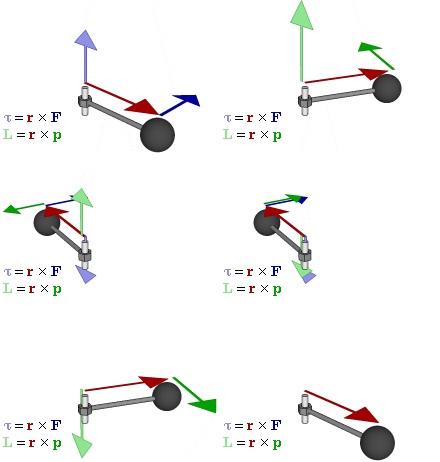
Torque, moment, or moment of force is the rotational equivalent of linear force. The concept originated with the studies of Archimedes on the usage of levers. Just as a linear force is a push or a pull, a torque can be thought of as a twist to an object. The symbol for torque is typically , the lowercase Greek letter tau. When being referred to as moment of force, it is commonly denoted by M.

Electrical impedance is the measure of the opposition that a circuit presents to a current when a voltage is applied. The term complex impedance may be used interchangeably.
Carbonic acid is a chemical compound with the chemical formula H2CO3 (equivalently OC(OH)2). It is also a name sometimes given to solutions of carbon dioxide in water (carbonated water), because such solutions contain small amounts of H2CO3. In physiology, carbonic acid is described as volatile acid or respiratory acid, because it is the only acid excreted as a gas by the lungs. It plays an important role in the bicarbonate buffer system to maintain acid–base homeostasis.

The ideal gas law, also called the general gas equation, is the equation of state of a hypothetical ideal gas. It is a good approximation of the behavior of many gases under many conditions, although it has several limitations. It was first stated by Émile Clapeyron in 1834 as a combination of the empirical Boyle's law, Charles's law, Avogadro's law, and Gay-Lussac's law. The ideal gas law is often written as
In statistics and its applications, the root mean square is defined as the square root of the mean square . The RMS is also known as the quadratic mean and is a particular case of the generalized mean with exponent 2. RMS can also be defined for a continuously varying function in terms of an integral of the squares of the instantaneous values during a cycle.
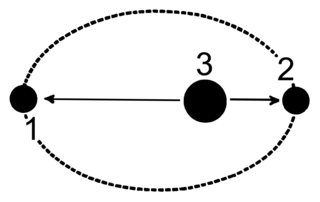
The term apsis refers to an extreme point in the orbit of an object. It denotes either the points on the orbit, or the respective distance of the bodies. The word comes via Latin from Greek, there denoting a whole orbit, and is cognate with apse. Except for the theoretical possibility of one common circular orbit for two bodies of equal mass at diametral positions, there are two apsides for any elliptic orbit, named with the prefixes peri- and ap-/apo-, added in reference to the body being orbited. All periodic orbits are, according to Newton's Laws of motion, ellipses: either the two individual ellipses of both bodies, with the center of mass of this two-body system at the one common focus of the ellipses, or the orbital ellipses, with one body taken as fixed at one focus, and the other body orbiting this focus. All these ellipses share a straight line, the line of apsides, that contains their major axes, the foci, and the vertices, and thus also the periapsis and the apoapsis. The major axis of the orbital ellipse is the distance of the apsides, when taken as points on the orbit, or their sum, when taken as distances.
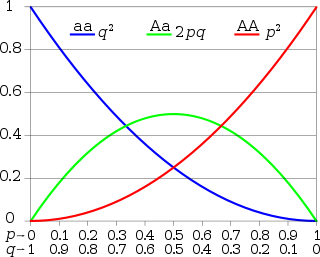
The Hardy–Weinberg principle, also known as the Hardy–Weinberg equilibrium, model, theorem, or law, states that allele and genotype frequencies in a population will remain constant from generation to generation in the absence of other evolutionary influences. These influences include genetic drift, mate choice, assortative mating, natural selection, sexual selection, mutation, gene flow, meiotic drive, genetic hitchhiking, population bottleneck, founder effect and inbreeding.
In thermodynamics, the Gibbs free energy is a thermodynamic potential that can be used to calculate the maximum of reversible work that may be performed by a thermodynamic system at a constant temperature and pressure. The Gibbs free energy is the maximum amount of non-expansion work that can be extracted from a thermodynamically closed system ; this maximum can be attained only in a completely reversible process. When a system transforms reversibly from an initial state to a final state, the decrease in Gibbs free energy equals the work done by the system to its surroundings, minus the work of the pressure forces.
In chemistry, Henry's law is a gas law that states that the amount of dissolved gas in a liquid is proportional to its partial pressure above the liquid. The proportionality factor is called Henry's law constant. It was formulated by the English chemist William Henry, who studied the topic in the early 19th century. In his publication about the number of gases absorbed by water,[1] he described the results of his experiments:
Effective radiated power (ERP), synonymous with equivalent radiated power, is an IEEE standardized definition of directional radio frequency (RF) power, such as that emitted by a radio transmitter. It is the total power in watts that would have to be radiated by a half-wave dipole antenna to give the same radiation intensity as the actual source at a distant receiver located in the direction of the antenna's strongest beam. ERP measures the combination of the power emitted by the transmitter and the ability of the antenna to direct that power in a given direction. It is equal to the input power to the antenna multiplied by the gain of the antenna. It is used in electronics and telecommunications, particularly in broadcasting to quantify the apparent power of a broadcasting station experienced by listeners in its reception area.

An epicyclic gear train consists of two gears mounted so that the centre of one gear revolves around the centre of the other. A carrier connects the centres of the two gears and rotates to carry one gear, called the planet gear, around the other, called the sun gear. The planet and sun gears mesh so that their pitch circles roll without slip. A point on the pitch circle of the planet gear traces an epicycloid curve. In this simplified case, the sun gear is fixed and the planetary gear(s) roll around the sun gear.
In thermodynamics, an isentropic process is an idealized thermodynamic process that is both adiabatic and reversible. The work transfers of the system are frictionless, and there is no transfer of heat or matter. Such an idealized process is useful in engineering as a model of and basis of comparison for real processes.

Renal function, in nephrology, is an indication of the kidney's condition and its role in renal physiology. Glomerular filtration rate (GFR) describes the flow rate of filtered fluid through the kidney. Creatinine clearance rate is the volume of blood plasma that is cleared of creatinine per unit time and is a useful measure for approximating the GFR. Creatinine clearance exceeds GFR due to creatinine secretion, which can be blocked by cimetidine. In alternative fashion, overestimation by older serum creatinine methods resulted in an underestimation of creatinine clearance, which provided a less biased estimate of GFR. Both GFR and CCr may be accurately calculated by comparative measurements of substances in the blood and urine, or estimated by formulas using just a blood test result.

The Eemian was the interglacial period which began about 130,000 years ago at the end of the Penultimate Glacial Period and ended about 115,000 years ago at the beginning of the Last Glacial Period. It corresponds to Marine Isotope Stage 5e. Although sometimes referred to as the "last interglacial", it was the second-to-latest interglacial period of the current Ice Age, the most recent being the Holocene which extends to the present day. The prevailing Eemian climate was, on average, around 1 to 2 degrees Celsius warmer than that of the Holocene. However, due to global warming, the past few July global temperatures likely surpassed the July temperatures of the Eemian period. During the Eemian, the proportion of CO
2 in the atmosphere was about 280 parts per million.

In statistics, a moving average is a calculation to analyze data points by creating a series of averages of different subsets of the full data set. It is also called a moving mean (MM) or rolling mean and is a type of finite impulse response filter. Variations include: simple, and cumulative, or weighted forms.

In statistics, the coefficient of determination, denoted R2 or r2 and pronounced "R squared", is the proportion of the variance in the dependent variable that is predictable from the independent variable(s).

Rudolph Pabus Cleveringa was a professor of law at Leiden University. He is known for his speech of 26 November 1940, in which he protested against the dismissal of Jewish colleagues ordered by the German occupation authorities.

Leiden Law School is the law school, and one of the seven faculties, of Leiden University. Teaching and scholarship in the school take place across campuses in Leiden and The Hague in the Netherlands.

