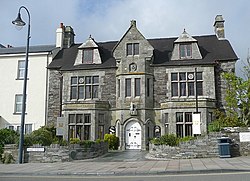
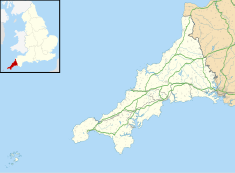
Bodmin is a town and civil parish in Cornwall, England, United Kingdom. It is situated south-west of Bodmin Moor.

Camelot is a legendary castle and court associated with King Arthur. Absent in the early Arthurian material, Camelot first appeared in 12th-century French romances and, since the Lancelot-Grail cycle, eventually came to be described as the fantastic capital of Arthur's realm and a symbol of the Arthurian world.

King Arthur, according to legends, was a king of Britain. He is a folk hero and a central figure in the medieval literary tradition known as the Matter of Britain.

The Round Table is King Arthur's famed table in the Arthurian legend, around which he and his knights congregate. As its name suggests, it has no head, implying that everyone who sits there has equal status, unlike conventional rectangular tables where participants order themselves according to rank. The table was first described in 1155 by Wace, who relied on previous depictions of Arthur's fabulous retinue. The symbolism of the Round Table developed over time; by the close of the 12th century, it had come to represent the chivalric order associated with Arthur's court, the Knights of the Round Table.
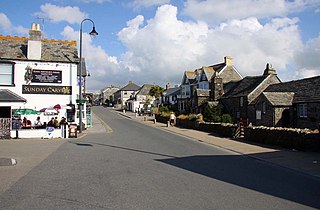
Tintagel or Trevena is a civil parish and village situated on the Atlantic coast of Cornwall, England, United Kingdom. The village and nearby Tintagel Castle are associated with the legends surrounding King Arthur and in recent times have become a tourist attraction. It was claimed by Geoffrey of Monmouth that the castle was the place of Arthur's conception.

Tintagel Castle is a medieval fortification located on the peninsula of Tintagel Island adjacent to the village of Tintagel (Trevena), North Cornwall in the United Kingdom. The site was possibly occupied in the Romano-British period, as an array of artefacts dating from this period have been found on the peninsula, but as yet no Roman-era structure has been proven to have existed there. It was settled during the early medieval period, when it was probably one of the seasonal residences of the regional king of Dumnonia. A castle was built on the site by Richard, 1st Earl of Cornwall in the 13th century, during the High Middle Ages. It later fell into disrepair and ruin.

Liskeard is an ancient stannary and market town in south-east Cornwall, England, United Kingdom. It is situated approximately 20 miles (32 km) west of Plymouth, 14 miles (23 km) west of the Devon border, and 12 miles (20 km) east of Bodmin. The Bodmin Moor lies to the north-west of the town. The total population of the town at the 2011 census was 11,366

In Arthurian legend, Gorlois of Tintagel was the Duke of Cornwall. He was the first husband of King Arthur's mother Igraine and the father of her daughters, Arthur's half-sisters. Her second husband was Uther Pendragon, the High King of Britain and Arthur's father, who marries her after killing him.

Tywardreath is a small hilltop village on the south coast of Cornwall, England, United Kingdom, about 3 miles (5 km) north west of Fowey. It is located in a sheltered spot overlooking a silted up estuary opposite Par and near the beach of Par Sands. It is on the Saints' Way path.

Treknow is a small village in Tintagel civil parish, Cornwall, England, United Kingdom: it is the second largest settlement, and is located between Trevena and Trebarwith. It is situated 19 miles (31 km) north of Bodmin, 4 miles (6.4 km) north-west of Camelford, and 1 mile (1.6 km) west of Tintagel, grid reference SX056869

Calstock is a civil parish and a large village in south east Cornwall, England, United Kingdom, on the border with Devon. The village is situated on the River Tamar 6 miles (9.7 km) south west of Tavistock and 10 miles (16 km) north of Plymouth.
King Arthur and King Cornwall is an English ballad surviving in fragmentary form in the 17th-century Percy Folio manuscript. An Arthurian story, it was collected by Francis James Child as Child Ballad 30. Unlike other Child Ballads, but like the Arthurian "The Boy and the Mantle" and "The Marriage of Sir Gawain", it is not a folk ballad but a professional minstrel's song. It is notable for containing the Green Knight, a character known from the medieval poems The Greene Knight and the more famous Sir Gawain and the Green Knight; he appears as "Bredbeddle", the character's name in The Greene Knight.

Veronica Mary Whall (1887–1967) was an important stained glass artist, painter, and illustrator associated with the Arts and Crafts movement. Her father, Christopher Whall, was the leader of the movement in stained glass. She was educated in the techniques of painting and stained glass making in her father's studio-workshop. She later became his studio assistant and designer for his studio in 1914. In 1922, Whall and her father co-founded a stained glass studio together, which she managed for nearly thirty years after his death in 1924.
Antony Charles Thomas, was a British historian and archaeologist who was Professor of Cornish Studies at Exeter University, and the first Director of the Institute of Cornish Studies, from 1971 until his retirement in 1991. He was recognised as a Bard of the Cornish Gorseth with the name Gwas Godhyan in 1953.

Saint Materiana is a Welsh saint, patron of two churches in Cornwall and one in Wales.

The Parish Church of Saint Materiana at Tintagel is a Church of England parish church in the Church of England Diocese of Truro in Cornwall, England, UK. It stands on the cliffs between Trevena and Tintagel Castle and is listed Grade I.

The Catholic Church of St Paul the Apostle, in Bossiney Road, Tintagel, Cornwall, England, UK, was built in 1967 and consecrated by the Bishop of Plymouth, Cyril Restieaux, in February 1968. It was originally a mission administered by the Canons Regular of the Lateran based in Bodmin, services being held in the Social Hall, Trevena. It is now administered as part of the Plymouth Diocese and is part of the Parish of Bodmin which consists of churches in Bodmin, Wadebridge, Padstow and Tintagel. Fr. Bryan Storey was priest from 1973 until his death 26 July 2018. He was priest in charge for 45 years.
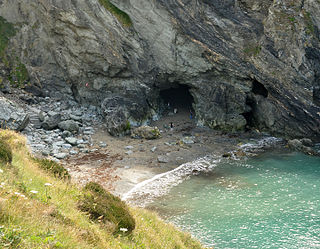
Merlin's Cave is a cave located beneath Tintagel Castle, 5 kilometres (3.1 mi) south-west of Boscastle, Cornwall, England. It is 100 metres (330 ft) long, passing completely through Tintagel Island from Tintagel Haven on the east to West Cove on the west. It is a sea cave formed by marine erosion along a thrust plane between slate and volcanic rocks. The cave fills with water at high tide, but has a sandy floor and is explorable at low tide.