If you can address this concern by improving, copyediting, sourcing, renaming, or merging the page, please edit this page and do so. You may remove this message if you improve the article or otherwise object to deletion for any reason. Although not required, you are encouraged to explain why you object to the deletion, either in your edit summary or on the talk page. If this template is removed, do not replace it.
The article may be deleted if this message remains in place for seven days, i.e., after 12:17, 8 October 2018 (UTC). If you created the article, please don't be offended. Instead, consider improving the article so that it is acceptable according to the deletion policy.PRODExpired+%5B%5BWP%3APROD%7CPROD%5D%5D%2C+concern+was%3A+Not+notable%2C+no+sources+indicating+notabilityExpired [[WP:PROD|prod]], concern was: Not notable, no sources indicating notability
Nominator: Please consider notifying the author/project: {{subst:proposed deletion notify|Konami Sound Cartridge|concern=Not notable, no sources indicating notability}} ~~~~
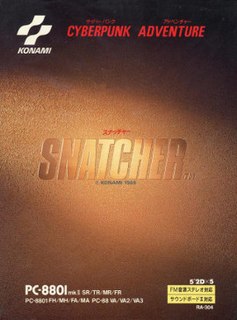
The Konami Sound Cartridge is supplied with the MSXvideo gamesSnatcher and SD Snatcher. Sometimes it is known as the SCC+. It includes a slightly improved Konami SCC sound chip and 64kB of volatile RAM. It is likely that the RAM was included since most MSX computers in Japan at the time of release had very little memory (mostly 64kB).
MSX is a standardized home computer architecture, announced by Microsoft on June 16, 1983. It was conceived and marketed by Kazuhiko Nishi, then vice-president at Microsoft Japan and director at ASCII Corporation. Nishi conceived the project as an attempt to create unified standards among various home computing system manufacturers of the period.
A video game is an electronic game that involves interaction with a user interface to generate visual feedback on a two- or three-dimensional video display device such as a TV screen, virtual reality headset or computer monitor. Since the 1980s, video games have become an increasingly important part of the entertainment industry, and whether they are also a form of art is a matter of dispute.
Snatcher is a cyberpunk graphic adventure game developed and published by Konami. It was written and designed by Hideo Kojima and first released in 1988 for the PC-8801 and MSX2 in Japan. Snatcher is set in a future East Asian metropolis where humanoid robots dubbed "Snatchers" have been discovered killing humans and replacing them in society. The player takes on the role of Gillian Seed, an amnesiac who joins a Snatcher hunting agency hoping it will help him remember his past. Gameplay takes place primarily through a menu-based interface through which the player can choose to examine items, search rooms, speak to characters, explore a semi-open world, and perform other actions.
Like the normal SCC, the chip has 5 audio channels. The waveform is set by 32 bytes of 8 bit samples. Each channel has its own 32 bytes of waveform, unlike the SCC where channel 4 and 5 share the waveform.
The Konami SCC(-I) sound chip
The cartridge included with Snatcher is different from the one included with SD Snatcher, but only in memory layout. It was probably done to make it incompatible. Some MSX emulators emulate this cartridge, MESS and OpenMSX for example.
openMSX is a free software emulator for the MSX architecture. It is available for multiple platforms, including Microsoft Windows and POSIX systems such as Linux
Most video games on the Konami Games Collections for the MSX can use the cartridge that is included with Snatcher for better sound. Apart from those the Sound Cartridge is not used by any other programs.
The print on the chip is: KONAMI 052539 SCC-I2312P001 JAPAN followed by a fabrication location/date number, like 8951EAI. The first two digits are the year, followed by the week. The letters after that are some location/lot code.
Expanding memory
It is possible to expand the memory to 128kB by adding 64kB of RAM to the cartridge. There are two open places on the PCB. When the RAM is added, both types of cartridges become functionally identical. The cartridge will work with both the SD Snatcher and Snatcher video games.
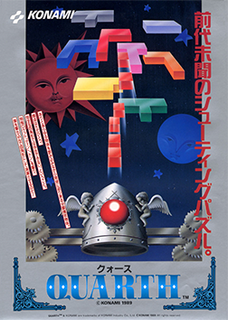
Surprisingly enough, a cartridge with 128kB RAM can behave exactly like a SCC ROM cartridge of 128kB. This means you can load those games into the RAM (e.g. Gradius 2, F1 Spirit, Quarth and so on) and it will behave like the original ROM cartridge until the power is turned off, since it is volatile RAM. It is possible that this chip was originally developed for internal development and testing use at Konami.
A ROM cartridge, usually referred to simply as a cartridge or cart, is a removable memory card containing ROM designed to be connected to a consumer electronics device such as a home computer, video game console and to a lesser extent, electronic musical instruments. ROM cartridges can be used to load software such as video games or other application programs.
Gradius is a series of shooter video games, introduced in 1985, developed and published by Konami for a variety of portable, console and arcade platforms. In many games in the series, the player controls a ship known as the Vic Viper.
Quarth is a hybrid puzzle game/shoot 'em up developed by Konami which was released in 1989 as an arcade game, sold as Block Hole outside Japan.
The RAM ICs are of type 4464. They are four bits wide and a 64K range. There might still some solder in the holes, you can use a solder sucker for that.
If you would like the cartridge to work with both video games then you can also connect the memory banks (so they are mirrored). Connect CAS (pin 16 of RAM IC) of one of the RAM ICs with one of the empty slots.
Using the memory
Everything is done using memory-mapped I/O and it is much like the SCC ROM cartridges.
As with SCC cartridges, the memory is divided into four memory banks of 8kB:
Bank 1
4000h - 5FFFh
Bank 2
6000h - 7FFFh
Bank 3
8000h - 9FFFh
Bank 4
A000h - BFFFh
To change the mapping, write to one of these addresses:
Bank 1
5000h - 57FFh
Bank 2
7000h - 77FFh
Bank 3
9000h - 97FFh
Bank 4
B000h - B7FFh
Bits 3 through 7 are ignored. Values 0 to 7 select 8kB pages of the lower 64kB (which is included with Snatcher) and values 8 to 15 the higher 64kB (which is included with SD Snatcher).
By default (after reset) bank 1 selected area 0, bank 2 area 1, bank 3 area 2 and bank 4 area 3. Again this is the same as SCC ROM cartridges. If the lower 64kB is empty (as it is with the Super Deform Snatcher cartridge) then the memory will be empty (reads FFh).
By default, the RAM cannot be changed. By setting a bit somewhere else the areas can no longer be changed (ROM mode) but can be written to (RAM mode). This is done by writing to the mode register, which is always accessible through address BFFEh and BFFFh. The SCC can be put in also be put in SCC+ mode through this register, where channel 4 and 5 do not share a waveform.
bit 7
no function
bit 6
no function
bit 5
if set, sound chip is in SCC+ mode otherwise SCC compatibility
bit 4
if set, banks 1 to 3 are in RAM mode otherwise area select
bit 3
no function
bit 2
if set and bit 5 reset, bank 3 is RAM mode irrespective of bit 4
bit 1
if set, bank 2 is RAM mode irrespective of bit 4
bit 0
if set, bank 1 is RAM mode irrespective of bit 4
Even in RAM mode the memory under BFFEh and BFFFh cannot be changed through those addresses as that will always end up in the mode register.
Konami uses 20h and 3Fh for the mode register as they always use SCC+ mode. 30h would also work for RAM mode.
Using the sound chip
If bank 3 is in area select mode and bit 5 of mode register is reset, the SCC compatibility mode can be activated by writing 3Fh to one address 9000h through 97FFh. The layout is very similar to the SCC and the meaning of the registers is the same although the address differ somewhat and the waveform of channel 5 can be read. The SCC is visible at 9800h through 9FDFh.
Address
read/write
Function
9800h - 981Fh
rw
waveform channel 1
9820h - 983Fh
rw
waveform channel 2
9840h - 985Fh
rw
waveform channel 3
9860h - 987Fh
rw
read: waveform channel 4
write: waveform channel 4 and 5
9880h - 9881h
w
frequency channel 1
9882h - 9883h
w
frequency channel 2
9884h - 9885h
w
frequency channel 3
9886h - 9887h
w
frequency channel 4
9888h - 9889h
w
frequency channel 5
988Ah
w
volume channel 1
988Bh
w
volume channel 2
988Ch
w
volume channel 3
988Dh
w
volume channel 4
988Eh
w
volume channel 5
988Fh
w
on/off switch channel 1 to 5
9890h - 989Fh
w
same as 9880h to 988Fh
98A0h - 98BFh
w
waveform channel 5
98C0h - 98DFh
rw
deformation register
98E0h - 98FFh
no function
If bank 4 is in area select mode and bit 5 of the mode register is set, the SCC+ can be activated by writing a value with bit 7 set to anywhere to B000h through B7FFh. Now the SCC+ becomes active at B800h through BFDFh.
This page is based on this Wikipedia article Text is available under the CC BY-SA 4.0 license; additional terms may apply. Images, videos and audio are available under their respective licenses.