The Subcommittee on International Organizations of the Committee on International Relations was a committee of the United States House of Representatives which met in 1976 and 1977 and conducted an investigation into South Korea–United States relations. It was chaired by Representative Donald M. Fraser of Minnesota. The committee's 447-page report, made public on November 29, 1977, reported on plans by the National Intelligence Service (KCIA) to manipulate American institutions to the advantage of South Korean government policies, overtly and covertly.
Bilateralism is the conduct of political, economic, or cultural relations between two sovereign states. It is in contrast to unilateralism or multilateralism, which is activity by a single state or jointly by multiple states, respectively. When states recognize one another as sovereign states and agree to diplomatic relations, they create a bilateral relationship. States with bilateral ties will exchange diplomatic agents such as ambassadors to facilitate dialogues and cooperations.
Unequal treaty is the name given by the Chinese to a series of treaties signed with Western powers, Russian Empire and Empire of Japan during the 19th and early 20th centuries by Qing dynasty China after military attacks or military threats by foreign powers.
The United States House Committee on Foreign Affairs of the United States House of Representatives, also known as the House Foreign Affairs Committee, is a standing committee of the United States House of Representatives, which has jurisdiction over bills and investigations related to the foreign affairs of the United States.

South Korea–United States relations refers to international relations between South Korea and the United States. Relations commenced since 1950, when the United States helped establish the modern state of South Korea, also known as the Republic of Korea, and fought on its UN-sponsored side in the Korean War (1950–1953). During the subsequent four decades, South Korea experienced tremendous economic, political and military growth, and significantly reduced U.S. dependency.
A special relationship is a diplomatic relationship that is especially strong and important. This term is usually used to refer to the historic relationship between the United States and the United Kingdom. In its extended use outside it and the Anglosphere, it has also been used to describe the whole of EU–US relations and the following relations:

The United States and Belgium maintain a friendly bilateral relationship. Continuing to celebrate cooperative U.S. and Belgian relations, 2007 marked the 175th anniversary of the nations' relationship.

South Korea–Thailand relations are the bilateral relations between the Kingdom of Thailand and the Republic of Korea. The two countries established diplomatic relations on 1 October 1958.

Canada–North Korea relations refer to the relations between Canada and the Democratic People's Republic of Korea. The relations between the two nations are very limited, as Canada suspended full diplomatic relations in 2010 over North Korea's destabilizing nuclear activity. Travel and commerce with North Korea are discouraged by the Canadian government and there is very little trade or diplomatic contact due to Canada's perspective that North Korea plays a destabilizing role in the Asia Pacific region.
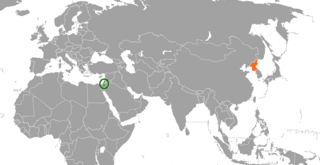
Israeli-North Korean relations are very hostile. North Korea does not recognise Israel, denouncing it as an "imperialist satellite". Since 1988 it recognises the sovereignty of the State of Palestine over all of Israel, except for the disputed region of the Golan Heights, which it recognises as part of Syria. At times, Israel has been the subject of fiery threats from North Korean state media.

The United States has formal diplomatic relations with most nations. This includes all UN member states and UN observer states other than (i) UN member states Bhutan, Iran, North Korea and Syria and (ii) the UN observer State of Palestine. Additionally, the U.S. has diplomatic relations with the European Union and Kosovo. The United States federal statutes relating to foreign relations can be found in Title 22 of the United States Code. For several years, the United States had the most diplomatic posts of any state but as of 2020, it is second to the People's Republic of China.

The relationship between the Republic of Korea and the United Kingdom of Great Britain and Northern Ireland spans from the 19th century to the present day. Although the Republic of Korea gives 18 January 1949 as the date of the establishment of formal relations with the United Kingdom, diplomatic ties go back to 1883. British military participation in the Korean War during the 1950s was significant, but relations between the two countries at the time were described as "tenuous", with relatively little known about each other. Commercial and trade relationships grew rapidly during the 1970s. During the Asian Financial Crisis in the late 1990s, Queen Elizabeth II made a state visit to South Korea, which was well received at a time of crisis in the country. Today, there are strong economic and diplomatic links between the two countries.

North Korea–Palestine relations refers to the bilateral relations between North Korea and Palestine. North Korea has long regarded Israel as an "imperialist satellite" and recognizes the sovereignty of Palestine over all territory held by Israel, excluding the Golan Heights, conquered from Syria in 1967 and annexed in 1981, which is considered as Syrian Territory by the International Community, North Korea included.
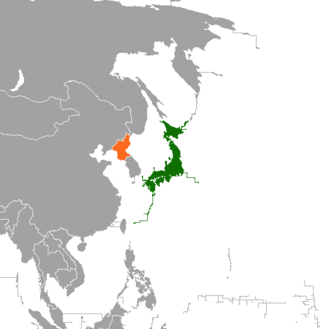
Japan–North Korea relations refers to international relations between Japan and North Korea. Relations between Japan and North Korea have not been formally established, but there have been diplomatic talks between the two governments to discuss the issue of kidnapped Japanese citizens and North Korea's nuclear program. Relations between the two countries are severely strained and marked by tension and hostility. According to a 2014 BBC World Service poll, 91% of Japanese people view North Korea's influence negatively, with just 1% expressing a positive view; the most negative perception of North Korea in the world.

Grenada–North Korea relations began as formal diplomatic relations between the People's Revolutionary Government of Grenada and the Democratic People’s Republic of Korea. The People's Revolutionary Government of Grenada and the Democratic People’s Republic of Korea established full diplomatic relations on Wednesday 9 May 1979. The two countries' diplomatic relationship ended in 24 January 1985. Grenada and the DPRK resumed diplomatic relations in 11 December 1991.

The North Korea–Philippines relations relates to the diplomatic relationship of the Democratic People's Republic of Korea and the Republic of the Philippines.

North Korea-United Kingdom Relations are the bilateral relations between North Korea and the United Kingdom.

Mexico–North Korea refers to the current and historical relations between Mexico and North Korea. In 2017, there were 366 North Koreans residing in Mexico.
This page is based on this
Wikipedia article Text is available under the
CC BY-SA 4.0 license; additional terms may apply.
Images, videos and audio are available under their respective licenses.
