La Paz is the administrative capital of Bolivia.

Chacao is one of the five political and administrative subdivisions of the city of Caracas, Venezuela. The other four are Baruta, El Hatillo, Libertador and Sucre. This legal entity is known as the Caracas Metropolitan District. Chacao is also one of the 21 municipalities that make up the State of Miranda, Venezuela.

Altamira is a neighborhood located in the Chacao municipality of Caracas, Venezuela. It has its own Metro Station, many hotels and restaurants, and it is an important business and residential center of the city. It is also an important tourist destination and cultural center in Caracas. The Francisco de Miranda avenue and the Distibuidor Altamira are both located in Altamira. This neighborhood borders El Ávila National Park to the north, La Castellana neighborhood to the west, Los Palos Grandes to the east, and Bello Campo neighborhood to the south. It has an estimated area of 161 hectares or approximately 1.61 square kilometers.
La Razón is used as a name for newspapers in the Spanish-speaking world including:
Luis Roche was an important Venezuelan urbanist and was the Venezuelan ambassador to Argentina. He was also an amateur film director.

Paseo de la Castellana, commonly known as La Castellana, is a major thoroughfare in Madrid, Spain. Cutting across the city from South to North, it has been described as the "true structuring axis" of the city.
Montalbán or Montalban may refer to:

The Bello orthography or Chilean orthography was a Spanish-language orthography created by the Venezuelan linguist Andrés Bello and the Colombian Juan García del Río, published in London in 1823. Part of the orthography was used officially for a time in Chile, and it influenced other Spanish-speaking countries. The aim of the orthography was a perfect correspondence between graphemes and phonemes. The reform did not succeed. Standard Spanish orthography as used for Hispanic American Spanish contains several homophones or letters that represent more than one sound, and other variances. Bello proposed several modifications that he believed should be undertaken in two stages:
- Substitute ⟨j⟩ for "weak" ⟨g⟩ sounds ;
- Substitute ⟨z⟩ for "weak" ⟨c⟩ sounds ;
- Remove silent ⟨h⟩s and the silent ⟨u⟩ of ⟨qu⟩- ;
- Substitute ⟨i⟩ for ⟨y⟩s used as vowels ;
- Always write ⟨rr⟩ where a rolled ⟨r⟩ is pronounced.
- Substitute ⟨q⟩ for "strong" ⟨c⟩ sounds ;
- Remove the silent ⟨u⟩ in ⟨gu⟩-.
La Chiquinquirá Church may refer to several churches in Venezuela and Colombia:

David Ramón Sánchez Palomares was a Venezuelan poet, born in Escuque. In 1975 received the National Prize for Literature; in 2006 the first Víctor Valera Mora International Prize for Poetry; and in 2010 the Ibero-America Award for Literature.
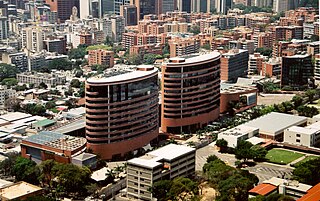
La Castellana is a district in Caracas, Venezuela, located in the northeast part of the city, La Castellana is bordered on the south by Chacao, on the east by Altamira (Caracas) neighbourhood, on the west by Caracas Country Club and Campo Alegre neighbourhood and on the north by El Ávila National Park. It has an approximate surface of 98 hectares.

Campo Alegre is a residential neighborhood located in the Chacao municipality of Caracas, Venezuela. This district holds the hotel Embassy Suites by Hilton , and the most exclusive party room of the city, the "Quinta Esmeralda", meeting point of the Venezuelan upper-class families.
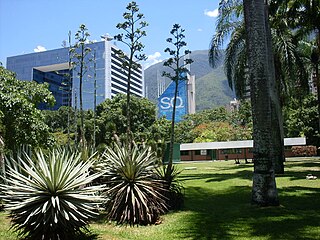
Los Palos Grandes is a residential, tourist and financial district located in the Chacao Municipality in east Caracas, served by the Caracas Metro through the Miranda station of line 1. It has an estimated area of 117 hectares.

The Hungarian-Venezuelan community is primarily composed of immigrants who left Hungary after World War II and the Hungarian Revolution of 1956. Although settled as immigrants in the second half of the 20th century, records of previous centuries prove there were Hungarians who visited Venezuela motivated by exploratory interests. Such is the case of the noble Hungarian expeditionary Pál Rosti, who traveled to the country in 1857 and photographed the region of San Juan de los Morros.

East Caracas generally refers to the eastern portions of Caracas, and may refer specifically to the municipalities from the Metropolitan District of Caracas located in Miranda State: Chacao, Baruta, Sucre, and El Hatillo. It concentrates the 34.8% population of the Metropolitan District of Caracas, and the 21.7% population of the Greater Caracas Area. Caracas Country Club, the richest neighborhood of the city, is located between El Recreo and Chacao districts.
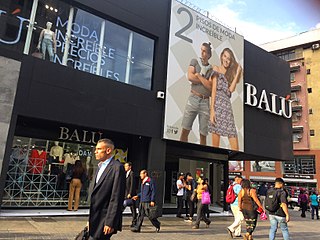
The Boulevard of Sabana Grande is an important leisure and shopping area located in eastern Caracas in the geographic center of the Metropolitan District of Caracas. It is a pedestrian-only, tree-shaded public space. In 2011, the boulevard of Sabana Grande went through a rehabilitation process founded by PDVSA La Estancia. A commercial and financial district, Sabana Grande is the commercial corridor, and a tourist district of Caracas. The boulevard of Sabana Grande is home to the most important ornithological collection in Latin America, the William Phelps Ornithological Collection. Until the beginning of the 20th century, it was called Calle Real because it was the town's main road.
This page is based on this
Wikipedia article Text is available under the
CC BY-SA 4.0 license; additional terms may apply.
Images, videos and audio are available under their respective licenses.
