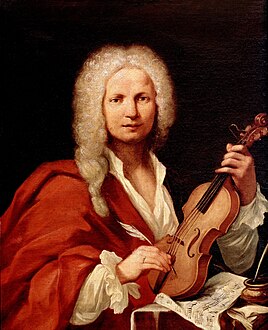
Antonio Lucio Vivaldi was an Italian Baroque composer, virtuoso violinist, teacher, impresario, and Roman Catholic priest. Born in Venice, the capital of the Venetian Republic, Vivaldi is regarded as one of the greatest Baroque composers, and his influence during his lifetime was widespread across Europe, being paramount in the development of Johann Sebastian Bach's instrumental music. He composed many instrumental concertos, for the violin and a variety of other musical instruments, as well as sacred choral works and more than fifty operas. His best-known work is a series of violin concertos known as the Four Seasons.
A concerto is, from the late Baroque era, mostly understood as an instrumental composition, written for one or more soloists accompanied by an orchestra or other ensemble. The typical three-movement structure, a slow movement preceded and followed by fast movements, became a standard from the early 18th century.
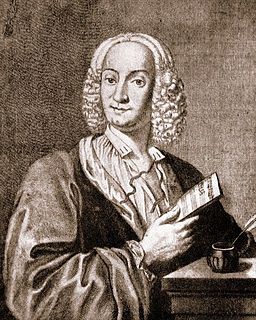
The Four Seasons is a group of four violin concerti by Italian composer Antonio Vivaldi, each of which gives musical expression to a season of the year. These were composed around 1718−1720, when Vivaldi was the court chapel master in Mantua.They were published in 1725 in Amsterdam, together with eight additional concerti, as Il cimento dell'armonia e dell'inventione.

Federico Maria Sardelli is an Italian conductor, historicist, composer, musicologist, comic artist, and flautist. He founded the medieval ensemble Modo Antiquo in 1984. In 1987, Modo Antiquo also became a baroque orchestra, debuting with the performance of Jean-Baptiste Lully's Ballet des Saisons in front of an audience of about five thousand.

Alfredo Casella was an Italian composer, pianist and conductor.

Franz Xaver Wolfgang Mozart, also known as Wolfgang Amadeus Mozart, Jr., was the youngest child of six born to Wolfgang Amadeus Mozart and his wife Constanze. He was the younger of his parents' two surviving children. He was a composer, pianist, conductor, and teacher of the late classical period whose musical style was of an early Romanticism, heavily influenced by his father's mature style.

F major is a major scale based on F, with the pitches F, G, A, B♭, C, D, and E. Its key signature has one flat. Its relative minor is D minor and its parallel minor is F minor.

Günter Raphael was a German composer. Born in Berlin, Raphael was the grandson of composer Albert Becker. His first symphony was premiered by Wilhelm Furtwängler in 1926 in Leipzig. From 1926 to 1934 he taught in Leipzig, but illness and the rise of Fascism – he was declared a half-Jew – made this difficult for him. For surviving the Nazis while managing his illness he was awarded the Franz Liszt Award in 1948. His students include Kurt Hessenberg.
Franz Liszt wrote drafts for his Concerto for Piano and Orchestra No. 2 in A major, S.125, during his virtuoso period, in 1839 to 1840. He then put away the manuscript for a decade. When he returned to the concerto, he revised and scrutinized it repeatedly. The fourth and final period of revision ended in 1861. Liszt dedicated the work to his student Hans von Bronsart, who gave the first performance, with Liszt conducting, in Weimar on January 7, 1857.

Nicolas Chédeville was a French composer, musette player and musette maker.

Fabio Biondi is an Italian violinist and conductor. He is a specialist in Baroque and early music.
A triple concerto is a concerto with three soloists. Such concertos have been composed from the Baroque period, including works by Corelli, Vivaldi, Bach and Telemann, to the 21st century, such as two works by Dmitri Smirnov. The most famous example is Beethoven's Triple Concerto for violin, cello and piano. His combination of solo instruments, a piano trio, was often used also in later works.
Although Franz Liszt provided opus numbers for some of his earlier works, they are rarely used today. Instead, his works are usually identified using one of two different cataloging schemes:

Antonio Vivaldi wrote a set of flute concertos, Op. 10, that were published c. 1728 by Amsterdam publisher Michel-Charles Le Cène.
Il gran mogol, RV 431a, is a flute concerto by Antonio Vivaldi, written in the late 1720s or early 1730s. It was the Indian part of a set of four 'national' concertos, La Francia (France), La Spagna (Spain) and L'Inghilterra (England) - the other three are all lost.
Claudio Brizi is an Italian organist and harpsichordist.
Marco Rogliano is an Italian violinist.
La tempesta di mare, a flute concerto in F Major, is the first of Six Flute Concertos, Op. 10 by Antonio Vivaldi, published in the late 1720s. La tempesta di mare may also refer to two earlier versions of the same concerto, RV 98, a concerto da camera featuring the flute, from which Vivaldi derived the concerto grosso RV 570.
