
A security is a tradable financial asset. The term commonly refers to any form of financial instrument, but its legal definition varies by jurisdiction. In some countries and languages people commonly use the term "security" to refer to any form of financial instrument, even though the underlying legal and regulatory regime may not have such a broad definition. In some jurisdictions the term specifically excludes financial instruments other than equities and fixed-income instruments. In some jurisdictions it includes some instruments that are close to equities and fixed income, e.g., equity warrants.
A multinational company (MNC) is a corporate organization that owns and controls the production of goods or services in at least one country other than its home country. Control is considered an important aspect of an MNC, to distinguish it from international portfolio investment organizations, such as some international mutual funds that invest in corporations abroad simply to diversify financial risks. Black's Law Dictionary suggests that a company or group should be considered a multinational corporation if it derives 25% or more of its revenue from out-of-home-country operations. A multinational corporation can also be referred to as a multinational enterprise (MNE), a transnational enterprise (TNE), a transnational corporation (TNC), an international corporation, or a stateless corporation. There are subtle but real differences between these terms.

A trade agreement is a wide-ranging taxes, tariff and trade treaty that often includes investment guarantees. It exists when two or more countries agree on terms that help them trade with each other. The most common trade agreements are of the preferential and free trade types, which are concluded in order to reduce tariffs, quotas and other trade restrictions on items traded between the signatories.
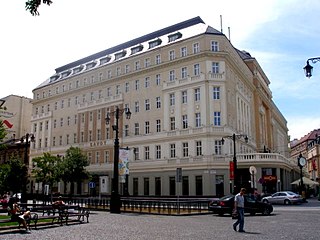
Lodging refers to the use of a short-term dwelling, usually by renting the living space or sometimes through some other arrangement. People who travel and stay away from home for more than a day need lodging for sleep, rest, food, safety, shelter from cold temperatures or rain, storage of luggage and access to common household functions. Lodging is a form of the sharing economy.
A credit linked note (CLN) is a form of funded credit derivative. It is structured as a security with an embedded credit default swap allowing the issuer to transfer a specific credit risk to credit investors. The issuer is not obligated to repay the debt if a specified event occurs. This eliminates a third-party insurance provider.

A privately held company or private company is a company which does not offer or trade its company stock (shares) to the general public on the stock market exchanges, but rather the company's stock is offered, owned and traded or exchanged privately or over-the-counter. In the case of a close corporation, there are a relatively small number of shareholders or company members. Related terms are closely held corporation, unquoted company, and unlisted company.

The Licence Raj or Permit Raj was the system of licences, regulations, and accompanying red tape, that hindered the set up and running of businesses in India between 1947 and 1990. Up to 80 government agencies had to be satisfied before private companies could produce something and, if granted, the government would regulate production. The term is a play on the "British Raj", which refers to the period of British rule in India. It was coined by Indian independence activist and statesman Chakravarti Rajagopalachari, who firmly opposed it for its potential for political corruption and economic stagnation, founding the Swatantra Party to oppose these practices.
A proprietary company,, is a form of privately held company in Australia and South Africa that is either limited or unlimited. However, unlike a public company there are, depending on jurisdiction, restrictions on what it can and cannot do.
A private-equity fund is a collective investment scheme used for making investments in various equity securities according to one of the investment strategies associated with private equity. Private equity funds are typically limited partnerships with a fixed term of 10 years. At inception, institutional investors make an unfunded commitment to the limited partnership, which is then drawn over the term of the fund. From the investors' point of view, funds can be traditional or asymmetric.

The Ghana Stock Exchange (GSE) is the principal stock exchange of Ghana. The exchange was incorporated in July 1989 with trading commencing in 1990. It currently lists 42 equities and 2 corporate bonds. All types of securities can be listed. Criteria for listing include capital adequacy, profitability, spread of shares, years of existence and management efficiency. The GSE is located within the Cedi House in Accra.
A SICAV is a collective investment scheme common in Western Europe, especially Luxembourg, Switzerland, Italy, Spain, Belgium, Malta, France, and the Czech Republic. SICAV is an acronym in French for société d'investissement à capital variable, which can be translated as 'investment company with variable capital'.
The Agreement on Trade-Related Investment Measures (TRIMs) are rules that are applicable to the domestic regulations a country applies to foreign investors, often as part of an industrial policy. The agreement, concluded in 1994, was negotiated under the WTO's predecessor, the General Agreement on Tariffs and Trade (GATT), and came into force in 1995. The agreement was agreed upon by all members of the World Trade Organization. Trade-Related Investment Measures is one of the four principal legal agreements of the WTO trade treaty.

The economy of Northern Ireland is the smallest of the four constituents of the United Kingdom. Northern Ireland previously had a traditionally industrial economy, most notably in shipbuilding, rope manufacture and textiles, but most heavy industry has since been replaced by services.
Economic liberalization is the lessening of government regulations and restrictions in an economy in exchange for greater participation by private entities. In politics, the doctrine is associated with classical liberalism and neoliberalism. Liberalization in short is "the removal of controls" to encourage economic development.

The Bank Holding Company Act of 1956 is a United States Act of Congress that regulates the actions of bank holding companies.
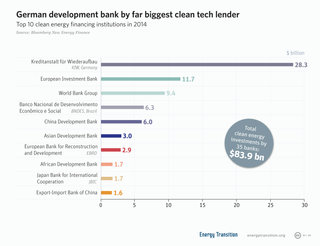
A development financial institution (DFI), also known as a development bank or development finance company (DFC), is a financial institution that provides risk capital for economic development projects on a non-commercial basis.

The Saint Kitts and Nevis passport is issued to citizens of Saint Kitts and Nevis for international travel. Prior to 1983, Saint Kitts and Nevis together with Anguilla, was an associated state of the United Kingdom. The passport is a Caricom passport as Saint Kitts and Nevis is a member of the Caribbean Community.
The economic liberalisation in India refers to the economic liberalization of the country's economic policies with the goal of making the economy more market and service-oriented and expanding the role of private and foreign investment. Indian economic liberalization was part of a general pattern of economic liberalization and modernization occurring across the world in the late 20th century. Although unsuccessful attempts at liberalization were made in 1966 and the early 1980s, a more thorough liberalization was initiated in 1991. The reform was prompted by a balance of payments crisis that had led to a severe recession.
Indian Trusts Act, 1882 is a law in India relating to private trusts and trustees. The Act defines what would lawfully be called as a trust and who can legally be its trustees and provides a definition for them. The Indian Trusts Amendment Bill of 2015 amended the Act and removed some restrictions on investment of the monetary assets by the trust in certain investments. But at the same time, it enabled the government to scrutinise the trusts' investments at will
The Baillie Gifford Japan Trust is a publicly traded investment trust. The Trust invests exclusively in Japan. The Trust is managed by Baillie Gifford & Co Limited, the Edinburgh-based investment management partnership. It is listed on the London Stock Exchange and is a constituent of the FTSE 250 Index.


