
Legendary Lives Player's Primer is the first of two books published by Marquee Press in 1990 required for the role-playing game Legendary Lives .
Legendary Lives Player's Primer is the first of two books published by Marquee Press in 1990 required for the role-playing game Legendary Lives .
Legendary Lives is a medieval fantasy role-playing game largely based upon various types of faeries and other supernatural creatures from northern Europe mythology. Legendary Lives Player's Primer has all of the rules that players need to know for the Legendary Lives role-playing game: player character generation rules, with 26 character races to choose from, 12 spellcasters, other classes, and a Lifeline system to allow players to generate background history for their characters. [1] The book also includes an introductory adventure. [2] The other book required for play is the Referee's Rulebook . [3]
The player first chooses one of 26 different races: Avian, Barbarian, Brownie, Bush Person, Corsair, Draconian, Dwarf, Oriental, Elf, Elfin, Entomolian, Bestial, Firbolg, Forester, Goblin, Gypsy, Hill People, Hob, Netherman, Nomad, Ratling, Serpent, Sidhe, Spriggan, Viking, and Wolfling. [4]
After choosing an occupation for the character, the player then rolls a six-sided dice for each of the character's 12 abilities (Agility, Vigilance, Charm, Cunning, Dexterity, Destiny, Intelligence, Knowledge, Mechanics, Nature, Endurance, and Strength), adding a bonus to each score according to the race chosen. [4]
To see if an action is successful, the gamemaster first assigns the result that is needed to achieve success, which, from worst to best, are Catastrophic, Pathetic, Feeble, Inferior, Poor, Passable, Good, Great, Superior, and Awesome. The player then rolls percentile die, and cross-references the result against their relevant specialty or skill score on an Action Results Table (ART). If the player equals or exceeds the difficulty level set by the gamemaster, the character succeeds at their task. [2]
Combat resolution uses the same ART, with ranges for combat simplified into only three categories: "melee", "thrown missile", and "too far away."
The game is set in a medieval fantasy alternate world called "Le Monde". [4]
In 1990 Marquee Press published two books written by Joe Williams and Kathleen Williams that together form the Legendary Lives role-playing game: Legendary Lives Player's Primer and the Referee's Rulebook. [3] Legendary Lives Player's Primer is a 96-page softcover book with interior art by Wayne Henke, Kathleen Williams and Erik Weiber, and cover art by Wayne Henke. [2]
The two "core" rulebooks were followed in 1991 by the 72-page Legendary Lives Societies Sourcebook , which details the social structure of the various faerie types. [2]
Marquee Press published a revised second edition of Legendary Lives in 1993 that combines the Player's Primer and the Referee's Rulebook into one 272-page softcover book, with additional material by Dmitri Ashling. [5]
Joe and Kathleen Williams would use much the same game rules from Legendary Lives to produce the supernatural role-playing game Lost Souls in 1992. [2]
Stewart Wieck reviewed the product in the August/September 1990 issue of White Wolf Magazine , and noted the game's "excellent game mechanics and fine character generation system" while downplaying its magic system. Wieck concluded with a strong recommendation, saying "Legendary Lives is probably one of the five best fantasy game systems available" at the time, and gave it an overall rating of 4 out of a possible 5. [3]
In the July 1993 edition of Dragon (Issue #195), Lester W. Smith defined both the Legendary Lives Player's Primer and the Referee's Rulebook as "amateur appearance but impressive content." He pointed out that "The Legendary Lives game constitutes a fresh look at role-playing, reflecting a fantasy world that, while it is strongly rooted in European legend, differs considerably from the normal gaming approach to those legends, and having game mechanics that are far different from the norm." For instance, Smith thought the ART system of skill resolution "stresses quick play and storytelling over realism." However, Smith noted some problems, namely that opponents were "wimpy", and that the introductory adventure was "less than clear and overly linear (leading the PCs about 'by the nose')." He also noted that "some people are sure to find the game’s magic system less than satisfactory." But Smith concluded with a strong recommendation, saying, "Overall, the strengths of the Legendary Lives game far outweigh any weaknesses. Because its PC creation system is so entertaining, and its play is so fast in general, it makes a great 'change-of-pace' game. Also, the world it presents is an engaging one [...], capable of handling a wide range of adventure types and standing up to sustained play." [2]
In 2002, Legendary Lives was one of a dozen role-playing games termed by Ron Edwards as "fantasy heartbreakers", which are as Shannon Appelcline explains, "fantasy RPG games that were designed by people who seemed to know nothing about the advancement of game design since the original productions of Dungeons & Dragons ". [6]

Castle Falkenstein is a steampunk-themed fantasy role-playing game (RPG) designed by Mike Pondsmith and originally published by R. Talsorian Games in 1994. The game is named for a legendary unbuilt castle in the Bavarian Alps. Players play the roles of gallant adventurers who take on quests of intrigue and derring-do in the spirit of Victorian adventures such as The Prisoner of Zenda.

An adventure is a playable scenario in a tabletop role-playing game. These can be constructed by gamemasters for their players, and are also released by game publishers as pre-made adventure modules. Different types of designs exist, including linear adventures, where players move between scenes in a predetermined order; non-linear adventures, where scenes can go in multiple directions; and solo adventures, which are played alone, without a game group.

Talislanta is a fantasy role-playing game published by Bard Games in 1987 that forgoes many of the tropes used by popular games of the genre in favor of a unique world and many new game mechanisms. There have been six different English-language editions and several foreign language editions published.

Dark Conspiracy is a near-future horror role-playing game (RPG) originally written by Lester W. Smith and published by Game Designers' Workshop (GDW) in 1991. Several newer editions have been published.
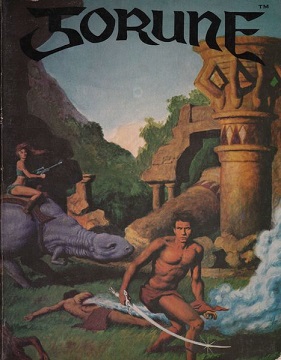
Skyrealms of Jorune is a science-fantasy role-playing game that was first published in 1984 through SkyRealms Publishing. The game is set on the fictional alien planet of Jorune above which float levitating islands. The second edition was published in 1986 as a boxed set, and a third edition was published by Chessex in 1992. The computer game Alien Logic: A Skyrealms of Jorune Adventure was published in 1994. The various editions received positive reviews in game periodicals including Casus Belli, White Dwarf, White Wolf, Different Worlds, Dragon, Polyhedron, The Games Machine, and Challenge.

Recon is a military role-playing game where players assume the role of American soldiers during the Vietnam War. The first edition featured a wargame with role-playing elements, somewhat like Behind Enemy Lines and Twilight 2000, then gradually evolved into a full role-playing game.

GURPS Time Travel is a sourcebook for GURPS. It was written by Steve Jackson and John M. Ford and published in 1991.

Lords of Creation is a multi-genre tabletop role-playing game published by Avalon Hill in 1983. Although expectations were high when Avalon Hill entered the role-playing game market, the game failed to find an audience and was discontinued relatively quickly.

Timemaster is a role-playing game centered on traveling through time and alternate dimensions, published by Pacesetter Ltd in 1984. Players take on the role of Time Corps agents who fix deviations in the timeline of the game. The primary antagonists are the Demoreans, a fictional race of shape-shifting aliens from another dimension who are determined to mold time to suit their needs.

A gamemaster's screen, also called a GM's screen, is a gaming accessory, usually made out of either cardboard or card stock, and is used by the gamemaster to hide all the relevant data related to a tabletop role-playing game session from the players in order to not spoil the plot of the story. It also hides any dice rolls made by the gamemaster that players should not see. In addition, screens often have essential tables and information printed on the inside for the gamemaster to easily reference during play.
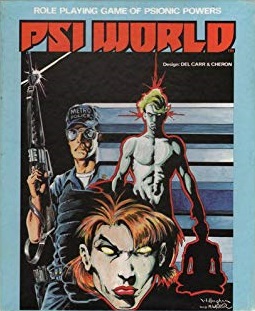
Psi World is a science fiction role-playing game published by Fantasy Games Unlimited (FGU) in 1984 that takes place in a near-future society in which certain individuals have psionic powers.

Year of the Phoenix is a science-fiction role-playing game published by Fantasy Games Unlimited in 1986 in which the characters are accidentally transported a century into the future when Russia has occupied North America.

Hong Kong Action Theatre! is a martial arts role-playing game published by Event Horizon Productions in 1996. A revised edition was published by Guardians of Order in 2001.

Eldritch Role-Playing System is a role-playing game published by Goodman Games in 2008.

The Compleat Alchemist is a generic role-playing game supplement first published by Bard Games in 1982.

Barony, subtitled "Fantasy Role-Play", is a role-playing game published by Better Games in 1990.

Lost Souls is a supernatural horror role-playing game about ghosts published by Sage Lore Productions in 1991, with a second edition published by Marquee Press in 1992. In this game, the player characters are ghosts who must fulfill an unfinished task to move on to the next life. The game received positive reviews in game periodicals including Dragon, White Wolf, and Pyramid.

GURPS Robots is a supplement for GURPS. Written by David Pulver, it was published by Steve Jackson Games in 1995.

Legendary Lives Referee's Rulebook is one of the two books published by Marquee Press in 1990 required for the role-playing game Legendary Lives.

Era Ten, subtitled "Sci Fi Role-Play", is a science fiction role-playing game (RPG) published by Better Games in 1990.