 | The topic of this article may not meet Wikipedia's general notability guideline .(October 2016) |
A Liber beneficiorum ("Book of Benefice") is a register concerning beneficials, benefactors, properties and privileges.
| The topic of this article may not meet Wikipedia's general notability guideline .(October 2016) |
A Liber beneficiorum ("Book of Benefice") is a register concerning beneficials, benefactors, properties and privileges.
 | This article about a non-fiction book is a stub. You can help Wikipedia by expanding it. |

Jan Długosz, also known in Latin as Johannes Longinus, was a Polish priest, chronicler, diplomat, soldier, and secretary to Bishop Zbigniew Oleśnicki of Kraków. He is considered Poland's first historian.

Wilamowice is a rural town in southern Poland, situated in the Bielsko County, Silesian Voivodeship. The town is inhabited by a Germanic ethnic group of Vilamovians, who speak the highly endangered Wymysorys language.

Kozy is a large village with a population of 12,457 (2013) within Bielsko County, located in the historical and geographical south-west region of Lesser Poland, between Kęty and Bielsko-Biała, and about 65 kilometres south-west of Kraków and south of Katowice. It is the largest village in Poland. The village name translates to 'Goats' in English, and has an area of 26,9 km2.

Niskopronounced[ˈɲiskɔ] is a town in Nisko County, Subcarpathian Voivodeship, Poland on the San River, with a population of 15,534 inhabitants as of 2 June 2009. Together with neighbouring city of Stalowa Wola, Nisko creates a small agglomeration. Nisko has been situated in the Subcarpathian Voivodship since 1999.

Ruś Szlachtowska was a name introduced in 1930s by Prof. Roman Reinfuss to denote the region surrounding the villages of Biała and Czarna Woda, Jaworki, and Szlachtowa in the Grajcarek valley in the Pieniny mountains, in the Nowy Targ County of southern Poland.

Godziemba is a Polish coat of arms. A rare medieval Polish knightly coat of arms used by Polish and Austrian noble family Głownia.

Nowa Góra is a village in Poland in Gmina Krzeszowice, Kraków County, Lesser Poland Voivodeship. In the years 1975–1998 it was in Kraków Voivodeship.
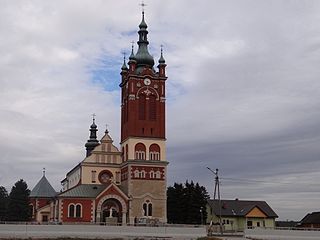
Borzęcin is a village in Brzesko County, Lesser Poland Voivodeship, in southern Poland. It is the seat of the gmina called Gmina Borzęcin. It lies approximately 14 kilometres (9 mi) north-east of Brzesko and 55 km (34 mi) east of the regional capital Kraków. It is located on the Uszwica river and divided into two sołectwos, Upper Borzęcin and Lower Borzęcin. Currently it has a population of about 3,700 inhabitants.

Przyszowa is a village in southern Poland, in the Limanowa County, within the province of Lesser Poland. It lies approximately 61 km (38 mi) south-east of the regional capital Kraków.
Jadowniki is a village in the administrative district of Gmina Pawłów, within Starachowice County, Świętokrzyskie Voivodeship, in south-central Poland. It lies approximately 4 kilometres (2 mi) south-west of Pawłów, 12 km (7 mi) south of Starachowice, and 34 km (21 mi) east of the regional capital Kielce.
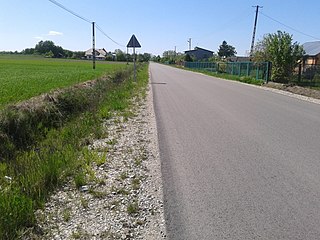
Mokrosęk is a village and sołectwo in the administrative district of Gmina Jedlińsk, within Radom County, Masovian Voivodeship, in the east-central Poland. Sołectwo Mokrosęk contains two villages: Mokrosęk and Gryzów.

Wieprz is a village in Żywiec County, Silesian Voivodeship, in southern Poland. It is the seat of the gmina called Gmina Radziechowy-Wieprz. It lies approximately 7 kilometres (4 mi) south of Żywiec and 70 km (43 mi) south of the regional capital Katowice.
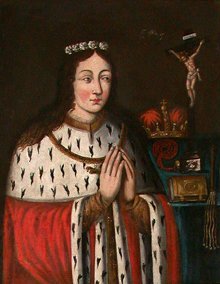
Adelaide of Poland , was a Polish princess and member of the Piast dynasty.

The ruins of Czorsztyn Castle are located in the southernmost part of Poland in Czorsztyn, at Czorsztyn Lake within Pieniny National Park borders. On the other side of the Czorsztyn Lake is located Niedzica Castle.

Tucznawa is a district of the city of Dąbrowa Górnicza, in Silesian Voivodeship, in southern Poland. It was included within city limits in 1977. It is located 11.5 km (7.1 mi) south-east of the city centre and along the route Dąbrowa Górnicza – Zawiercie. Its neighbouring districts are: Sikorka and Bugaj. Tucznawa itself is divided into a few smaller parts: Smardz, Piaski, Rogatka, New Bugaj and Przymiarki. The majority of buildings in the district are single-family homes of country temper, with neighbouring gardens.

Brzęczkowice is a neighbourhood and a part of dzielnica (district) Brzęczkowice and Słupna, in Mysłowice, Silesian Voivodeship, southern Poland. It was previously an independent village and gmina, that was absorbed by Mysłowice in 1945 and again in 1951.
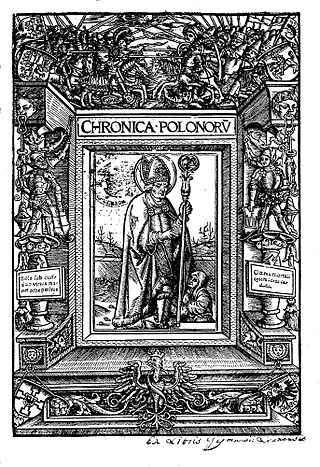
Chronica Polonorum is a treatise about Polish history and geography written in Latin by a Polish renaissance scholar Maciej Miechowita, a professor of Jagiellonian University, historian, geographer, astrologer, and royal physician of king Sigismund I the Old. Chronica Polonorum was first published in 1519.

The Nagorski family - Polish noble family with the coat of arms of Ostoja, belonging to the heraldic Clan Ostoja (Moscics), originating from Nagorzyce (Nagórzyce) in the former province Sandomierz.

The Kraków Land, also known as the Cracow Land, was a land of Poland in the Middle Ages. It was located in the Lesser Poland, and centered around its capital, Kraków. Since 1138, it was a main land of the Seniorate Province, that in 1227, was replaced by the Duchy of Kraków. Around 1314, the area of land was incorporated into Kraków Voivodeship, that was established within the same borders.