
SMS Zrínyi was a Radetzky-class semi-dreadnought battleship (Schlachtschiff) of the Austro-Hungarian Navy, named for the Zrinski, a Croatian-Hungarian noble family. Zrínyi and her sisters, Erzherzog Franz Ferdinand and Radetzky, were the last pre-dreadnoughts built for the Austro-Hungarian Navy.

Lika is a traditional region of Croatia proper, roughly bound by the Velebit mountain from the southwest and the Plješevica mountain from the northeast. On the north-west end Lika is bounded by Ogulin-Plaški basin, and on the south-east by the Malovan pass. Today most of the territory of Lika is part of Lika-Senj County. Josipdol, Plaški and Saborsko are part of Karlovac County and Gračac is part of Zadar County.
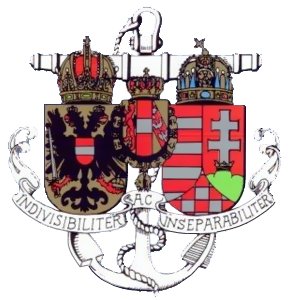
The Austro-Hungarian Navy or Imperial and Royal War Navy was the naval force of Austria-Hungary. Ships of the Austro-Hungarian Navy were designated SMS, for Seiner Majestät Schiff. The k.u.k. Kriegsmarine came into being after the formation of Austria-Hungary in 1867, and ceased to exist in 1918 upon the Empire's defeat and subsequent collapse at the end of World War I.

Marko Orešković was a Croatian and Yugoslav Partisan commander. He was also known by his nickname Krntija.

Naval warfare in the Mediterranean during World War I took place between the naval forces of the Entente and the Central Powers in the Mediterranean Sea between 1914 and 1918.
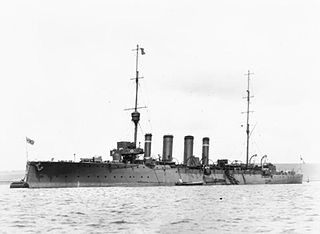
The First Battle of Durazzo was a naval battle of World War I. It was fought off Durazzo, Albania at the end of December 1915 and involved the navies of Austria-Hungary, the United Kingdom, Italy, and France.

The Adriatic Campaign of World War I was a naval campaign fought between the Central Powers and the Mediterranean squadrons of Great Britain, France, the Kingdom of Italy, Australia and the United States.

SMS Radetzky was the first of the three Radetzky-class pre-dreadnought battleships built for the Austro-Hungarian Navy. She was named for the 19th-century Austrian field marshal Joseph Radetzky von Radetz. Radetzky and her sisters, Erzherzog Franz Ferdinand and Zrínyi, were the last pre-dreadnoughts built by the Austro-Hungarian Navy—they were followed by the larger and significantly more powerful Tegetthoff-class dreadnoughts.

The Bombardment of Ancona was a naval engagement of the Adriatic Campaign of World War I between the navies of Italy and Austria-Hungary. Forces of the Imperial and Royal Navy attacked and bombarded military and civilian targets all across Ancona in central Italy and several other nearby islands and communities in response to Italy's declaration of war on Austria-Hungary.
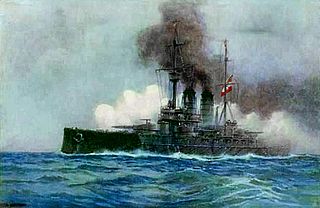
SMS Erzherzog Franz Ferdinand was an Austro-Hungarian Radetzky-class pre-dreadnought battleship commissioned into the Austro-Hungarian Navy on 5 June 1910. She was named after Archduke Franz Ferdinand. The first ship of her class to be built, she preceded Radetzky by more than six months. Her armament included four 30.5 cm (12 in) guns in two twin turrets, and eight 24 cm (9.4 in) guns in four twin turrets.

The Škoda 10 cm K10 was a 100 mm (3.9-inch) naval gun of the Austro-Hungarian Navy used as tertiary armament on semi-dreadnought battleships and as primary armament on scout cruisers and destroyers during World War I. After World War I, variants of the Škoda 10 cm K10 were widely produced in Italy as the 100/47 series of guns, which served in a number of roles, on a wide variety of ships, with a number of navies.

SMS Lika was one of six Tátra-class destroyers built for the kaiserliche und königliche Kriegsmarine shortly before the First World War. Completed in August 1914, she helped to sink an Italian destroyer during the action off Vieste in May 1915 after Italy declared war on Austria-Hungary. Two months later the ship participated in an unsuccessful attempt to recapture a small island in the Central Adriatic Sea from the Italians. In November and early December Lika was one of the ships conducting raids off the Albanian coast to interdict the supply lines between Italy and Albania. The ship was sunk in Durazzo harbor during the early stages of the 1st Battle of Durazzo in late December after striking several mines.

SMS Triglav was one of six Tátra-class destroyers built for the kaiserliche und königliche Kriegsmarine shortly before the First World War. Completed in August 1914, the ship participated in an unsuccessful attempt to recapture a small island in the Central Adriatic Sea from the Italians in July 1915. In November and early December Triglav was one of the ships conducting raids off the Albanian coast to interdict the supply lines between Italy and Albania. She was crippled by a mine during the 1st Battle of Durazzo in late December, but was taken in tow. The ship had to be abandoned when the Austro-Hungarian ships were spotted on the return voyage and she was sunk by French destroyers.
SMS Orjen was one of six Tátra-class destroyers built for the kaiserliche und königliche Kriegsmarine shortly before the First World War. Completed in 1914, she helped to sink an Italian destroyer during the action off Vieste in May 1915 after Italy declared war on Austria-Hungary. Two months later the ship participated in an unsuccessful attempt to recapture a small island in the central Adriatic Sea from the Italians. In November and early December Orjen was one of the ships conducting raids off the Albanian coast to interdict the supply lines between Italy and Albania, although she did not participate in the First Battle of Durazzo in late December. Orjen participated in several raids on the Otranto Barrage in 1916–1917 with limited success. She was transferred to Italy in 1920 in accordance with the peace treaties ending the war and renamed Pola. She mostly served as a training ship or in Italian North Africa when she was not in reserve from 1924 to 1928. Renamed Zenson in 1931, the ship was scrapped in 1937.
SMS Csepel was one of six Tátra-class destroyers built for the kaiserliche und königliche Kriegsmarine shortly before the First World War. Completed in 1913, she helped to sink an Italian destroyer during the action off Vieste in May 1915 after Italy declared war on Austria-Hungary. Two months later the ship participated in an unsuccessful attempt to recapture a small island in the central Adriatic Sea from the Italians. In November and early December Csepel was one of the ships conducting raids off the Albanian coast to interdict the supply lines between Italy and Albania. She was hit one time during the First Battle of Durazzo in late December. Her stern was blown off by a French submarine in early 1916 and her repairs were not completed until early 1917.

SMS Balaton was one of six Tátra-class destroyers built for the kaiserliche und königliche Kriegsmarine shortly before the First World War. Completed in 1913, she did not participate in the attacks on the Italian mainland after Italy declared war on Austria-Hungary in May 1915. Two months later the ship bombarded a small island in the Central Adriatic Sea during an unsuccessful attempt to recapture it from the Italians. In November and early December Balaton was one of the ships conducting raids off the Albanian coast to interdict the supply lines between Italy and Albania. She played a minor role in the 1st Battle of Durazzo in late December. Balaton participated in several unsuccessful raids on the Otranto Barrage in 1917, although she sank an ammunition ship during the Battle of the Strait of Otranto. She was transferred to Italy in 1920 in accordance with the peace treaties ending the war and renamed Zenson. The Regia Marina used her for spare parts; she was discarded in 1923 and subsequently scrapped.

SMS Tátra was the lead ship of her class of six destroyers built for the kaiserliche und königliche Kriegsmarine shortly before the First World War. Completed in 1913, she helped to sink an Italian destroyer during the action off Vieste in May 1915 after Italy declared war on Austria-Hungary. Two months later the ship participated in an unsuccessful attempt to recapture a small island in the Central Adriatic Sea from the Italians. In November and early December Tátra was one of the ships conducting raids off the Albanian coast to interdict the supply lines between Italy and Albania. During the early stages of the 1st Battle of Durazzo in late December, the ship was tasked to tow her one of her sister ships that had been crippled by a mine. She was forced to abandon her sister when the Austro-Hungarians were spotted by a strong force of Allied ships and had to evade their pursuit. Tátra participated in several unsuccessful raids on the Otranto Barrage in 1917. She was transferred to Italy in 1920 in accordance with the peace treaties ending the war and renamed Fasana. The Regia Marina used her for spare parts; she was discarded in 1923 and subsequently scrapped.
SMS Triglav was one of four Ersatz Triglav-class destroyers built for the kaiserliche und königliche Kriegsmarine during the First World War. Completed in 1917, she participated in several unsuccessful raids on the Otranto Barrage later that year. She was transferred to Italy in 1920 in accordance with the peace treaties ending the war and renamed Grado. The Regia Marina kept her in service until 1937 and the ship was subsequently scrapped.
SMS Lika was one of four Ersatz Triglav-class destroyers built for the kaiserliche und königliche Kriegsmarine during the First World War. Completed in 1917, she participated in several unsuccessful raids on the Otranto Barrage later that year. She was transferred to Italy in 1920 in accordance with the peace treaties ending the war and renamed Cortellazzo. The Regia Marina kept her in service until 1939 and the ship was subsequently scrapped.
SMS Dukla was one of four Ersatz Triglav-class destroyers built for the kaiserliche und königliche Kriegsmarine during the First World War. Completed in 1917, she participated in several unsuccessful raids on the Otranto Barrage before the end of the war the following year. She was transferred to France in 1920 in accordance with the peace treaties ending the war and renamed Matelot Leblanc. The French Navy kept her in service until 1936 and the ship was subsequently scrapped.
