
Qi was a state of the Zhou dynasty-era in ancient China, variously reckoned as a march, duchy, and independent kingdom. Its capital was Yingqiu, located within present-day Linzi in Shandong.
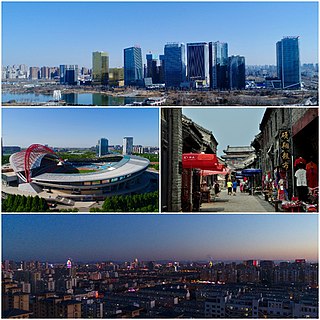
Zibo is a prefecture-level city in central Shandong province, China. It borders the provincial capital of Jinan to the west, Laiwu and Tai'an to the southwest, Linyi to the south, Weifang to the east, Dongying to the northeast, and Binzhou to the north.

Linzi District is a district of the prefecture-level city of Zibo, in central Shandong province, China.

Lindsey Jane Drew, known professionally as Linzi Drew, is an English former glamour model, producer, adult model and pornographic actress.

Linzi, originally called Yingqiu, was the capital of the ancient Chinese state of Qi during the Zhou Dynasty. The ruins of the city lie in modern-day Linzi District, Shandong, China. The city was one of the largest and richest in China during the Spring and Autumn Period. With occupying Linzi in 221 BC, King Zheng of Qin completed his conquest of the Chinese rival states and declared himself the first emperor of Ancient China shortly afterwards. The ruins of the ancient city were excavated in 1926 by Japanese archaeologists and in 1964 by Chinese archaeologists.

Jay Brown is a fictional character from the BBC soap opera EastEnders, played by Jamie Borthwick. He made his first appearance on 14 December 2006.
Linzi Stoppard is a British electric violinist.

Drowning on Dry Land is a 2004 play by British playwright Alan Ayckbourn, his 66th to be produced. Exploring the culture of B-list celebrities, it is a comedy about the rise and fall of Charlie Conrad, a man apparently famous for being a failure.
The 2010 AFC U-19 Championship was the 36th edition of the tournament organized by the Asian Football Confederation.
Linzi Stadium is a football stadium in Linzi, China. It hosts football matches and hosted the 2010 AFC U-19 Championship. The stadium holds 14,000 spectators.
Duke Ping of Jin was from 557 to 532 BC the ruler of the State of Jin, a major power during the Spring and Autumn period of ancient China. His ancestral name was Ji, given name Biao, and Duke Ping was his posthumous name. He succeeded his father, Duke Dao of Jin, who died in 558 BC.
Duke Hu of Qi was the sixth recorded ruler of the ancient Chinese state of Qi during the Western Zhou Dynasty. His personal name was Lü Jing (呂靜), ancestral name Jiang (姜), and Duke Hu was his posthumous title.
Duke Xian of Qi was from 859 to 851 BC the seventh recorded ruler of the State of Qi during the Western Zhou Dynasty of ancient China. His personal name was Lü Shan (呂山), ancestral name Jiang (姜), and Duke Xian was his posthumous title.
Duke Jing of Qi was ruler of the State of Qi from 547 to 490 BC. Qi was a major power during the Spring and Autumn period of ancient China. His personal name was Lü Chujiu (呂杵臼), ancestral name Jiang (姜), and Duke Jing was his posthumous title. After the years of unrest as two powerful ministers, Cui Zhu and Qing Feng, sought to control the state of Qi, Duke Jing appointed Yan Ying as his prime minister, and Qi entered a period of relative peace and prosperity.
Yan, Marquis of Tian was from 383 to 375 BC ruler of the State of Qi, a major power during the Warring States period of ancient China. His personal name was Tián Yǎn (田剡), and ancestral name Gui (媯).
Duke Huan of Tian Qi was from 374 to 357 BC ruler of the State of Qi, a major power during the Warring States period of ancient China. Duke Huan's personal name was Tian Wu (田午), and ancestral name Gui (媯). His official posthumous title was simply Duke Huan of Qi, but he is commonly called Duke Huan of Tian Qi to be distinguished from the original Duke Huan of Qi from the House of Jiang, who was the first of the Five Hegemons of the Spring and Autumn period.

Qingzhou or Qing Province was one of the Nine Provinces of ancient China dating back to c. 2070 BCE that later became one of the thirteen provinces of the Han dynasty. The Nine Provinces were first described in the Tribute of Yu chapter of the classic Book of Documents, with Qingzhou lying to the east of Yuzhou and north of Yangzhou. Qingzhou's primary territory included most of modern Shandong province except the southwest corner.

Zai Yu, also known by his courtesy name Ziwo and as Zai Wo, was a prominent disciple of Confucius, known for his gift in speech. However, Confucius severely criticized him for proposing to shorten the three-year mourning period after the death of a parent.
The war of Qi's succession was a civil war in the State of Qi from 643 to 642 BCE, as the sons of Duke Huan of Qi fought against each other for the throne. Their struggle led to chaos in Qi and the intervention of several outside powers, until Duke Huan's intended heir, Prince Zhao, emerged victorious. Nevertheless, four of Prince Zhao's rival brothers remained at large and continued to conspire for the throne, leading to a succession crisis that plagued Qi for decades. As result, the succession war and its consequences greatly weakened Qi, which lost its status as China's predominant state.
Qi Commandery was a commandery in historical China, located in what is now central Shandong province.
