
Aermacchi was an Italian aircraft manufacturer. Formerly known as Aeronautica Macchi, the company was founded in 1912 by Giulio Macchi at Varese in north-western Lombardy as Nieuport-Macchi, to build Nieuport monoplanes under licence for the Italian military. With a factory located on the shores of Lake Varese, the firm originally manufactured a series of Nieuport designs, as well as seaplanes.

A biplane is a fixed-wing aircraft with two main wings stacked one above the other. The first powered, controlled aeroplane to fly, the Wright Flyer, used a biplane wing arrangement, as did many aircraft in the early years of aviation. While a biplane wing structure has a structural advantage over a monoplane, it produces more drag than a monoplane wing. Improved structural techniques, better materials and higher speeds made the biplane configuration obsolete for most purposes by the late 1930s.

The Sopwith Pup is a British single-seater biplane fighter aircraft built by the Sopwith Aviation Company. It entered service with the Royal Naval Air Service and the Royal Flying Corps in the autumn of 1916. With pleasant flying characteristics and good manoeuvrability, the aircraft proved very successful. The Pup was eventually outclassed by newer German fighters, but it was not completely replaced on the Western Front until the end of 1917. Remaining Pups were relegated to Home Defence and training units. The Pup's docile flying characteristics also made it ideal for use in aircraft carrier deck landing and takeoff experiments and training.
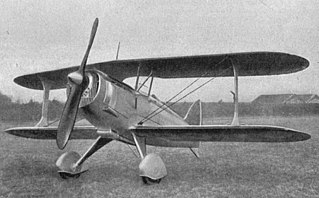
The Blériot SPAD S.510 was a French single-seat, single-engined biplane fighter aircraft. First flying in 1933, 60 were built for the Armée de l'Air, entering service in 1936. The type remained in service as a fighter-trainer at the start of the Second World War. It was the last French biplane fighter to enter production.

Nieuport, later Nieuport-Delage, was a French aeroplane company that primarily built racing aircraft before World War I and fighter aircraft during World War I and between the wars.
World War I was the first major conflict involving the large-scale use of aircraft. Tethered observation balloons had already been employed in several wars, and would be used extensively for artillery spotting. Germany employed Zeppelins for reconnaissance over the North Sea and Baltic and also for strategic bombing raids over Britain and the Eastern Front.
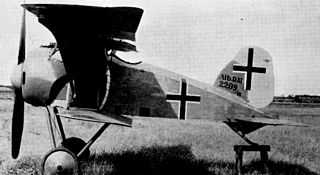
The Idflieg designation system was used to classify German heavier-than-air military aircraft from the early days of the Fliegertruppe/Luftstreitkräfte to the end of World War I. The system evolved during this period as new classes of aircraft came into use.

A triplane is a fixed-wing aircraft equipped with three vertically stacked wing planes. Tailplanes and canard foreplanes are not normally included in this count, although they occasionally are.

The SPAD S.XIII is a French biplane fighter aircraft of the First World War, developed by Société Pour L'Aviation et ses Dérivés (SPAD) from the earlier and highly successful SPAD S.VII.

SPAD was a French aircraft manufacturer active between 1911 and 1921. Its SPAD S.XIII biplane was the most produced French fighter airplane of the First World War.
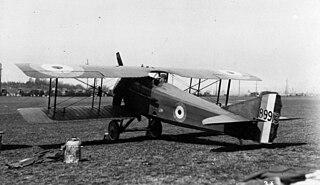
The SPAD S.VII was the first of a series of highly successful biplane fighter aircraft produced by Société Pour L'Aviation et ses Dérivés (SPAD) during the First World War. Like its successors, the S.VII was renowned as a sturdy and rugged aircraft with good climbing and diving characteristics. It was also a stable gun platform, although pilots used to the more manoeuvrable Nieuport fighters found it heavy on the controls. It was flown by a number of the famous aces, such as France's Georges Guynemer, Italy's Francesco Baracca and Australia's Alexander Pentland.

The Deutsche Luftstreitkräfte —known before October 1916 as Die Fliegertruppen des deutschen Kaiserreiches abbreviated to Die Fliegertruppe—was the air arm of the Imperial German Army. In English-language sources it is usually referred to as the Imperial German Air Service, although that is not a literal translation of either name. German naval aviators of the Marine-Fliegerabteilung were an integral part of the Imperial German Navy. Both military branches operated aeroplanes, observation balloons and airships.

The Nieuport 28 C.1, a French biplane fighter aircraft flown during World War I, was built by Nieuport and designed by Gustave Delage. Owing its lineage to the successful line of sesquiplane fighters that included the Nieuport 17, the Nieuport 28 continued a similar design philosophy of a lightweight and highly maneuverable aircraft.

The Nieuport 10 was a French First World War sesquiplane that filled a wide variety of roles including reconnaissance, fighter and trainer.
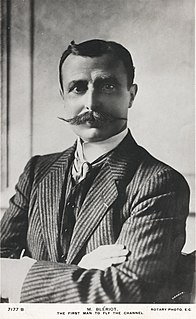
Blériot Aéronautique was a French aircraft manufacturer founded by Louis Blériot. It also made a few motorcycles between 1921 and 1922 and cyclecars during the 1920s.

The SPAD S.XII or SPAD 12 was a French single-seat biplane fighter aircraft of the First World War developed from the successful SPAD VII by Louis Béchereau, chief designer of the Société Pour L'Aviation et ses Dérivés (SPAD).

The SPAD S.XI or SPAD 11 was a French two-seat biplane reconnaissance aircraft of the First World War. The SPAD 11 was the work of Louis Béchereau, chief designer of the Société Pour L'Aviation et ses Dérivés (SPAD), who also designed the highly successful SPAD 7 and SPAD 13 single-seat fighter aircraft. It was developed under military specification C2, which called for a two-seat fighter aircraft. As a result of its failure to meet the levels of performance and agility demanded by the C2 specification, the SPAD 11 was used, along with the more successful Salmson 2 and Breguet 14, to replace ageing Sopwith 1½ Strutter and Dorand AR reconnaissance aircraft. Persistent problems with the SPAD 11 led to its early replacement by the SPAD S.XVI or SPAD 16 variant.