
Lee Harvey Oswald was a U.S. Marine veteran who assassinated John F. Kennedy, the 35th president of the United States, on November 22, 1963.

Nikolai Ivanovich Bukharin was a Russian revolutionary, Soviet politician, and Marxist theorist. A prolific author on economic theory, Bukharin was a prominent Bolshevik and was active in the leadership of the Communist Party of the Soviet Union from 1917 until his purge in the 1930s.
Russian(s) refers to anything related to Russia, including:
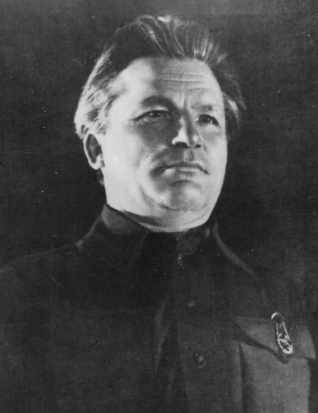
Sergei Mironovich Kirov was a Russian and Soviet politician and Bolshevik revolutionary.

The Tehran Conference was a strategy meeting of Joseph Stalin, Franklin D. Roosevelt, and Winston Churchill from 28 November to 1 December 1943. It was held at the Soviet Union's embassy at Tehran in Iran. It was the first of the World War II conferences of the "Big Three" Allied leaders and closely followed the Cairo Conference, which had taken place on 22–26 November 1943, and preceded the 1945 Yalta and Potsdam conferences. Although the three leaders arrived with differing objectives, the main outcome of the Tehran Conference was the Western Allies' commitment to open a second front against Nazi Germany. The conference also addressed the 'Big Three' Allies' relations with Turkey and Iran, operations in Yugoslavia and against Japan, and the envisaged postwar settlement. A separate contract signed at the conference pledged the Big Three to recognize Iranian independence.

Akhmad-Khadzhi Abdulkhamidovich Kadyrov was a Russian politician and revolutionary who served as Chief Mufti of the Chechen Republic of Ichkeria in the 1990s during and after the First Chechen War. At the outbreak of the Second Chechen War he switched sides, offering his service to the Russian government, and later became the President of the Chechen Republic from 5 October 2003, having acted as head of administration since July 2000.

Symon Vasylyovych Petliura was a Ukrainian politician and journalist. He was the Supreme Commander of the Ukrainian People's Army (UNA) and led the Ukrainian People's Republic during the Ukrainian War of Independence, a part of the wider Russian Civil War.
The "doctors' plot" was a Soviet state-sponsored antisemitic campaign and conspiracy theory that alleged a cabal of prominent medical specialists, predominantly of Jewish ethnicity, intended to murder leading government and party officials. It was also known as the case of saboteur doctors or killer doctors. In 1951–1953, a group of predominantly Jewish doctors from Moscow were accused of a conspiracy to assassinate Soviet leaders. This was later accompanied by publications of antisemitic character in the media which talked about the threats of Zionism and condemned people with Jewish surnames. Following this, many doctors, both Jews and non-Jews, were dismissed from their jobs, arrested, and tortured to produce admissions. A few weeks after Stalin's death in 1953, the new Soviet leadership said there was a lack of evidence regarding the doctors' plot and the case was dropped. Soon after, the case was declared to have been a fabrication.
The Russian mafia, otherwise referred to as Bratva, is a collective of various organized crime elements originating in the former Soviet Union (FSU). Any of the mafia's groups may be referred to as an "Organized Criminal Group" (OPG). This is sometimes modified to include a specific name, such as the Orekhovskaya OPG. The "P" in the initialism comes from the Russian word for criminal: prestupnaya. Sometimes, the Russian word is dropped in favour of a full translation, and OCG is used instead of OPG.
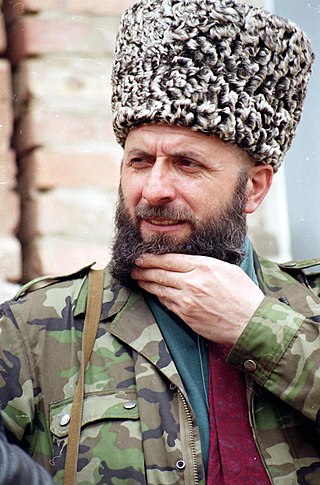
Zelimkhan Abdulmuslimovich Yandarbiyev was a writer and politician from Chechnya, who served as acting president of the breakaway Chechen Republic of Ichkeria between 1996 and 1997. Yandarbiyev was deemed by UN a suspected associate of Al-Qaida extremist group, and is the first of Chechen leader to be named part of Al-Qaida terrorist network. In 2004, Yandarbiyev was assassinated while in exile in Qatar.
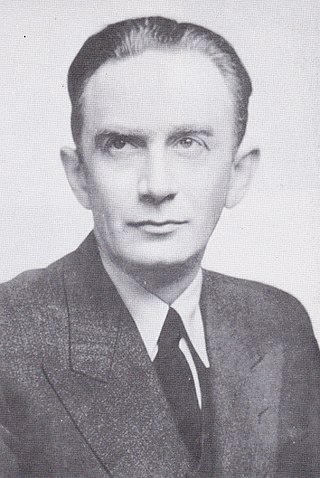
Walter Germanovich Krivitsky was a Soviet intelligence officer who revealed plans of signing the Molotov–Ribbentrop Pact after he defected to the West.

Active measures is a term used to describe political warfare conducted by the Soviet Union and the Russian Federation. The term, which dates back to the 1920s, includes operations such as espionage, propaganda, sabotage and assassination, based on foreign policy objectives of the Soviet and Russian governments. Active measures have continued to be used by the administration of Vladimir Putin.
As early as the 1920s, the Soviet Union, through its GRU, OGPU, NKVD, and KGB intelligence agencies, used Russian and foreign-born nationals, as well as Communists of American origin, to perform espionage activities in the United States, forming various spy rings. Particularly during the 1940s, some of these espionage networks had contact with various U.S. government agencies. These Soviet espionage networks illegally transmitted confidential information to Moscow, such as information on the development of the atomic bomb. Soviet spies also participated in propaganda and disinformation operations, known as active measures, and attempted to sabotage diplomatic relationships between the U.S. and its allies.

Anti-Sovietism or anti-Soviet sentiment refers to persons and activities that were actually or allegedly aimed against the Soviet Union or government power within the Soviet Union.
Yakov Grigoryevich Blumkin was a Left Socialist-Revolutionary, a Bolshevik, and an agent of the Cheka and the Joint State Political Directorate (OGPU).
Golubev or Golubeva is a Russian last name, derived from the Russian word голубь. It may refer to:

The 17th Congress of the All-Union Communist Party (Bolsheviks) was held during 26 January – 10 February 1934. The congress was attended by 1,225 delegates with a casting vote and 736 delegates with a consultative vote, representing 1,872,488 party members and 935,298 candidate members.
Ukrainian nationalism is the promotion of the unity of Ukrainians as a people and the promotion of the identity of Ukraine as a nation state. The origins of modern Ukrainian nationalism emerge during the 17th-century Cossack uprising against the Polish–Lithuanian Commonwealth led by Bohdan Khmelnytsky. Ukrainian nationalism draws upon a single national identity of culture, ethnicity, geographic location, language, politics, religion, traditions and belief in a shared singular history, that dates back to the 9th century.
Boris Georgiyevich Bazhanov was a Soviet secretary of the Secretariat of the Communist Party of the Soviet Union who defected from the Soviet Union on 1 January 1928.
The CIA Kennedy assassination is a prominent John F. Kennedy assassination conspiracy theory. According to ABC News, the Central Intelligence Agency (CIA) is represented in nearly every theory that involves American conspirators. The secretive nature of the CIA, and the conjecture surrounding the high-profile political assassinations in the United States during the 1960s, has made the CIA a plausible suspect for some who believe in a conspiracy. Conspiracy theorists have ascribed various motives for CIA involvement in the assassination of President Kennedy, including Kennedy's firing of CIA director Allen Dulles, Kennedy's refusal to provide air support to the Bay of Pigs invasion, Kennedy's plan to cut the agency's budget by 20 percent, and the belief that the president was weak on communism.
