The name Bess has been used for one tropical cyclone in the Atlantic Ocean, and ten tropical cyclones in the western Pacific.
Bess was used for one tropical cyclone in the Atlantic:
Bess was used for ten tropical cyclones in the Western Pacific:
The name Bess was retired after the 1974 season, and replaced by Bonnie. However, when the tropical cyclone naming lists changed in 1979, Bess was re-included. The name Bess was re-retired after the 1982 season, and replaced by Brenda.
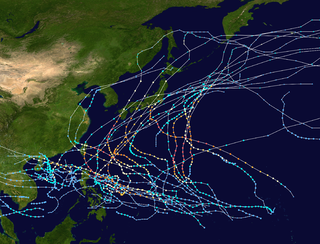
The 1979 Pacific typhoon season featured the largest and most intense tropical cyclone recorded globally, Typhoon Tip. The season also experienced slightly below-average tropical cyclone activity. The season had no official bounds; it ran year-round in 1979, but most tropical cyclones tend to form in the northwestern Pacific Ocean between June and December. These dates conventionally delimit the period of each year when most tropical cyclones form in the northwestern Pacific Ocean.
The 1974 Pacific typhoon season was the first season on record to not feature a Category 5 equivalent super typhoon; a feat later repeated by the 1977 and 2017 seasons. Even so, the season was overly active, with 32 tropical storms and 16 typhoons being developed this year. It has no official bounds; it ran year-round in 1974, but most tropical cyclones tend to form in the northwestern Pacific Ocean between June and December. These dates conventionally delimit the period of each year when most tropical cyclones form in the northwestern Pacific Ocean.
The 1965 Pacific typhoon season has no official bounds; it ran year-round in 1965, but most tropical cyclones tend to form in the northwestern Pacific Ocean between June and December. These dates conventionally delimit the period of each year when most tropical cyclones form in the northwestern Pacific Ocean.
Typhoon Bess, was a powerful, deadly, and destructive tropical cyclone, which was the deadliest typhoon to hit Japan since Tip in 1979. The eleventh tropical storm, sixth typhoon, and first super typhoon of the 1982 Pacific typhoon season, the system first developed on July 21. Two days later, it was upgraded into a tropical storm, and subsequently began to intensify while tracking northwest. Bess attained typhoon intensity on July 24, before it briefly turned southwest. After turning north-northwest, the typhoon entered a period of rapid intensification and late on July 28 reached peak winds of 230 km/h (145 mph). After turning north, Bess began to weaken as it encountered less favorable conditions. On August 1, Bess was downgraded into a tropical storm. Shortly after that, the storm struck southeastern Japan, and on August 2 merged with a low pressure area atop of the Sea of Japan.
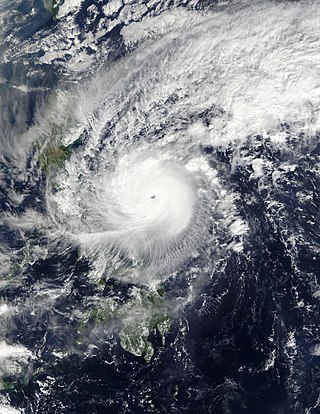
Typhoon Nock-ten, known in the Philippines as Super Typhoon Nina, was the strongest Christmas Day tropical cyclone worldwide in terms of 1-minute sustained winds. Forming as a tropical depression southeast of Yap and strengthening into the twenty-sixth tropical storm of the annual typhoon season on December 21, 2016, Nock-ten intensified into the thirteenth typhoon of the season on December 23. Soon afterwards, the system underwent explosive intensification and became a Category 5-equivalent super typhoon early on December 25. Nock-ten weakened shortly afterwards before making eight landfalls over the Philippines. The typhoon weakened rapidly due to the landfalls as it entered the South China Sea on December 26, turned southwest, and ultimately dissipated on December 28 due to the winter monsoon.