
The 1996 Atlantic hurricane season had the most major hurricanes since 1950, which are Category 3 or higher on the Saffir-Simpson scale. The season was above-average, featuring a total of thirteen named storms, nine hurricanes, and six major hurricanes. The season officially began on June 1, 1996 and ended on November 30, 1996, dates which conventionally delimit the period of each year when most tropical cyclones form in the Atlantic basin. The season's first tropical cyclone, Tropical Storm Arthur, developed on June 17, while the final cyclone, Hurricane Marco dissipated on November 26. The most intense hurricane, Edouard, was a powerful Cape Verde-type hurricane that affected portions of the Mid-Atlantic states and New England. The season featured nine tropical cyclone landfalls, including six hurricanes, one of which was a major hurricane. In total, six major hurricanes formed during the 1996 Atlantic hurricane season—the highest number produced in a single season since 1950.
The name Bonnie has been used for ten tropical cyclones worldwide, eight in the Atlantic Ocean and one each in the Western Pacific and the Australian region of the Southern Hemisphere.

Hurricane Cesar–Douglas was one of the few tropical cyclones to survive the crossover from the Atlantic to east Pacific basin, and was the last to receive two names upon doing so. Hurricane Cesar was the third named storm and second hurricane of the 1996 Atlantic hurricane season. The system formed in the southern Caribbean Sea and affected several countries in South America before crossing Nicaragua and entering the Eastern Pacific where it was renamed Hurricane Douglas, the fourth named storm, third hurricane, and first and strongest major hurricane of the 1996 Pacific hurricane season. The storm killed 113 people in Central and South America and left 29 others missing, mainly due to flooding and mudslides.
The name Bertha has been used for ten tropical cyclones in the Atlantic Ocean.
The name Dolly has been used for twelve tropical cyclones worldwide.

The 1996 Pacific hurricane season is tied with 2021 for the most Pacific hurricanes to make landfall on Mexico in one year, with four striking the country. It was a below average season that produced 9 tropical storms, 5 hurricanes and 2 major hurricanes. With 9 tropical storms, 1996 ranks as the second-least active Pacific hurricane season on record. It officially began May 15, 1996, in the eastern north Pacific and on June 1, 1996, in the central north Pacific. It ended on November 30, 1996. These dates conventionally delimit the period of each year when most tropical cyclones form in the northeastern Pacific Ocean. The season slightly exceeded these bounds when tropical storm One-E formed on May 13.
The name Douglas has been used for seven tropical cyclones in the Eastern Pacific Ocean.
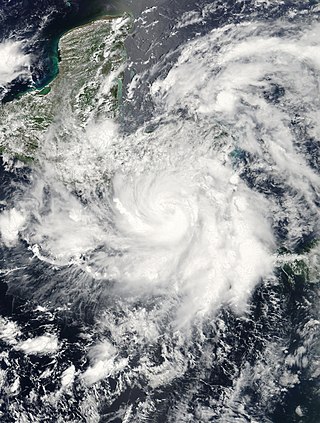
Tropical Storm Alma of the 2008 Pacific hurricane season was the easternmost forming Pacific tropical cyclone on record. It formed within the monsoon trough just off the coast of Costa Rica on May 29. Initially forecast to remain a weak tropical storm, the cyclone rapidly strengthened and developed an eye, before making landfall on May 29 in Nicaragua, near León, with peak winds of 65 mph (105 km/h). Alma degenerated into a remnant low on May 30, before merging with another approaching tropical wave in the Gulf of Honduras shortly afterward, which became Tropical Storm Arthur on the next day. Alma was the first tropical storm on record to strike the Pacific coast of Nicaragua. In Costa Rica, heavy rainfall caused flooding and landslides, killing two and causing $35 million (USD) in damage. Three people were killed in Nicaragua, one from drowning and two others from electrocution. Five others died in Honduras from an aviation accident likely related to the storm and one other was swept away in floodwaters.
The 1996 Atlantic hurricane season had 13 named storms, of which 9 became hurricanes and 6 became major hurricanes. These major hurricanes were Bertha, Edouard, Fran, Hortense, Isidore, and Lili. This timeline documents all the storm formations, strengthening, weakening, landfalls, extratropical transitions, as well as dissipation. The timeline also includes information that was not operationally released, meaning that information from post-storm reviews by the National Hurricane Center, such as information on a storm that was not operationally warned on, has been included. The season officially began on June 1, 1996, and ended on November 30 that same year.

Hurricane Otto was a strong late-season tropical cyclone that impacted parts of Central America in November 2016. It was the first Atlantic hurricane since Cesar–Douglas in 1996 to survive the crossover from the Atlantic Ocean to the Pacific Ocean. Forming late on November 20 in the southwestern Caribbean Sea, Otto was the fifteenth and final named storm, seventh hurricane and fourth major hurricane of the 2016 Atlantic hurricane season. It quickly intensified into a strong tropical storm the next day, and on November 23–24, rapidly strengthened into a Category 3 hurricane, the first in the month of November since Hurricane Paloma in 2008, and the latest date an Atlantic hurricane attained such intensity on record. Otto made landfall in Nicaragua at peak intensity on November 24, thus becoming the latest hurricane to make landfall in the Atlantic basin since 1851 when records began. Traveling along the Nicaragua–Costa Rica border, the system rapidly weakened to a tropical storm before emerging over the eastern Pacific Ocean, becoming the final storm of the 2016 Pacific hurricane season as well. Hostile environmental conditions inhibited reorganization, and Otto subsequently degenerated into an elongated trough on November 26.

Nicaragua, officially the Republic of Nicaragua, is the largest country in the Central American isthmus, bordered by Honduras to the northwest, the Caribbean to the east, Costa Rica to the south, and the Pacific Ocean to the southwest. Tropical cyclones are common in the country, with an average of one storm a year. The coast is especially subject to destructive tropical storms and hurricanes, particularly from July through October. The high winds and floods, accompanying these storms often cause considerable destruction of property. Hurricanes or heavy rains in the central highlands where agriculture has destroyed much of the natural vegetation also cause considerable crop damage and soil erosion. One of the deadliest hurricanes to hit Nicaragua has been Hurricane Mitch in 1998, in which the storm killed thousands in the country.

During 1996, tropical cyclones formed within seven different tropical cyclone basins, located within various parts of the Atlantic, Pacific, and Indian Oceans. During the year, a total of 139 tropical cyclones formed in bodies of water known as tropical cyclone basins. 90 of them were named by various weather agencies when they attained maximum sustained windS of 35 knots. The strongest tropical cyclone of the year was Cyclone Daniella, peaking with a pressure of 915 hPa (27.02 inHg) in the open waters of the Indian Ocean. Hurricane Fran and Typhoon Herb tie for the costliest storm of the year, both with a damage cost of $5 billion. The deadliest tropical cyclone of the year was the 1996 Andhra Pradesh cyclone, which was blamed for over 1,000 fatalities as it directly affected the state of Andhra Pradesh in India. Five Category 5 tropical cyclones were formed in 1996.
