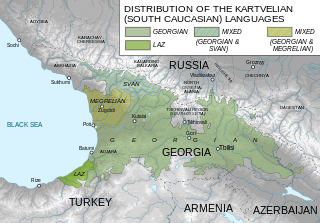
Georgian is the most widely spoken Kartvelian language. It is the official language of Georgia and the native or primary language of 88% of its population. It also serves as the literary language or lingua franca for speakers of related languages. Its speakers today amount to approximately 3.8 million. Georgian is written with its own unique Georgian scripts, alphabetical systems of unclear origin.

Mary Johnston was an American novelist and women's rights advocate from Virginia. She was one of America's best selling authors during her writing career and had three silent films adapted from her novels. Johnston was also an active member of the Equal Suffrage League of Virginia, using her writing skills and notability to draw attention to the cause of women's suffrage in Virginia.
Butt is a German and an English surname whose origins lie in the South West peninsula region of England.

Anita Lily Pollitzer was an American photographer and suffragist.
Georgia most commonly refers to:
Fortson is a surname. Notable people with the surname include:
Mary Johnson may refer to:

Lucy Gwynne Branham was an American suffragist associated with the National Women's Party.

Women's suffrage was established in the United States on a full or partial basis by various towns, counties, states, and territories during the latter decades of the 19th century and early part of the 20th century. As women received the right to vote in some places, they began running for public office and gaining positions as school board members, county clerks, state legislators, judges, and, in the case of Jeannette Rankin, as a member of Congress.
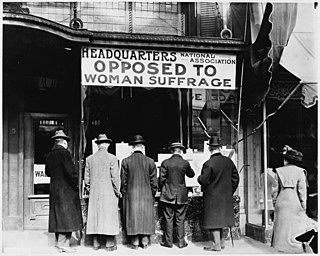
The National Association Opposed to Women Suffrage (NAOWS) was founded in the United States by women opposed to the suffrage movement in 1911. It was the most popular anti-suffrage organization in northeastern cities. NAOWS had influential local chapters in many states, including Texas and Virginia.
Alice Harrell Strickland was an American politician and activist from Duluth, Georgia. Strickland was the first woman to be elected mayor in the U.S. state of Georgia. She was also known for philanthropic work including establishing the first community forest in Georgia. In 2002 she was posthumously named a Georgia Woman of Achievement.

The "Prison Special" was a train tour organized by suffragists who, as members of the Silent Sentinels and other demonstrations, had been jailed for picketing the White House in support of passage of the federal women's suffrage amendment. In February 1919, 26 members of the National Woman's Party boarded a chartered train they dubbed the "Democracy Limited" in Washington, D.C. They visited cities across the country where they spoke to large crowds about their experiences as political prisoners at Occoquan Workhouse, and were typically dressed in their prison uniforms. The tour, which concluded in March 1919, helped create support for the ratification effort that ended with the adoption of the Nineteenth Amendment on August 26, 1920.

The Historiography of the Suffragette Campaign deals with the various ways Suffragettes are depicted, analysed and debated within historical accounts of their role in the campaign for women's suffrage in early 20th century Britain.

The first women's suffrage group in Georgia, the Georgia Woman Suffrage Association (GWSA), was formed in 1892 by Helen Augusta Howard. Over time, the group, which focused on "taxation without representation" grew and earned the support of both men and women. Howard convinced the National American Women's Suffrage Association (NAWSA) to hold their first convention outside of Washington, D.C., in 1895. The convention, held in Atlanta, was the first large women's rights gathering in the Southern United States. GWSA continued to hold conventions and raise awareness over the next years. Suffragists in Georgia agitated for suffrage amendments, for political parties to support white women's suffrage and for municipal suffrage. In the 1910s, more organizations were formed in Georgia and the number of suffragists grew. In addition, the Georgia Association Opposed to Woman Suffrage also formed an organized anti-suffrage campaign. Suffragists participated in parades, supported bills in the legislature and helped in the war effort during World War I. In 1917 and 1919, women earned the right to vote in primary elections in Waycross, Georgia and in Atlanta respectively. In 1919, after the Nineteenth Amendment went out to the states for ratification, Georgia became the first state to reject the amendment. When the Nineteenth Amendment became the law of the land, women still had to wait to vote because of rules regarding voter registration. White Georgia women would vote statewide in 1922. Native American women and African-American women had to wait longer to vote. Black women were actively excluded from the women's suffrage movement in the state and had their own organizations. Despite their work to vote, Black women faced discrimination at the polls in many different forms. Georgia finally ratified the Nineteenth Amendment on February 20, 1970.
Adele Logan Alexander is an American academic and author who is a history professor at George Washington University. She is known for her work on family history, gender, and social issues in African American families.
This page is based on this
Wikipedia article Text is available under the
CC BY-SA 4.0 license; additional terms may apply.
Images, videos and audio are available under their respective licenses.
