
The economy of the Bahamas is dependent upon tourism and offshore banking. The Bahamas is the richest country in the West Indies and is ranked 14th in North America for nominal GDP. It is a stable, developing nation in the Lucayan Archipelago, with a population of 391,232 (2016). Steady growth in tourism receipts and a boom in construction of new hotels, resorts, and residences had led to solid GDP growth for many years. The slowdown in the Economy of the United States and the September 11 attacks held back growth in these sectors from 2001 to 2003.

Gross domestic product (GDP) is a monetary measure of the market value of all the final goods and services produced in a specific time period by countries. GDP (nominal) per capita does not, however, reflect differences in the cost of living and the inflation rates of the countries; therefore, using a basis of GDP per capita at purchasing power parity (PPP) may be more useful when comparing living standards between nations, while nominal GDP is more useful comparing national economies on the international market. Total GDP can also be broken down into the contribution of each industry or sector of the economy. The ratio of GDP to the total population of the region is the per capita GDP and the same is called Mean Standard of Living.

The economy of Trinidad and Tobago is the third wealthiest in the Caribbean and the fifth-richest by GDP (PPP) per capita in the Americas. Trinidad and Tobago is recognised as a high-income economy by the World Bank. Unlike most of the English-speaking Caribbean, the country's economy is primarily industrial, with an emphasis on petroleum and petrochemicals. The country's wealth is attributed to its large reserves and exploitation of oil and natural gas.
Purchasing power parity (PPP) is the measurement of prices in different countries that uses the prices of specific goods to compare the absolute purchasing power of the countries' currencies, and, to some extent, their people's living standards. In many cases, PPP produces an inflation rate equal to the price of the basket of goods at one location divided by the price of the basket of goods at a different location. The PPP inflation and exchange rate may differ from the market exchange rate because of tariffs, and other transaction costs. The Purchasing Power Parity indicator can be used to compare economies regarding their GDP, labour productivity and actual individual consumption, and in some cases to analyse price convergence and to compare the cost of living between places. The calculation of the PPP, according to the OECD, is made through a basket of goods that contains a "final product list [that] covers around 3,000 consumer goods and services, 30 occupations in government, 200 types of equipment goods and about 15 construction projects".
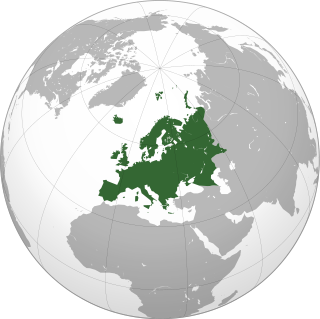
This page compares the sovereign states of Europe on economic, financial and social indicators.
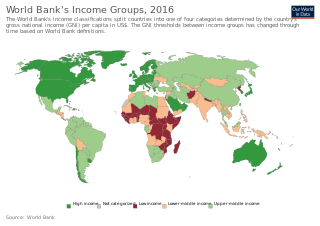
The gross national income (GNI), previously known as gross national product (GNP), is the total domestic and foreign output claimed by residents of a country, consisting of gross domestic product (GDP), plus factor incomes earned by foreign residents, minus income earned in the domestic economy by nonresidents. Comparing GNI to GDP shows the degree to which a nation's GDP represents domestic or international activity. GNI has gradually replaced GNP in international statistics. While being conceptually identical, it is calculated differently. GNI is the basis of calculation of the largest part of contributions to the budget of the European Union. In February 2017, Ireland's GDP became so distorted from the base erosion and profit shifting ("BEPS") tax planning tools of U.S. multinationals, that the Central Bank of Ireland replaced Irish GDP with a new metric, Irish Modified GNI. In 2017, Irish GDP was 162% of Irish Modified GNI.
This page is based on this
Wikipedia article Text is available under the
CC BY-SA 4.0 license; additional terms may apply.
Images, videos and audio are available under their respective licenses.
