See also

This article includes a nobility-related list of lists.
Lists of marquessates or marquisates include:

A marquess is a nobleman of high hereditary rank in various European peerages and in those of some of their former colonies. The German-language equivalent is Markgraf (margrave). A woman with the rank of a marquess or the wife of a marquess is a marchioness or marquise. These titles are also used to translate equivalent Asian styles, as in Imperial China and Imperial Japan.
The Peerage of Ireland consists of those titles of nobility created by the English monarchs in their capacity as Lord or King of Ireland, or later by monarchs of the United Kingdom of Great Britain and Ireland. It is one of the five divisions of Peerages in the United Kingdom. The creation of such titles came to an end in the 19th century. The ranks of the Irish peerage are duke, marquess, earl, viscount and baron. As of 2016, there were 135 titles in the Peerage of Ireland extant: two dukedoms, ten marquessates, 43 earldoms, 28 viscountcies, and 52 baronies. However, these titles have no official recognition in Ireland, with Article 40.2 of the Constitution of Ireland forbidding the state conferring titles of nobility and stating that an Irish citizen may not accept titles of nobility or honour except with the prior approval of the Irish government.

Marquess of Queensberry is a title in the Peerage of Scotland. The title has been held since its creation in 1682 by a member of the Douglas family. The Marquesses also held the title of Duke of Queensberry from 1684 to 1810, when it was inherited by the Duke of Buccleuch.
The Peerage of England comprises all peerages created in the Kingdom of England before the Act of Union in 1707. From that year, the Peerages of England and Scotland were closed to new creations, and new peers were created in a single Peerage of Great Britain. There are five peerages in the United Kingdom in total. English Peeresses obtained their first seats in the House of Lords under the Peerage Act 1963 from which date until the passage of the House of Lords Act 1999 all Peers of England could sit in the House of Lords.

The title Duke of Queensberry was created in the Peerage of Scotland on 3 February 1684 along with the subsidiary title Marquess of Dumfriesshire for the 1st Marquess of Queensberry. The Dukedom was held along with the Marquessate of Queensberry until the death of the 4th Duke in 1810, when the Marquessate was inherited by Sir Charles Douglas of Kelhead, 5th Baronet, while the Dukedom was inherited by the 3rd Duke of Buccleuch. Since then the title of Duke of Queensberry has been held by the Dukes of Buccleuch.
The Peerage of Great Britain comprises all extant peerages created in the Kingdom of Great Britain between the Acts of Union 1707 and the Acts of Union 1800. It replaced the Peerage of England and the Peerage of Scotland, but was itself replaced by the Peerage of the United Kingdom in 1801.
The Peerage of the United Kingdom is one of the five Peerages in the United Kingdom. It comprises most peerages created in the United Kingdom of Great Britain and Ireland after the Acts of Union in 1801, when it replaced the Peerage of Great Britain. New peers continued to be created in the Peerage of Ireland until 1898

The titles of Earl of Hertford and Marquess of Hertford have been created several times in the peerages of England and Great Britain.
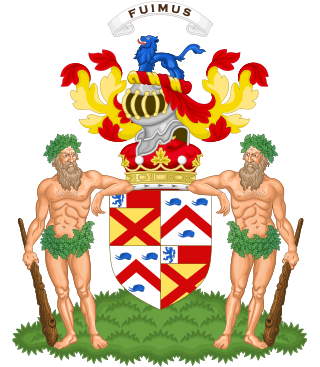
Marquess of Ailesbury, in the County of Buckingham, is a title in the Peerage of the United Kingdom. It was created on 17 July 1821 for Charles Brudenell-Bruce, 2nd Earl of Ailesbury.
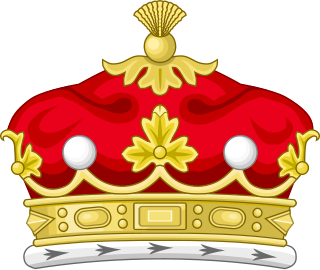
Marquess of Reading is a title in the Peerage of the United Kingdom. It was created in 1926 for Rufus Isaacs, who had been Member of Parliament for Reading between 1904 and 1913, before serving as Viceroy of India and Lord Chief Justice of England and Wales. He had already been created Baron Reading, of Erleigh in the County of Berkshire, in 1914, Viscount Reading, of Erleigh in the County of Berkshire, in 1916, and Viscount Erleigh, of Erleigh in the County of Berkshire, and Earl of Reading, in 1917.
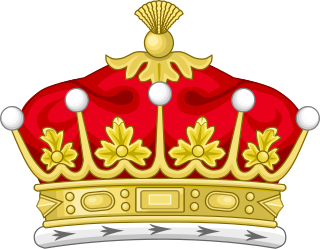
Earl of Cardigan is a title in the Peerage of England, currently held by the Marquesses of Ailesbury, and used as a courtesy title by the heir apparent to that Marquessate, currently Thomas Brudenell-Bruce, Earl of Cardigan, son of the 9th Marquess. The Brudenell family descends from Sir Robert Brudenell, Chief Justice of the Common Pleas from 1520 to 1530. His great-grandson, Sir Thomas Brudenell, was created a Baronet in the Baronetage of England, styled "of Deene in the County of Northampton", on 29 June 1611. On 26 February 1628, he was raised to the Peerage of England as Baron Brudenell, of Stanton Wyvill in the County of Leicester, and on 20 April 1661 he was further honoured when he was made Earl of Cardigan, also in the Peerage of England. On his death, the titles passed to his son, Robert, the 2nd Earl, and on the 2nd Earl's death to his grandson, George, the 3rd Earl, the 2nd Earl's only son, Francis, Lord Brudenell, having predeceased his father.
Earl of Antrim is a title that has been created twice, both times in the Peerage of Ireland and both times for members of the MacDonnell family, originally of Scottish origins.
The title of Earl of Aboyne in the Peerage of Scotland is held by the Gordon family, with the heir apparent to the Marquessate of Huntly using it as a courtesy title.
Earl of Clanricarde is a title that has been created twice in the Peerage of Ireland, first in 1543 and again in 1800. The former creation became extinct in 1916 while the 1800 creation is extant and held by the Marquess of Sligo since 1916.

John Henry de la Poer Beresford, 5th Marquess of Waterford,, styled Earl of Tyrone from 1859 to 1866, was an Irish peer and Conservative politician. He served as Master of the Buckhounds under Lord Salisbury from 1885 to 1886.
Archibald Kennedy IV, Earl of Cassilis,, was styled Lord Kennedy until 1831, and Earl of Cassilis thereafter until his death.
Thomas Taylour, 2nd Marquess of Headfort KP PC, styled Viscount Headfort from 1795 to 1800 and Earl of Bective from 1800 to 1829, was an Anglo-Irish Whig politician. He was the Member of Parliament (MP) for Meath from 1812 to 1830.
Marquess is a rank of nobility in the peerages of the United Kingdom, ranking below a duke and above an earl. There are currently 35 marquessates.