
The Julio-Claudian dynasty was the first Roman imperial dynasty, consisting of the first five emperors—Augustus, Tiberius, Caligula, Claudius, and Nero—or the family to which they belonged. They ruled the Roman Empire from its formation under Augustus in 27 BC until AD 68, when the last of the line, Nero, committed suicide. The name "Julio-Claudian dynasty" is a historiographical term derived from the two main branches of the imperial family: the Julii Caesares and Claudii Nerones.

Nero Claudius Drusus Germanicus, also called Drusus the Elder, was a Roman politician and military commander. He was a patrician Claudian on his birth father's side but his maternal grandmother was from a plebeian family. He was the son of Livia Drusilla and the legal stepson of her second husband, the Emperor Augustus. He was also brother of the Emperor Tiberius, father to both the Emperor Claudius and general Germanicus, paternal grandfather of the Emperor Caligula, and maternal great-grandfather of the Emperor Nero.

Livia Drusilla, also known as Julia Augusta after her formal adoption into the Julian family in AD 14, was the wife of the Roman emperor Augustus throughout his reign, as well as his adviser. She was the mother of the emperor Tiberius, paternal grandmother of the emperor Claudius, paternal great-grandmother of the emperor Caligula, and maternal great-great-grandmother of the emperor Nero. She was deified by Claudius who acknowledged her title of Augusta.

Antonia Minor, also known as Antonia the Younger or simply Antonia was the younger of two daughters of Mark Antony and Octavia Minor. She was a niece of the Emperor Augustus, sister of Cleopatra Selene II, sister-in-law of the Emperor Tiberius, paternal grandmother of the Emperor Caligula and Empress Agrippina the Younger, mother of the Emperor Claudius, and both maternal great-grandmother and paternal great-aunt of the Emperor Nero. She was additionally the maternal great-aunt of the Empress Valeria Messalina and Faustus Cornelius Sulla Felix, the paternal grandmother of Claudia Antonia, Claudia Octavia, and Britannicus and the maternal grandmother of Julia Livia and Tiberius Gemellus.

Bona Dea was a goddess in ancient Roman religion. She was associated with chastity and fertility in Roman women, healing, and the protection of the state and people of Rome. According to Roman literary sources, she was brought from Magna Graecia at some time during the early or middle Republic, and was given her own state cult on the Aventine Hill.

I, Claudius is a historical novel by English writer Robert Graves, published in 1934. Written in the form of an autobiography of the Roman Emperor Claudius, it tells the history of the Julio-Claudian dynasty and the early years of the Roman Empire, from Julius Caesar's assassination in 44 BC to Caligula's assassination in AD 41. Though the narrative is largely fictionalized, most of the events depicted are drawn from historical accounts of the same time period by the Roman historians Suetonius and Tacitus.

Adoption in Ancient Rome was practiced and performed by the upper classes; a large number of adoptions were performed by the Senatorial class. Succession and family legacy were very important; therefore Romans needed ways of passing down their fortune and name when unable to produce a male heir. Adoption was one of the few ways to guarantee succession, so it became a norm to adopt young males into the homes of high ranking families. Due to the Roman inheritance laws, women had very little rights or the ability to inherit fortunes. This made them less valuable for adoption. However, women were still adopted and it was more common for them to be wed to an influential family.

Tiberius Claudius Nero was a politician who lived in the last century of the Roman Republic. He was the first husband of Livia, but was forced to divorce her in 38 BC so that she could marry the future emperor Augustus. Nero was the father of the second Roman emperor Tiberius,, and Roman general Nero Claudius Drusus. He was also the paternal grandfather of Emperor Claudius, General Germanicus, and Consul Drusus Julius Caesar, paternal great-grandfather of Emperor Caligula and Empresses Agrippina the Younger and Claudia Octavia and maternal great-great-grandfather of Emperor Nero.
Marcus Livius Drusus Claudianus was a senator and praetor of the Roman Republic. He was born with the name Appius Claudius Pulcher, into the patrician family of the Claudii Pulchri but adopted by a Livii Drusi as a small child. His daughter Livia Drusilla became the wife of the first Roman Emperor Augustus, and he was a direct ancestor of the Julio-Claudian emperors Tiberius, Caligula, Claudius and Nero.
"The Vale of Lost Women" is a fantasy short story by American author Robert E. Howard, one of his original short stories about Conan the Cimmerian, however not published during his lifetime. The story was first published in The Magazine of Horror for Spring, 1967, and republished in the collection Conan of Cimmeria. It has most recently been republished in the collections The Conan Chronicles Volume 1: The People of the Black Circle and Conan of Cimmeria: Volume One (1932-1933). It's set in the pseudo-historical Hyborian Age and details Conan rescuing a female Ophirean captive from the Bakalah tribe, on the (apparent) condition that he will receive sexual favors in return for his generosity.

The Julii Caesares were the most illustrious family of the patrician gens Julia. The family first appears in history during the Second Punic War, when Sextus Julius Caesar was praetor in Sicily. His son, Sextus Julius Caesar, obtained the consulship in 157 BC; but the most famous descendant of this stirps is Gaius Julius Caesar, a general who conquered Gaul and became the undisputed master of Rome following the Civil War. Having been granted dictatorial power by the Roman Senate and instituting a number of political and social reforms, he was assassinated in 44 BC. After overcoming several rivals, Caesar's adopted son and heir, Gaius Julius Caesar Octavianus, was proclaimed Augustus by the senate, inaugurating what became the Julio-Claudian line of Roman emperors.

Augustus of Prima Porta is a full-length portrait statue of Augustus Caesar, the first emperor of the Roman Empire. The marble statue stands 2.08 meters tall and weighs 1,000 kg. The statue was discovered on April 20, 1863 at the Villa of Livia owned by Augustus’ third wife, Livia Drusilla in Prima Porta. Livia had retired to the villa after Augustus's death in AD 14. Carved by expert Greek sculptors, the statue is assumed to be a copy of a lost bronze original displayed in Rome. The Augustus of Prima Porta is now displayed in the Braccio Nuovo of the Vatican Museums.
Alfidia was the mother of Rome's first empress, Livia. She is mistakenly called Aufidia by Seutonius, and this was assumed to be her name for centuries, but inscriptions found shows that her name was the rare nomen Alfidia.
Marcus Aufidius Lurco also known simply as Aufidius Lurco, was a Roman magistrate who lived in the 1st century BC. Lurco was a member of the gens Aufidia, a Roman family of plebeian status, who appeared in the Roman Republic and Roman Empire. They became a family of consular rank. Lurco originally came from Fundi.

The Villa of Livia is an ancient Roman villa at Prima Porta, 12 kilometres (7.5 mi) north of Rome along the Via Flaminia. It was probably part of Livia Drusilla's dowry she brought when she married the emperor Augustus, her second husband, in 39 BC. It was her sumptuous country residence complementing her house on the Palatine Hill in Rome.

Senso is a 1954 Italian historical melodrama film, an adaptation of Camillo Boito's Italian novella Senso by the Italian director Luchino Visconti, with Alida Valli as Livia Serpieri and Farley Granger as Lieutenant Franz Mahler. The word senso[ˈsɛn.so] is Italian for "sense," "feeling," or "lust." The title refers to the delight Livia experiences while reflecting on her affair with a handsome lieutenant.

Livias was a city in Transjordan in Classical Antiquity. In the writings of Josephus (English translation), the name is transcribed as Julias.
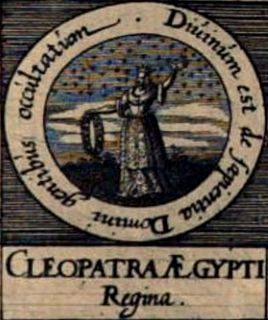
Cleopatra the Alchemist was a Greek alchemist, author, and philosopher. She experimented with practical alchemy but is also credited as one of the four female alchemists that could produce the Philosopher's stone. Some writers consider her to be the inventor of the alembic, a distillation apparatus.
Tracene Harvey is the author of Julia Augusta: Images of Rome's First Empress on Coins of the Roman Empire. As of 2019, the book was the most comprehensive examination of the image of the Roman Empress, Julia Augusta, also known as Livia or Livia Drusilla, in existing Roman coins. Harvey is also the curator of the Museum of Antiquities (Saskatoon) at the University of Saskatchewan, Saskatoon, Saskatchewan, Canada.

