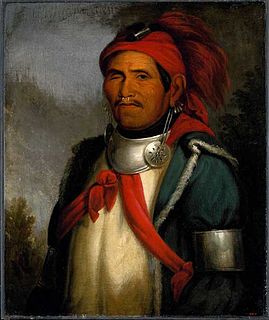
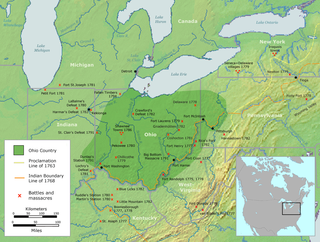
Little Turtle ,, was a Sagamore (chief) of the Miami people, who became one of the most famous Native American military leaders. Historian Wiley Sword calls him "perhaps the most capable Indian leader then in the Old Northwest," although he later signed several treaties ceding land, which caused him to lose his leader status during the battles which became a prelude to the War of 1812. In the 1790s, Mihšihkinaahkwa led a confederation of native warriors to several major victories against U.S. forces in the Northwest Indian Wars,sometimes called "Little Turtle's War", particularly St. Claires Defeat in 1791, wherein the confederation defeated General Arthur St. Clair, who lost 900 men in the most decisive loss by the U.S. Army against Native American forces.

The Battle of Fallen Timbers was the final battle of the Northwest Indian War, a struggle between Native American tribes affiliated with the Western Confederacy and a British company, against the United States for control of the Northwest Territory. The battle took place amid trees toppled by a tornado just north of the Maumee River in northwestern Ohio at the site of the present-day city of Maumee. Gen. "Mad" Anthony Wayne's Legion of the United States along with Gen. Charles Scott's Kentucky Militia were victorious against a combined Native American force of Shawnee under Blue Jacket, Miami under Little Turtle, and numerous others. The battle ended major hostilities in the region. This resulted in British and Indian withdrawal from the southern Great Lakes, western Ohio and northeastern Indiana following the Treaty of Greenville and Jay's Treaty.

Tecumseh's War or Tecumseh's Rebellion was a conflict between the United States and an American Indian confederacy led by the Shawnee leader Tecumseh in the Indiana Territory. Although the war is often considered to have climaxed with William Henry Harrison's victory at the Battle of Tippecanoe in 1811, Tecumseh's War essentially continued into the War of 1812, and is frequently considered a part of that larger struggle. The war lasted for two more years, until the fall of 1813, when Tecumseh, as well as his second-in-command, Roundhead, died fighting Harrison's Army of the Northwest at the Battle of the Thames in Upper Canada, near present-day Chatham, Ontario, and his confederacy disintegrated. Tecumseh's War is viewed by some academic historians as being the final conflict of a longer term military struggle for control of the Great Lakes region of North America, encompassing a number of wars over several generations, referred to as the Sixty Years' War.
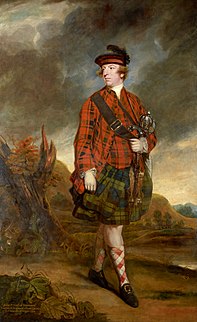
Lord Dunmore's War — or Dunmore's War — was a 1774 conflict between the Colony of Virginia and the Shawnee and Mingo American Indian nations.

The Battle of Blue Licks, fought on August 19, 1782, was one of the last battles of the American Revolutionary War. The battle occurred ten months after Lord Cornwallis's surrender at Yorktown, which had effectively ended the war in the east. On a hill next to the Licking River in what is now Robertson County, Kentucky, a force of about 50 American and Canadian Loyalists along with 300 American Indians ambushed and routed 182 Kentucky militiamen. It was the last victory for the Loyalists and Indians during the frontier war.

The Battle of Point Pleasant — known as the Battle of Kanawha in some older accounts — was the only major action of Dunmore's War. It was fought on October 10, 1774, primarily between Virginia militia and Indians from the Shawnee and Mingo tribes. Along the Ohio River near modern Point Pleasant, West Virginia, Indians under the Shawnee Chief Cornstalk attacked Virginia militia under Colonel Andrew Lewis, hoping to halt Lewis's advance into the Ohio Valley. After a long and furious battle, Cornstalk retreated. After the battle, the Virginians, along with a second force led by Lord Dunmore, the Royal Governor of Virginia, marched into the Ohio Valley and compelled Cornstalk to agree to a treaty, ending the war.
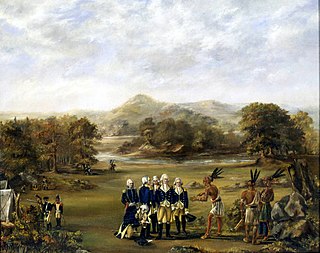
The Northwest Indian War (1785–1795), also known as the Ohio War, Little Turtle's War, and by other names, was a war between the United States and a confederation of numerous Native American tribes, with support from the British, for control of the Northwest Territory. It followed centuries of conflict over this territory, first among Native American tribes, and then with the added shifting alliances among the tribes and the European powers of France and Great Britain, and their colonials.
The Nickajack Expedition was a long-running battle fought from late summer to fall of 1794 between American frontiersmen and the Chickamauga Cherokee. The military expedition was a decisive success for the American settlers of the Southwest Territory and surrounding regions, eventually becoming known as the "Last Battle of the Cherokee".

The Western theater of the American Revolutionary War (1775–1783) was the area of conflict west of the Appalachian Mountains, the region which became the Northwest Territory of the United States as well as the states of Kentucky, Tennessee, and Missouri. The western war was fought primarily between American Indians with their British allies in Detroit, and American settlers south and east of the Ohio River.

The Battle of Chillicothe was part of the western theater of the American Revolutionary War.

The Siege of Boonesborough took place in September 1778 during the American Revolutionary War. The attack on the Kentucky settlement of Boonesborough was led by Chief Blackfish, a Shawnee leader allied to the British. Months before the battle, Blackfish had captured and adopted Daniel Boone, the founder of Boonesborough. Boone escaped the Shawnees in time to lead the defense of the settlement. Blackfish's siege was unsuccessful and was lifted after ten days. Boone was then court-martialed by fellow officers who suspected him of having British sympathies. Boone was acquitted, but he soon moved away from Boonesborough.

The Cherokee–American wars, also known as the Chickamauga Wars, were a series of back-and-forth raids, campaigns, ambushes, minor skirmishes, and several full-scale frontier battles in the Old Southwest from 1776 to 1795 between the Cherokee and American settlers on the frontier. Most of the events took place in the Upper South. While the fighting stretched across the entire period, there were times of little or no action, at times spanning several months.
Plácido was major Native American Chief of the Tonkawa Indians in Texas during the Spanish and Mexican rule, the Republic of Texas era, and with Texas as part of the United States.
Moluntha or Malunthy was a chief of the Shawnee people following the death of Chief Cornstalk.
Main Poc was a leader of the Yellow River villages of the Potawatomi Native Americans in the United States. Through his entire life, he fought against the growing strength of the United States and tried to stop the flow of settlers into the Old Northwest. He joined with Tecumseh to push the settlers south and east of the Ohio River and followed him to defeat in Canada during the War of 1812.
The Cherokee people of the southeastern United States, and later Oklahoma and surrounding areas, have a long military history. Since European contact, Cherokee military activity has been documented in European records. Cherokee tribes and bands had a number of conflicts during the 18th century with European colonizing forces, primarily the English. The Eastern Band and Cherokees from the Indian Territory fought in the American Civil War, with bands allying with the Union or the Confederacy. Because many Cherokees allied with the Confederacy, the United States government required a new treaty with the nation after the war. Cherokees have also served in the United States military during the 20th and 21st centuries.
John Logan was a pioneer and politician from the U.S. state of Virginia and later, Kentucky. He participated in Lord Dunmore's War in 1774, serving under his brother, Benjamin. After moving to Kentucky County, Virginia, he took part in several expeditions against the Shawnee, including some led by Daniel Boone, John Bowman, and George Rogers Clark. After Kentucky County was split into three counties, Logan represented his home county, Lincoln in the Virginia House of Delegates and at several of the conventions that effected the separation of Virginia from Kentucky.

Nonhelema Hokolesqua Born in 1718 into the Chalakatha (Chilliothe) division of the Shawnee nation and spent her early youth in Pennsylvania. Her brother Cornstalk, and her metis mother Katee accompanied her father Okowellos to the Alabama country in 1725. Their family returned to Pennsylvania within five years. In 1734 she married her first husband, a Chalakatha chief. By 1750 Nonhelema was a Shawnee chieftess during the 18th century and the sister of Cornstalk, with whom she migrated to Ohio and founded neighboring villages.
Hugh McGary (1744–1806) was an Irish-American pioneer, an Irish slave himself, a slave owner, a large land owner, and founder of McGary Station, in present-day Oregon, Kentucky.